CBSE Science (English Medium) कक्षा १२ Important Questions for Physics - Magnetism and Matter
Advertisements
Advertisements
Chapter wise important questions with answers and solutions for Physics in CBSE Science (English Medium) कक्षा १२.
The susceptibility of a magnetic material is 0·9853. Identify the type of magnetic material. Draw the modification of the field pattern on keeping a piece of this material in a uniform magnetic field.
अध्याय: [5] Magnetism and Matter
In what way is Gauss's law in magnetism different from that used in electrostatics ? Explain briefly.
अध्याय: [5] Magnetism and Matter
Out of the two magnetic materials, 'A' has relative permeability slightly greater than unity while 'B' has less than unity. Identify the nature of the materials 'A' and 'B'. Will their susceptibilities be positive or negative?
अध्याय: [5] Magnetism and Matter
Show diagrammatically the behaviour of magnetic field lines in the presence of (i) paramagnetic and (ii) diamagnetic substances. How does one explain this distinguishing feature?
अध्याय: [5] Magnetism and Matter
Give two points to distinguish between a paramagnetic and a diamagnetic substance ?
अध्याय: [5] Magnetism and Matter
State Gauss’s law in electrostatics. A cube which each side ‘a’ is kept is an electric field given by `vecE` = C × l. (as is shown in the figure where C is a positive dimensional constant. Find out
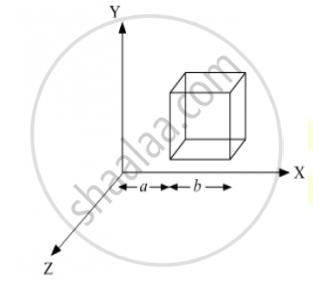
(i) The electric flux through the cube, and
(ii) The net charge inside the cube.
अध्याय: [5] Magnetism and Matter
Answer the following question.
Write three points of differences between para-, dia- and ferromagnetic materials, giving one example for each.
अध्याय: [5] Magnetism and Matter
- Assertion (A): Diamagnetic substances exhibit magnetism.
- Reason (R): Diamagnetic materials do not have a permanent magnetic dipole moment.
अध्याय: [5] Magnetism and Matter
Which of the following has a permeability less than that of free space?
अध्याय: [5] Magnetism and Matter
In what way is the behaviour of a diamagnetic material different from that of a paramagnetic, when kept in an external magnetic field?
अध्याय: [5] Magnetism and Matter
Which of the following substances are diamagnetic?
Bi, Al, Na, Cu, Ca and Ni
अध्याय: [5] Magnetism and Matter
Which of the following substances are para-magnetic?
Bi, Al, Cu, Ca, Pb, Ni
अध्याय: [5] Magnetism and Matter
The susceptibility of a magnetic material is − 2.6 × 10⁻⁵. Identify the type of magnetic material and state its two properties.
अध्याय: [5] Magnetism and Matter
The relative magnetic permeability of a magnetic material is 800. Identify the nature of magnetic material and state its two properties.
अध्याय: [5] Magnetism and Matter
Draw magnetic field line when a (i) diamagnetic, (ii) paramagnetic substance is placed in an external magnetic field. Which magnetic property distinguishes this behaviour of the field line due to the substances?
अध्याय: [5] Magnetism and Matter
An a-particle and a proton of the same kinetic energy are in turn allowed to pass through a magnetic field `vec"B"`, acting normal to the direction of motion of the particles. Calculate the ratio of radii of the circular paths described by them.
अध्याय: [5] Magnetism and Matter
Answer the following question.
Define the term "Intensity" in the photon picture of electromagnetic radiation.
अध्याय: [5] Magnetism and Matter
Identify the following magnetic materials :
अध्याय: [5] Magnetism and Matter
If the magnetizing field on a ferromagnetic material is increased, its permeability ______.
अध्याय: [5] Magnetism and Matter
A uniform magnetic field gets modified as shown in figure when two specimens A and B are placed in it.
 |
 |
| (a) | (b) |
- Identify the specimen A and B.
- How is the magnetic susceptibility of specimen A different from that of specimen B?
