Advertisements
Advertisements
प्रश्न
In what way is Gauss's law in magnetism different from that used in electrostatics ? Explain briefly.
Advertisements
उत्तर
Gauss's law for magnetism states that net magnetic flux ΦB through any closed surface is zero.
`ϕB=∮vecB.vecds=0`
On the other hand, Gauss's law for electrostatics states that electric flux through a closed surface S is given by
`ϕE=∮vecE.vecds=q/ε_0`
where
q = Electric charge enclosed by closed surface
ε0 = Permittivity of free space
So, if an electric dipole is enclosed by surface, electric flux will be zero. But the fact that ΦB is zero indicates that in magnetism there is no counterpart of isolated charge as in electricity. So, by this, we can say that isolated magnetic poles or monopoles do not exist.
APPEARS IN
संबंधित प्रश्न
State Gauss’s law in electrostatics. A cube which each side ‘a’ is kept is an electric field given by `vecE` = C × l. (as is shown in the figure where C is a positive dimensional constant. Find out
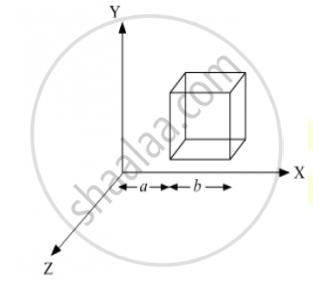
(i) The electric flux through the cube, and
(ii) The net charge inside the cube.
Verify the Gauss’s law for magnetic field of a point dipole of dipole moment m at the origin for the surface which is a sphere of radius R.
A short magnet produces a deflection of 30° when placed at certain distance in tanA position of magnetometer. If another short magnet of double the length and thrice the pole strength is placed at the same distance in tanB position of the magnetometer, the deflection produced will be:
How do magnetic field lines entering and leaving a closed surface contribute to its net magnetic flux?
After whom is the topic of Gauss’s law named?
In electrostatics, what determines the net electric flux through a closed surface?
What is magnetic flux?
What is the total outward magnetic flux through a closed surface?
Why can a closed surface not enclose a net magnetic “charge” in the way it can enclose electric charge?
Which example has current loops and magnetic dipole moments even though the atom as a whole is neutral?
