Advertisements
Advertisements
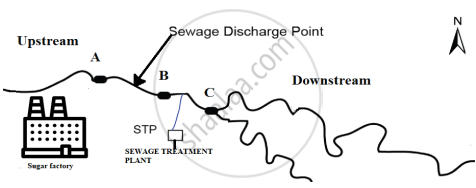
Water samples were collected at points A, B and C in a segment of a river near a sugar factory and tested for BOD level. The BOD levels of samples A, B and C were 400 mg/L, 480 mg/L and 8 mg/L respectively. What is this indicative of? Explain why the BOD level gets reduced considerably at the collection point C?
Concept: Effects of Domestic Sewage and Industrial Effluents on Water
Assertion: When white eyed, yellow bodied Drosophila females were hybridized with red eyed, brown-bodied males; and F1 progeny was intercrossed, F2 ratio deviated from 9 : 3 : 3 : 1.
Reason: When two genes in a dihybrid are on the same chromosome, the proportion of parental gene combinations is much higher than the non-parental type.
Concept: Linkage and Recombination
A true breeding pea plant, homozygous dominant for inflated green pods is crossed with another pea plant with constricted yellow pods (ffgg). With the help of Punnett square show the above cross and mention the results obtained phenotypically and genotypically in F1 generation.
Concept: Punnett Square
Study the Pedigree chart given below and answer the questions that follow:

Symbols used in the given Pedigree Chart are as follows:
 |
Carrier male |
 |
Affected male |
 |
Normal male |
 |
Carrier female |
 |
Affected female |
 |
Normal female |
(a) On the basis of the inheritance pattern exhibited in this pedigree chart, what conclusion can you draw about the pattern of inheritance?
(b) If the female is homozygous for the affected trait in this pedigree chart, then what percentage of her sons will be affected?
(c) Give the genotype of offspring 1, 2, 3 and 4 in III generations.
OR
(c) In this type of inheritance pattern, out of male and female children which one has less probability of receiving the trait from the parents? Give a reason.
Concept: Pedigree Analysis
"It is sometimes observed that the F1 progeny shows a phenotype that resembles both the parents." Explain this type of inheritance using the example of A, B, and O blood groups in human.
Concept: Mendel's Laws > The Law of Segregation (Law of Purity of Gametes)
Describe the dihybrid cross upto F2 generation as conducted by Gregor Mendel using pure lines of Garden Pea for characters-seed shape and seed colour.
Concept: Gregor Johann Mendel – Father of Genetics
Variations caused due to mutations are ______.
Concept: Mutations
What should be the genotype of the indicated member?

Concept: Pedigree Analysis
Which one of the following is a stop codon?
(a) UAG
(b) UAC
(c) AUG
(d) UCA
Concept: Translation
Following are the features of genetic codes. What does each one indicate?
Stop codon; Unambiguous codon; Degenerate codon; Universal codon.
Concept: Transcription
What do ‘Y’ and ‘B’ stand for in ‘YAC’ and ‘BAC’ used in the Human Genome Project (HGP)? Mention their role in the project.
Concept: Human Genome Project
Describe the process of transcription in bacteria
Concept: Transcription
How do m-RNA, t-RNA and ribosomes help in the process of translation?
Concept: Transcription
Explain the process of transcription in prokaryotes.
Concept: Transcription
Name the enzyme and state its property that is responsible for continuous and discontinuous replication of the two strands of a DNA molecule
Concept: Deoxyribonucleic Acid (DNA)
It is established that RNA is the first genetic material. Explain giving three reasons.
Concept: Properties of Genetic Material
Name the enzyme responsible for the transcription of tRNA and the amino acid the initiator tRNA gets linked with.
Concept: Transcription
State the aim and describe Messelson and Stahl’s experiment.
Concept: Transcription
How are the following formed and involved in DNA packaging in a nucleus of a cell?
(ii) Nucleosome
(iii) Chromatin
Concept: Packaging of DNA Helix
Differentiate between Euchromatin and Heterochromatin.
Concept: Packaging of DNA Helix
