हिंदी

Commerce (English Medium) कक्षा १२ - CBSE Important Questions for Economics

Advertisements
[object Object]
[object Object]
विषयों
मुख्य विषय
अध्याय
Advertisements
Advertisements
Economics
< prev  141 to 160 of 348  next > 

State the importance of 'liberty indicator'.

Appears in 3 question papers
Chapter: [8] Comparative Development Experiences of India and Its Neighbours
Concept: Indicators of Human Development

China initiated ______ in 1958, that aimed at industrializing the country on a massive scale.

Appears in 3 question papers
Chapter: [8] Comparative Development Experiences of India and Its Neighbours
Concept: Developmental Path - a Snapshot View

______ acts as a measure of 'the extent of democratic participation in social and political decision-making.'

Appears in 3 question papers
Chapter: [8] Comparative Development Experiences of India and Its Neighbours
Concept: Indicators of Human Development

Statement 1: Amongst India, China and Pakistan, China is the largest nation and has the higest population density.

Statement 2: One-child policy introduced in the late 1970s in china led to a considerable decline in the population growth rate.

In the light of the given statements, choose the correct alternative from the following:

Appears in 3 question papers
Chapter: [8] Comparative Development Experiences of India and Its Neighbours
Concept: Developmental Path - a Snapshot View

On the basis of the data given below, identify the incorrect statement in terms of annual growth of GDP (%): (Choose the correct alternative)

Annual Growth of Gross Domestic Product (%) 1980-2017
Country 1980-90 2015-2017
India 5.7 7.3
China 10.3 6.8
Pakistan 6.3 5.3
Appears in 3 question papers
Chapter: [8] Comparative Development Experiences of India and Its Neighbours
Concept: Gross Domestic Product and Sectors

On the basis of the given data: 

Some Selected Indicators of Human Development, 2017-2019
Item India China Pakistan
Human Development Index (Value) 0.645 0.761 0.557
Rank (based on HDI) 130 87 154
Life Expectancy at Birth (years) 69.7 76.9 67.3
Mean years of Schooling
(% aged 15 and above)
6.5 8.1 5.2
Gross National Income per capita (PPP US$) 6681 16.057 5005
Percentage of people living Below Poverty Line (National) 21.9* 1.7** 24.3*
Infant Mortality Rate
(per 1000 live births)
29.9 7.4 57.2
Maternal Mortality Rate
(per 1 lakh births)
133 29 140
Population using at least basic Sanitation (%) 60 75 60
Population using at least basic drinking Water Source (%) 93 96 91
Percentage of Undernourished Children 37.9 8.1 37.6
  1. Identify one income indicator and one health indicator, each.
  2. Compare India and China on the basis of any one of the indicator identified above in part (i)
Appears in 3 question papers
Chapter: [8] Comparative Development Experiences of India and Its Neighbours
Concept: Indicators of Human Development

Statement 1: Great Proletarian Cultural Revolution was introduced in China in 1950's.

Statement 2: China's growth is mainly contributed by the manufacturing sector.

In the light of given statements, choose the correct alternative from the following:

Appears in 3 question papers
Chapter: [8] Comparative Development Experiences of India and Its Neighbours
Concept: Developmental Path - a Snapshot View

Identify the incorrect statement from the following:

Appears in 3 question papers
Chapter: [8] Comparative Development Experiences of India and Its Neighbours
Concept: Demographic Indicators

Assertion (A): During 1980's, economic growth rate of Pakistan was more than that of India.

Reason (R): Pakistan followed the path of mixed economic structure with equal participation of the public and the private sector.

Appears in 3 question papers
Chapter: [8] Comparative Development Experiences of India and Its Neighbours
Concept: Development Strategies - an Appraisal

Compare and analyse the following information related to Annual Growth of Gross Domestic Product (GDP) of India and China: 

Annual Growth of Gross Domestic Product

Country 1980 - 90 2015 - 17
India 5.7 7.3
China 10.3 6.8
Appears in 3 question papers
Chapter: [8] Comparative Development Experiences of India and Its Neighbours
Concept: Gross Domestic Product and Sectors

Answer the following question.
Explain the meaning of opportunity cost with the help of a production possibility schedule.

Appears in 2 question papers
Chapter: [1] Introduction
Concept: Concepts of Production Possibility Frontier

What was the two-fold motive behind the systematic deindustrialisation effected by the British in pre-independent India?

Appears in 2 question papers
Chapter: [1] Indian Economy on the Eve of Independence
Concept: Introduction to Indian Economy on the Eve of Independence

Choose the correct alternative from given options:
In the given figure, the movement on the production possibility curve from point A to point B shows _____________.
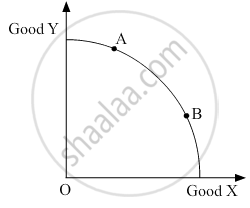
Appears in 2 question papers
Chapter: [1] Introduction
Concept: Concepts of Production Possibility Frontier

Identify and discuss the nature of the following newspaper reports in terms of positive or normative economic analysis:
(i) "India jumped 23 points in the World Bank's ease of doing business index to 77th place, highest in 2 years." – The Economic Times
(ii) "Government should further liberalise the business rules." – The Economic Times

Appears in 2 question papers
Chapter: [1] Introduction
Concept: Positive and Normative Economics

An economy is in equilibrium. Find investment expenditure :

National income =1200

Autonomous consumption expenditure=150

Marginal Propensity to consume =0.8

Appears in 2 question papers
Chapter: [2] National Income Accounting
Concept: Methods of Measurement of National Income >> Expenditure Method

Answer the following question.
Gross Domestic Product (GDP) Does Not Give Us a Clear Indication of Economic Welfare of a Country. "Defend Or Refute the Given Statement with Valid Reason.

Appears in 2 question papers
Chapter: [2] National Income Accounting
Concept: GDP and Welfare

Distinguish between positive externalities and negative externalities.

Appears in 2 question papers
Chapter: [2] National Income Accounting
Concept: Factor Cost, Basic Prices and Market Prices

Discuss any two merits and demerits of the Green Revolution in the agricultural sector in the Indian economy.

Appears in 2 question papers
Chapter: [2] Indian Economy 1950-1990
Concept: Agriculture

State the meanings of the following:

Operating Surplus

Appears in 2 question papers
Chapter: [2] National Income Accounting
Concept: Factor Cost, Basic Prices and Market Prices

Give two examples of fixed costs.

Appears in 2 question papers
Chapter: [3] Production and Costs
Concept: Cost - Fixed Cost
< prev  141 to 160 of 348  next > 
Advertisements
Advertisements
CBSE Commerce (English Medium) कक्षा १२ Important Questions
Important Questions for CBSE Commerce (English Medium) कक्षा १२ Accountancy
Important Questions for CBSE Commerce (English Medium) कक्षा १२ Business Studies
Important Questions for CBSE Commerce (English Medium) कक्षा १२ Computer Science (Python)
Important Questions for CBSE Commerce (English Medium) कक्षा १२ Economics
Important Questions for CBSE Commerce (English Medium) कक्षा १२ English Core
Important Questions for CBSE Commerce (English Medium) कक्षा १२ English Elective - NCERT
Important Questions for CBSE Commerce (English Medium) कक्षा १२ Entrepreneurship
Important Questions for CBSE Commerce (English Medium) कक्षा १२ Geography
Important Questions for CBSE Commerce (English Medium) कक्षा १२ Hindi (Core)
Important Questions for CBSE Commerce (English Medium) कक्षा १२ Hindi (Elective)
Important Questions for CBSE Commerce (English Medium) कक्षा १२ History
Important Questions for CBSE Commerce (English Medium) कक्षा १२ Informatics Practices
Important Questions for CBSE Commerce (English Medium) कक्षा १२ Mathematics
Important Questions for CBSE Commerce (English Medium) कक्षा १२ Physical Education
Important Questions for CBSE Commerce (English Medium) कक्षा १२ Political Science
Important Questions for CBSE Commerce (English Medium) कक्षा १२ Psychology
Important Questions for CBSE Commerce (English Medium) कक्षा १२ Sanskrit (Core)
Important Questions for CBSE Commerce (English Medium) कक्षा १२ Sociology
Share
Notifications

Englishहिंदीमराठी


      Forgot password?
Use app×