Please select a subject first
Advertisements
Advertisements
Give reason:
Uterine lining becomes thick and spongy after fertilisation.
Concept: The Female Reproductive System
In flowering plants, the pollen grains are transferred to stigma by pollination but the female germ cells are present in the ovary.
Explain with the help of a labelled diagram (only concerned parts), how the male germ cell reaches the ovary.
Concept: Sexual Reproduction in Plants
Consider the following three flowers namely X, Y and Z. Which flower(s) would develop into a fruit?
| Flower X | Flower Y | Flower Z |
 |
 |
 |
Concept: Sexual Reproduction in Plants
List two advantages of vegetative propagation technique.
Concept: Vegetative Reproduction or Vegetative Propagation >> Natural Vegetative Propagation
"A trait may be inherited, but may not be expressed." Justify this statement with the help of a suitable example.
Concept: Heredity
To perform an experiment to identify the different parts of an embryo of a dicot seed, first of all you require a dicot seed. Select dicot seeds from the following group:
Wheat, Gram, Maize, Pea, Barley, Ground-nut
(A) Wheat, Gram and Pea
(B) Gram, Pea and Ground-nut
(C) Maize, Pea and Barley
(D) Gram, Maize and Ground-nut
Concept: Heredity
Answer the following question.
Name the plant Mendel used for his experiment. What type of progeny was obtained by Mendel in F1 and F2 generations when he crossed the tall and short plants? Write the ratio he obtained in F2 generation plants.
Concept: Heredity
Assertion (A): In humans, if gene (B) is responsible for black eyes and gene (b) responsible for brown eyes, then the colour of eyes of the progeny having gene combination Bb, bb or BB will be black only.
Reason (R): The black colour of the eyes is a dominant trait.
Concept: Monohybrid Cross
One half of a convex lens of focal length 10 cm is covered with a black paper. Can such a lens produce an image of a complete object placed at a distance of 30 cm from the lens? Draw a ray diagram to justify your answer. A 4 cm tall object is placed perpendicular to its principal axis of a convex lens of focal length 20 cm. The distance of the object from the lens is 15 cm. Find the nature, position and the size of the image.
Concept: Spherical Mirrors
A student obtains a sharp image of the distant window (W) of the school laboratory on the screen (S) using the given concave mirror (M) to determine its focal length. Which of the following distances should he measure to get the focal length of the mirror?
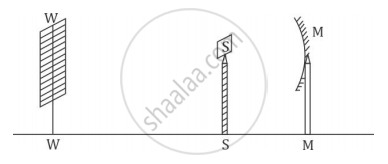
Concept: Spherical Mirrors
A student used a device (X) to obtain/focus the image of a well illuminated distant building on a screen (S) as shown below in the diagram. Select the correct statement about the device (X).
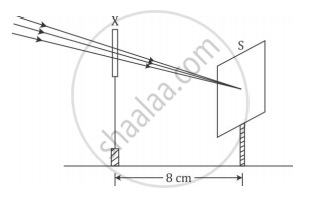
Concept: Spherical Mirrors
A 4 cm tall object is placed on the principal axis of a convex lens. The distance of the object from the optical centre of the lens is 12 cm and its sharp image is formed at a distance of 24 cm from it on a screen on the other side of the lens. If the object is now moved a little away from the lens, in which way (towards the lens or away from the lens) will he have to move the screen to get a sharp image of the object on it again? How will the magnification of the image be affected?
Concept: Spherical Mirrors
Explain the following term related to spherical lenses:- optical centre
Concept: Spherical Mirrors
A student focused the Sun rays using an optical device 'X' on a screen S as shown.
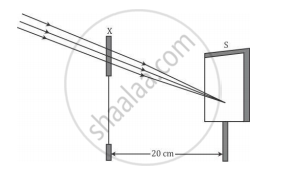
From this it may be concluded that the device 'X' is a (select the correct option)
(A) Convex lens of focal length 10 cm.
(B) Convex lens of radius of curvature 20 cm.
(C) Convex lens of focal length 20 cm.
(D) Concave mirror of focal length 20 cm.
Concept: Spherical Mirrors
Define the following term in the context of spherical mirrors:- Pole
Concept: Spherical Mirrors
Define the following term in the context of spherical mirrors:- Centre of curvature
Concept: Spherical Mirrors
Define the following term in the context of spherical mirrors:- Principal axis
Concept: Spherical Mirrors
Define the following term in the context of spherical mirrors:- Principal focus
Concept: Spherical Mirrors
State the power of a lens S.I. unit.
Concept: Power of a Lens
Explain the following term related to spherical lenses:- centres of curvature
Concept: Spherical Mirrors
