Definitions [21]
A relation from set A to set B is any subset of the Cartesian product \[A \times B\].
So, if \[R \subseteq A \times B\], then R is a relation from A to B.
- Domain: The set of all first components of the ordered pairs in a relation R is called the domain of the relation R.
-
Codomain: If R is a relation from A to B, then the set B is called the co–domain of the relation R.
-
Range: The set of all second components of all ordered pairs in a relation R is called the range of the relation.
A function from set A to set B is a relation in which every element of A has exactly one image in B.
Condition for a Function
-
every element of the domain must be used
-
no element of the domain can have more than one image
-
different elements may have the same image
An ordered pair is a pair of objects whose components occur in a special order. It is written by listing the two components in the specified order, separating them by a comma and enclosing the pair in parentheses. In the ordered pair (a, b), a is called the first component and b the second component.
-
Two ordered pairs are equal only if their corresponding components are equal, so (a,b) = (c,d) if and only if a = c and b = d.
-
In general, (a,b) ≠ (b,a)(a,b).
If A and B are two non-empty sets, then their Cartesian product is written as \[A \times B\].
-
It is the set of all ordered pairs \[(a, b)\] such that \[a \in A\] and \[b \in B\].
-
\[A \times B = \{(a, b) : a \in A, b \in B\}\].
Define a transitive relation ?
A relation R on a set A is said to be transitive if
(a, b) ∈ R and (b, c) ∈ R
⇒ (a, c) ∈ R for all a, b , c ∈ R
i.e. aRb and bRc
⇒ aRc for all a, b, c ∈ R
Define a symmetric relation ?
A relation R on a set A is said to be symmetric if
(a, b) ∈ R
⇒ (b, a) ∈ R for all a b ∈ A
i.e. aRb ⇒ bRa for all a , b ∈ A
Define an equivalence relation ?
A relation R on set A is said to be an equivalence relation if
(i) it is reflexive,
(ii) it is symmetric and
(iii) it is transitive.
Relation R on set A satisfying all the above three properties is an equivalence relation.
A relation R on a (non-empty) set A is called an equivalence relation iff it is :
(i) reflexive, (ii) symmetric and (iii) transitive, i.e. iff
- a R a for all a ∈ A
- a R b implies b R a for all a, b ∈ A and
- a R b, b R c implies a R c for all a, b, c ∈ A
If R is an equivalence relation on a set A, then the equivalence class of an element \[a \in A\] is the set of all elements of A related to a.
This means an equivalence class collects all elements that are considered “equivalent” under the given relation.
- Range: Set of actual output values of f
- Range ⊆ Codomain
f: X → Y is a function if each element of X is associated with a unique element of Y
- Domain (X): Set of all input values
- Codomain (Y): Set of all possible outputs
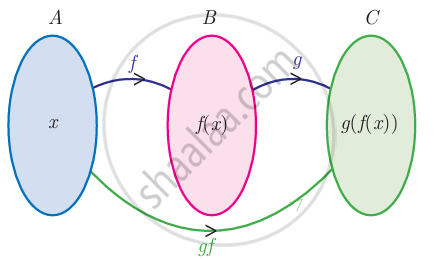
Let f: A → B and g: B → C be any two functions. Then, the composition of f and g, denoted by gof, is defined as a function gof: A → C given by
gof(x) = g[f(x)], ∀ x ∈ A
- Domain (gof) = Domain (f)
- g∘f(x) = g(f(x)) → first apply f, then g
A Function is called a self-inverse function if its inverse is the exact same as the original function.
-
Condition: \[(f \circ f)(x) = I_x = x\].
-
Examples: \[f(x) = \frac{5}{x}\] and \[g(x) = 7 - x\].
A function \[f: X \to Y\] is defined to be invertible if there exists a function \[g: Y \to X\] such that:
Where \[I_X\] and \[I_Y\] are identity functions on sets X and Y. The function g is the inverse of f, denoted as \[f^{-1}\].
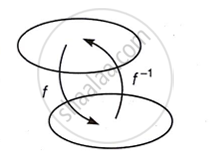
An inverse function takes
us back where we started
An ordered pair is a pair of objects whose components occur in a special order. It is written by listing the two components in the specified order, separating them by a comma and enclosing the pair in parentheses. In the ordered pair (a, b), a is called the first component and b the second component.
-
Two ordered pairs are equal only if their corresponding components are equal, so (a,b) = (c,d) if and only if a = c and b = d.
-
In general, (a,b) ≠ (b,a)(a,b).
If A and B are two non-empty sets, then their Cartesian product is written as \[A \times B\].
-
It is the set of all ordered pairs \[(a, b)\] such that \[a \in A\] and \[b \in B\].
-
\[A \times B = \{(a, b) : a \in A, b \in B\}\].
A relation from set A to set B is any subset of the Cartesian product \[A \times B\].
So, if \[R \subseteq A \times B\], then R is a relation from A to B.
A function from set A to set B is a relation in which every element of A has exactly one image in B.
Condition for a Function
-
every element of the domain must be used
-
no element of the domain can have more than one image
-
different elements may have the same image
- Domain: The set of all first components of the ordered pairs in a relation R is called the domain of the relation R.
-
Codomain: If R is a relation from A to B, then the set B is called the co–domain of the relation R.
-
Range: The set of all second components of all ordered pairs in a relation R is called the range of the relation.
Theorems and Laws [2]
Prove that the greatest integer function f : R → R, given by f(x) = [x], is neither one-one nor onto, where [x] denotes the greatest integer less than or equal to x.
f : R → R, given by f(x) = [x]
It is seen that f(1.2) = [1.2] = 1 and f(1.9) = [1.9] = 1.
∴ f(1.2) = f(1.9), but 1.2 ≠ 1.9.
∴ f is not one-one.
Now, consider 0.7 ∈ R.
It is known that f(x) = [x] is always an integer. Thus, there does not exist any element x ∈ R such that f(x) = 0.7.
∴ f is not onto.
Hence, the greatest integer function is neither one-one nor onto.
Let f, g and h be functions from R to R. Show that
(f + g)oh = foh + goh
(f · g)oh = (foh)·(goh)
To prove:
(f + g)oh = foh + goh
Consider:
((f + g)oh)(x)
= (f + g)(h(x))
= f(h(x)) + g(h(x))
= (foh)(x) + (goh)(x)
= {(foh) + (goh)}(x)
∴ ((f + g)oh)(x) = {(foh) + (goh)}(x) ∀ x ∈ R
Hence, (f + g)oh = foh + goh.
To prove:
(f · g)oh = (foh)·(goh)
Consider:
((f · g)oh)(x)
= (f · g)(h(x))
= f(h(x))·g(h(x))
= (foh)(x)·(goh)(x)
= {(foh)·(goh)}(x)
∴ ((f · g)oh)(x) = {(foh)·(goh)}(x) ∀ x ∈ R
Hence, (f · g) oh = (foh)·(goh).
Key Points
| Term | Meaning |
|---|---|
| Ordered Pair | Pair of elements written in a fixed order |
| Cartesian Product | Set of all ordered pairs from two sets |
| Relation | Subset of a Cartesian product |
| Domain | Set of first elements of a relation/function |
| Codomain | Target set into which mapping occurs |
| Range | Actual set of output values obtained |
| Function | Relation assigning exactly one output to each input |
-
Empty relation and universal relation are called trivial relations.
-
Identity relation always contains all self-pairs and is always reflexive.
-
To check reflexivity, see whether every (a,a) is present in the relation.
-
To check symmetry, see whether every (a,b) has the reverse pair (b,a).
-
To check transitivity, see whether (a,b) and (b,c) together give (a,c).
-
A relation is an equivalence relation only when all three properties—reflexive, symmetric, and transitive—are satisfied together.
-
An equivalence relation must be reflexive, symmetric, and transitive.
-
Equality is a standard example of an equivalence relation.
-
Relations like “greater than” or “is mother of” are not equivalence relations because they do not satisfy all three properties.
-
Equivalence classes are sets of mutually related elements.
-
Equivalence relations and partitions of sets are closely connected.
| Type of Function | Condition | Key Idea |
|---|---|---|
| One-One (Injective) | f(x₁) = f(x₂) ⇒ x₁ = x₂ | Different inputs → different outputs |
| Onto (Surjective) | Range = Codomain | Every element of the codomain is mapped |
| Into Function | Range ⊂ Codomain | Some elements of the codomain are not mapped |
| Many-One Function | x₁ ≠ x₂ but f(x₁) = f(x₂) | Different inputs → same output |
| Bijective Function | One-one + Onto | Perfect mapping (1-1 and onto) |
-
In \[g \circ f\], first apply f, then apply g.
-
\[(g \circ f)(x) = g(f(x))\].
-
Composition is defined only when the output of the first function is acceptable as input to the second function.
-
In general, \[g \circ f \neq f \circ g\].
-
Composition is associative whenever defined.
-
Identity function leaves a function unchanged under composition.
- An invertible function is a function that has an inverse.
-
A function is invertible if and only if it is bijective.
-
The graph of \[f^{-1}\] is the reflection of the graph of f in the line y = x.
- \[f^{-1}(f(x)) = x\] and \[f(f^{-1}(x)) = x\]
-
\[(f^{-1})^{-1} = f\]
-
\[(g \circ f)^{-1} = f^{-1} \circ g^{-1}\]
-
An inverse is unique whenever it exists.
| Term | Meaning |
|---|---|
| Ordered Pair | Pair of elements written in a fixed order |
| Cartesian Product | Set of all ordered pairs from two sets |
| Relation | Subset of a Cartesian product |
| Domain | Set of first elements of a relation/function |
| Codomain | Target set into which mapping occurs |
| Range | Actual set of output values obtained |
| Function | Relation assigning exactly one output to each input |
Important Questions [11]
- A relation R on (1, 2, 3) is given by R = {(1, 1), (2, 2), (1, 2), (3, 3), (2, 3)}. Then the relation R is ______.
- Let L be a set of all straight lines in a plane. The relation R on L defined as 'perpendicular to' is ______.
- The Binary Operation *: R X R → R Is Defined as a *B = 2a + B Find (2 * 3)*4
- Let A = R – {2} and B = R – {1}. If f: A → B is a function defined by f(x) = x-1x-2 then show that f is a one-one and an onto function.
- If f : R → R is defined by f(x)=2x-74, show that f(x) is one-one and onto.
- If the Function `F(X) = Sqrt(2x - 3)` is Invertible Then Find Its Inverse. Hence Prove that `(Fof^(-1))(X) = X`
- Let f(x)=x3 be a function with domain {0, 1, 2, 3}. Then domain of f−1 is ______.
- Which one of the following graphs is a function of x? Graph A Graph B
- If F : R → R, F(X) = X3 and G: R → R , G(X) = 2x2 + 1, and R is the Set of Real Numbers, Then Find Fog(X) and Gof (X)
- Let f:R{-13}→R-{0} be defined as f(x)=53x+1 is invertible. Find f–1(x).
- If f(x) = [4 – (x – 7)3]1/5 is a real invertible function, then find f–1(x).
