- Free oscillations occur when a body vibrates on its own at its natural frequency.
- Forced oscillations occur when an external periodic force makes the body vibrate at the driving frequency.
- Resonance occurs when the driving frequency equals the natural frequency.
- At resonance, amplitude and energy transfer are maximum.
Definitions [53]
Define the term oscillation.
Oscillation refers to a complete 'to and fro' motion of the body along its course.
Definition: Periodic Motion
Any motion which repeats itself after a definite interval of time is called periodic motion.
Definition: Periodic Function
A mathematical function which represents a periodic motion is called a periodic function.
Definition: Periodic
A fixed time period after which a motion repeats itself is called the time period.
Define linear simple harmonic motion.
Linear simple harmonic motion (S.H.M.) is defined as the linear periodic motion of a body, in which the restoring force (or acceleration) is always directed towards the mean position and its magnitude is directly proportional to the displacement from the mean position.
Definition: Linear Simple Harmonic Motion
A particular type of periodic motion in which a particle moves to and fro under the influence of restoring force about a mean position, where the acceleration is directly proportional to displacement from the mean position and its direction is always towards the mean position, is called Linear Simple Harmonic Motion.
Define linear S.H.M.
Linear S.H.M. is defined as the linear periodic motion of a body in which the restoring force (or acceleration) is always directed towards its mean position and its magnitude is directly proportional to the displacement from the mean position.
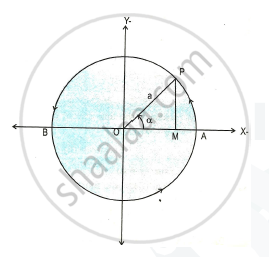
Consider a particle ‘P’ moving along the circumference of a circle of radius 'a' and centre O, with uniform angular speed of 'ω' in anticlockwise direction as shown.
Particle P along the circumference of the circle has its projection particle on diameter AB at point M.
Definition: Displacement (in SHM)
The distance an object in SHM travels from its initial position as a function of time is called displacement.
Definition: Acceleration (in SHM)
The rate of change of velocity with respect to time at any instant of a particle executing SHM is called acceleration.
Definition: Velocity (in SHM)
The rate of change of displacement with respect to time at any instant by a particle executing SHM is called velocity.
Definition: Amplitude
The maximum displacement of a particle performing SHM from its mean position is called amplitude.
Definition: Period
The time taken by the particle performing SHM to complete one oscillation is called period of SHM.
Definition: Reference Circle Method
A way to analyse simple harmonic motion (SHM) by using a circle as reference is called the reference circle method.
Definition: Phase in SHM
The state of oscillation of a particle performing SHM, represented by the angular displacement θ, is called phase in SHM.
Definition: Epoch
The initial phase of a particle i.e., the phase at time t=0t=0 is called epoch.
Definition: Graphical Representation of SHM
The pictorial representation of variation of displacement, velocity, and acceleration of a particle performing SHM with respect to time (or ωtωt) is called graphical representation of SHM.
Definition: Kinetic Energy (K) in SHM
The energy possessed by a particle performing SHM due to its motion, which is maximum at the mean position and minimum (zero) at the extreme position, is called kinetic energy.
Definition: Total Energy (in SHM)
The sum of kinetic energy and potential energy of a particle performing SHM is called total energy.
Definition: Potential Energy (U) in SHM
The energy possessed by a particle performing SHM due to its displacement from the mean position, which is maximum at the extreme position and minimum at the mean position, is called potential energy.
Define an ideal simple pendulum.
An ideal simple pendulum consists a point mass suspended from a perfectly rigid support by weightless, inextensible and perfectly flexible fibre.
An ideal simple pendulum is a heavy particle suspended by a massless, inextensible, flexible string from a rigid support.
Define second’s pendulum.
A simple pendulum whose period of oscillation is exactly two seconds is called a second’s pendulum.
Definition: Natural Frequency
The frequency with which a body oscillates freely is called natural frequency.
Definition: Simple Pendulum
A heavy but small sized metallic bob suspended by a light, inextensible and flexible string, which performs oscillatory motion, is called a simple pendulum.
Definition: Second's Pendulum
A simple pendulum whose period is two seconds is called a second's pendulum.
Definition: Angular SHM
A type of oscillatory motion where an object undergoes periodic angular displacement about an equilibrium position due to a restoring torque, which is the rotational analogue of linear SHM, is called angular SHM.
Definition: Undamped Oscillations
The oscillations of a body whose amplitude remains the same throughout the time are called undamped oscillations.
Definition: Damped Oscillations
The oscillations of a body whose amplitude goes on decreasing with time due to the presence of dissipative forces are called damped oscillations.
Definition: Forced Oscillations
The oscillation of a body under the influence of an external periodic force is called forced oscillation.
Definition: Free Oscillations
The oscillations in which a body or system oscillates with its own natural frequency without being acted upon by an external force are called free oscillations.
Definition: Resonance
The phenomenon that occurs when an external periodic force matches the natural frequency of a system, leading to maximum amplitude of oscillation, is called resonance.
Definition: Oscillatory (Vibratory) Motion
The periodic (to and fro) and bounded motion of a body about a fixed point is called oscillatory motion.
Definition: Free Oscillations
When a body, capable of oscillation, is slightly displaced from its position of equilibrium and left to itself, it starts oscillating with a frequency of its own — such oscillations are called free oscillations.
Definition: Damped Oscillations
The oscillations in which the amplitude decreases gradually with the passage of time are called damped oscillations.
Definition: Maintained Oscillations
When energy is continuously supplied from outside to an oscillating system at the same rate at which energy is lost, so that the amplitude remains constant, such oscillations are called maintained oscillations.
Definition: Forced Oscillations
When a body oscillates under the influence of an external periodic force, not with its own natural frequency but with the frequency of the external periodic force, its oscillations are called forced oscillations.
Definition: Resonant Oscillations (Resonance)
The particular case of forced oscillations in which the frequency of the driving force equals the natural frequency of the oscillator, and the amplitude of oscillations is very large — such oscillations are called resonant oscillations and the phenomenon is called resonance.
Definition: Periodic Motion
The motion which repeats itself after equal intervals of time is called periodic motion.
Definition: Periodic Motion
Any motion which repeats itself after a definite interval of time is called periodic motion.
Definition: Periodic Time
A body performing periodic motion goes on repeating the same set of movements. The time taken for one such set of movements is called its period or periodic time.
Definition: Simple Harmonic Motion
Simple harmonic motion is an oscillatory motion in which the restoring force (or acceleration) is directly proportional to the displacement from the equilibrium position and is directed towards it.
Definition: Oscillatory or Vibratory Motion
Another type of periodic motion in which a particle repeatedly moves to and fro along the same path is the oscillatory or vibratory motion.
Definition: Period of Oscillation
The smallest interval of time after which the to and fro motion is repeated is called its period (T).
Definition: Frequency of Periodic Motion
The number of oscillations completed per unit time is called the frequency (n) of the periodic motion.
Definition: Linear Simple Harmonic Motion
Linear S.HM. is defined as the linear periodic motion of a body, in which force (or acceleration) is always directed towards the mean position and its magnitude is proportional to the displacement from the mean position.
Definition: Amplitude of S.H.M
The maximum displacement of a particle performing S.H.M from its mean position is called the amplitude of S.H.M.
Definition: Period. of S.H.M.
The time taken by the particle performing S.H.M. to complete one oscillation is called the period of S.H.M.
Mathematically,
T = 2π\[\sqrt{\frac{m}{k}}\]
Definition: Frequency of S.H.M.
The number of oscillations performed by a particle performing S.H.M. per unit time is called the frequency of S.H.M.
Mathematically,
n = \[\frac {1}{T}\] = \[\frac {ω}{2π}\] = \[\frac{1}{2\pi}\sqrt{\frac{k}{m}}\]
Definition: Phase in S.H.M.
Phase in S.H.M. is the angular quantity θ = (ωt + ϕ) which specifies the state of oscillation of a particle at a given instant.
Definition: Ideal Simple Pendulum
An ideal simple pendulum consists of a point mass suspended by a massless, inextensible, and perfectly flexible string from a fixed rigid support.
Definition: Length of a Simple Pendulum
The distance between the point of suspension and the centre of gravity of the bob is called the length of the pendulum.
Definition: Second's Pendulum
A simple pendulum whose period is two seconds is called a second's pendulum.
Definition: Angular S.H.M
Angular S.H.M is defined as the oscillatory motion of a body in which the torque for angular acceleration is directly proportional to the angular displacement and its direction is opposite to that of angular displacement.
Definition: Damped Harmonic Oscillator.
Periodic oscillations of gradually decreasing amplitude are called damped harmonic oscillations, and the oscillator is called a damped harmonic oscillator.
Formulae [29]
Formula: Periodic Function
F(t) = F(t + T)
where T is the time period of the periodic function.
Formula: Differential Equation of SHM
F = −kx, a = −\[\frac {kx}{m}\]
\[\frac{d^2x}{dt^2}+\frac{k}{m}x\] = 0 OR \[\frac{d^2x}{dt^2}+\omega^2x\] = 0
Formula: Phase Angle of SHM
θ = (ωt + ϕ)
where ω = angular frequency, t = time, ϕ = initial phase (epoch).
Formula: Projection of Velocity
vy = rω cos(ωt + ϕ), v = rω
Formula: Potential Energy
U = \[\frac {1}{2}\]kx2 = \[\frac {1}{2}\]kA2 cos2 (ωt + Φ)
Formula: Total Energy
E = U + K = \[\frac {1}{2}\]kA2 = \[\frac {1}{2}\]mω2 A2
Formula: Kinetic Energy
K = \[\frac {1}{2}\]mv2 = \[\frac {1}{2}\]mω2 A2 sin2(ωt + Φ) = \[\frac {1}{2}\]KA2 sin2 (ωt + Φ) = \[\frac {1}{2}\]k(A2 - x2)
Formula: Kinetic Energy of the Pendulum
\[KE=\frac{1}{2}mv^2\]
Formula: Potential Energy of the Pendulum
\[PE=mgh\]
where,
m is mass
g is gravity
h is height
Formula: Time Period of Simple Pendulum
T = 2π\[\sqrt {\frac {l}{g}}\]
Formula: Frequency of Oscillation
n = \[\frac {1}{2π}\]\[\sqrt {\frac {g}{l}}\]
Formula: Time Period of Second's Pendulum
T = 2π\[\sqrt{\frac {L_s}{g}}\] = 2 seconds
Formula: Gravitational Acceleration
\[g=\frac{4\pi^2L}{T^2}\]
Formula: Total Mechanical Energy
\[E=PE+KE\]
Formula: Differential Equation of Angular SHM
\[I\frac{d^2\theta}{dt^2}+C\theta=0\]
Formula: Undamped Angular Frequency
ω = \[\sqrt {\frac {k}{m}\]
Formula: Damped Angular Frequency
\[\omega^{\prime}=\sqrt{\frac{k}{m}-\left(\frac{b}{2m}\right)^2}\]
Formula: Undamped Equation of Motion
\[\frac{d^2x}{dt^2}+\omega^2x=0\]
Formula: Damped Equation of Motion
\[m\frac{d^{2}x}{dt^{2}}+b\frac{dx}{dt}+kx\] = 0 & emsp; (b = damping constant)
Formula: Undamped Displacement
x = A sin(ωt + α)
Formula: Damped Displacement
x = Ae−bt/2m sin(ω′t + ϕ)
Formula: Amplitude of Damped Oscillation
A = Ae−bt/2m
Formula: Forced Equation of Motion
\[\frac{d^2x}{dt^2}+b\frac{dx}{dt}+kx=F_0\cos\omega_dt\]
Formula: Forced Displacement
x = A cos(ωdt + ϕ)
Formula: Amplitude of Forced Oscillation
A = \[\frac{F_0}{\sqrt{m^2(\omega^2-\omega_d^2)^2+\omega_d^2b^2}}\]
Formula: Condition for Resonance
ω = ω0
where ω = driving angular frequency and ω0 = natural angular frequency of the system.
At resonance: A = \[\frac {F_0}{ω_0b}\]
Formula: Simple Harmonic Motion
\[\frac{d^2x}{dt^2}+\omega^2x=0\] ⇒ x = ±A cos(ωt)
Formula: Time Period of Angular S.H.M
T = \[\frac {2π}{ω}\] = \[\frac {2\pi}{\sqrt{\text {angular acceleration per unit angular displacement}}}\]
Formula: Time Period of a Magnetic Dipole
T = \[2\pi\sqrt{\frac{I}{\mu B}}\]
Key Points
Key Points: Graphical Representation
(a) Particle starts from mean position (towards positive direction):
| Quantity | Expression | Range |
|---|---|---|
| Displacement | x = A sin(ωt) | −A to + A |
| Velocity | v = Aω cos(ωt) | −Aω to + Aω |
| Acceleration | a = −Aω2 sin(ωt) | −Aω2 to + Aω2 |
(b) Particle starts from positive extreme position:
| Quantity | Expression | Range |
|---|---|---|
| Displacement | x = A cos(ωt) | −A to + A |
| Velocity | v = −Aω sin(ωt) | −Aω to + Aω |
| Acceleration | a = −Aω2 cos(ωt) | −Aω2 to + Aω2 |
Key Points: Comparison of Two SHMs (Same Period, Same Path)
- When a particle is subjected simultaneously to two SHMs having the same period and along the same path, the resultant motion is also SHM along the same path.
- The resultant displacement of the particle at any instant is equal to the vector sum of its individual displacements due to both the SHMs at that instant.
Key Points: Energy of a Particle Performing SHM
- The total mechanical energy of a harmonic oscillation is independent of time, as expected for motion under any conservative force.
- Both kinetic and potential energies peak twice during each period of SHM.
- Period of kinetic energy and potential energy = \[\frac {T}{2}\].
Key Points: Simple Pendulum
- A simple pendulum is a mass on a string swinging under gravity
- Used to determine acceleration due to gravity (g)
- Energy dissipation can be analysed by plotting the square of amplitude vs. time
- At any point: total mechanical energy = PE + KE
- PE depends on height; KE depends on velocity
Key Points: Free and Forced Oscillations with Resonance
Key Points: Reference Circle Method
Key Points: Graphical Representation of S.H.M.
- In S.H.M., displacement, velocity, and acceleration change with time in sine or cosine form.
- Velocity is \[\frac {π}{2}\] ahead of displacement, and acceleration is opposite to displacement.
- Starting from the mean position → sine curve; starting from the extreme position → cosine curve.
Key Points: Energy of a Particle Performing S.H.M.
- Total mechanical energy in S.H.M. is constant and equals
E = \[\frac {1}{2}\]kA2. - At the mean position, K.E. is maximum, and P.E. is zero.
At extreme position: P.E. is maximum, and K.E. is zero. - During motion, energy continuously converts between kinetic and potential, but total energy remains conserved.
Key Points: Simple Pendulum
- For a small angular displacement, the restoring force of a simple pendulum is
F = −\[\frac {mg}{L}\]x,
hence the motion is simple harmonic. - The time period of a simple pendulum is
T = \[2\pi\sqrt{\frac{L}{g}},\]
which is valid only for small oscillations. - The period is directly proportional to \[\sqrt {L}\], inversely proportional to \[\sqrt{g}\], and is independent of mass and amplitude (for small angles).
Important Questions [30]
- Obtain the expression for the period of a magnet vibrating in a uniform magnetic field and performing S.H.M.
- Show that a linear S.H.M. is the projection of a U.C.M. along any of its diameter.
- The displacement of a particle performing simple harmonic motion is 13 rd of its amplitude. What fraction of total energy will be its kinetic energy?
- Define linear simple harmonic motion.
- A Particle Performing Linear S.H.M. Has a Period of 6.28 Seconds and a Pathlength of 20 cm. What is the Velocity When Its Displacement is 6 cm from Mean Position?
- Define linear S.H.M.
- The Maximum Velocity of a Particle Performing Linear S.H.M. is 0.16 m/s. If Its Maximum Acceleration is 0.64 m/s^2, Calculate Its Period.
- Two Particles Perform Linear Simple. Harmonic Motion Along the Same Path of Length 2a and Period T as Shown In the Graph Below. the Phase Difference Between Them is
- Obtain the differential equation of linear simple harmonic motion.
- A Particle Executing Linear S.H.M. Has Velocities V1 and V2 at Distances X1 and X2 Respectively from the Mean Position. the Angular Velocity of the Particle is
- A Particle Performing Linear S.H.M. Has the Maximum Velocity of 25 Cm/S and Maximum Acceleration of 100 Cm/ M2. Find the Amplitude and Period of Oscillation.
- From Differential Equation of Linear S.H.M., Obtain an Expression for Acceleration, Velocity and Displacement of a Particle Performing S.H.M.
- In SI units, the differential equation of an S.H.M. is (d^2x)/(dt^2) = − 36x. Find its frequency and period.
- A particle performing Linear S.H.M. has a maximum velocity 25 cm/sand maximum acceleration 100 cm/s2. Find the period of oscillations.
- Answer in brief. Using differential equations of linear S.H.M, obtain the expression for (a) velocity in S.H.M., (b) acceleration in S.H.M.
- Calculate the velocity of a particle performing S.H.M. after 1 second, if its displacement is given by x = 5sin(πt3)m.
- The velocity of bob of a second’s pendulum when it is 6 cm from its mean position and amplitude of 10 cm, is ______.
- Derive a formula for the length of second's pendulum.
- Obtain the expression for the period of a simple pendulum performing S.H.M.
- Define an ideal simple pendulum.
- Define second's pendulum.
- A bar magnet of mass 120 g in the form of a rectangular parallelepiped, has dimensions l = 40 mm, b = 10 mm and h = 80 mm, with its dimension ‘h’ vertical, the magnet performs angular oscillations
- Write the differential equation for angular S.H.M
- A 0.1 H inductor a 25 × 10-6 F capacitor and a 15 Ω resistor are connected in series to a 120 V, 50 Hz AC source. Calculate the resonant frequency.
- A copper metal cube has each side of length 1 m. The bottom edge of the cube is fixed and tangential force 4.2x10^8 N is applied to a top surface.
- The Length of the Second’S Pendulum in a Clock is Increased to 4 Times Its Initial Length. Calculate the Number of Oscillations Completed by the New Pendulum in One Minute.
- What is the Periodic Time (T) of that Pendulum Which is Suspended in an Elevator Moving with Constant Speed in Downward Direction
- Derive an Expression for the Period of Motion of a Simple Pendulum. On Which Factors Does It Depend?
- The Periodic Time of a Linear Harmonic Oscillator is 2π Second, with Maximum Displacement of 1 Cm.
- A Body of Mass 1 Kg is Mafe to Oscillate on a Spring of Force Constant 16 N/M. Calculate (A) Angular Frequency, (B) Frequency of Vibrations.
Concepts [17]
- Oscillations
- Explanation of Periodic Motion
- Linear Simple Harmonic Motion (S.H.M.)
- Differential Equation of Linear S.H.M.
- Acceleration (a), Velocity (v) and Displacement (x) of S.H.M.
- Amplitude (A), Period (T) and Frequency (N) of S.H.M.
- Reference Circle Method
- Phase in S.H.M.
- Graphical Representation of S.H.M.
- Composition of Two S.H.M.’S Having Same Period and Along Same Line
- The Energy of a Particle Performing S.H.M.
- Simple Pendulum
- Angular S.H.M. and It's Differential Equation
- Damped Oscillations
- Free Oscillations, Forced Oscillations and Resonance Oscillations
- Periodic and Oscillatory Motion
- Overview: Oscillations
