Theorems and Laws [11]
PQRS is a quadrilateral, PR and QS intersect each other at O. In which of the following case, PQRS is a parallelogram?
OP = 6.5 cm, OQ = 6.5 cm, OR = 5.2 cm, OS = 5.2 cm
We have a quadrilateral named PQRS, with diagonals PR and QS intersecting at O.
OP = 6.5 cm, OQ = 6.5 cm, OR = 5.2 cm, OS = 5.2 cm
We know that the diagonals of a parallelogram bisect each other.
But, here we have
OP ≠ OR
And OQ ≠ OS
Therefore,
PQRS is not a parallelogram.
Theorem: A quadrilateral is a parallelogram if a pair of opposite sides is equal and parallel.
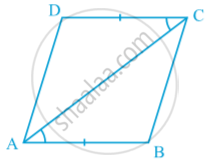
In above fig. which is AB = CD and AB || CD . Let us draw a diagonal AC. You can show that ∆ ABC ≅ ∆ CDA by SAS congruence rule. So , BC || AD .
Theorem : The line segment joining the mid-points of two sides of a triangle is parallel to the third side.
Observe following Fig. in which E and F are mid-points of AB and AC respectively and CD || BA.
∆ AEF ≅ ∆ CDF (ASA Rule)
So, EF = DF and BE = AE = DC
Therefore, BCDE is a parallelogram.
This gives EF || BC.
In this case, also note that EF = `1/2` ED = `1/2` BC.
Theorem : The line drawn through the mid-point of one side of a triangle, parallel to another side bisects the third side.
In following fig. 
Observe that E is the mid-point of AB, line l is passsing through E and is parallel to BC and CM || BA.
Prove that AF = CF by using the congruence of ∆ AEF and ∆ CDF.
ABCD is a rhombus. EABF is a straight line such that EA = AB = BF. Prove that ED and FC when produced, meet at right angles.
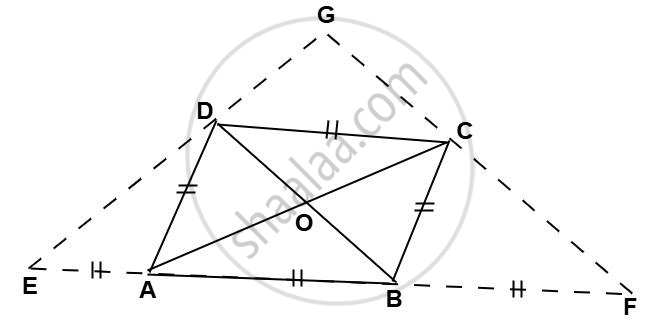
We know that the diagonals of a rhombus are perpendicular bisectors of each other
∴ OA = OC
OB = OD
∠AOD = ∠COD = 90°
And ∠AOB = ∠COB = 90°
In ΔBDE, A and O are midpoints of BE and BD, respectively
OA || DE
OC || DG
In ΔCFA, B and O are midpoints of AF and AC, respectively
∴ OB || CF
OD || GC
Thus, in quadrilateral DOCG, we have
OC || DG and OD || GC
⇒ DOCG is a parallelogram
∠DGC = ∠DOC
∠DGC = 90°
ABC is a triang D is a point on AB such that AD = `1/4` AB and E is a point on AC such that AE = `1/4` AC. Prove that DE = `1/4` BC.
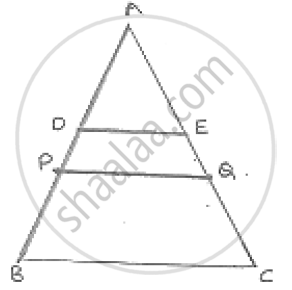
Let P and Q be the midpoints of AB and AC respectively.
Then PQ || BC such that
PQ = `1/2` BC ......(i)
In ΔAPQ, D and E are the midpoint of AP and AQ are respectively
∴ DE || PQ and DE = `1/2` PQ ....(ii)
From (1) and (2) DE = `1/2 PQ = 1/2 PQ = 1/2 (1/2 BC) `
DE = `1 /4`BC
Hence, proved.
The opposite sides of a parallelogram are of equal length.
Given: ABCD is a parallelogram.
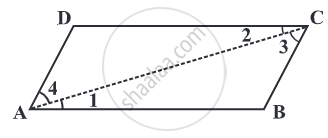
To Prove: AB = DC and BC = AD.
Construction: Draw any one diagonal, say `bar(AC)`.
Proof:
Consider a parallelogram ABCD,
In triangles ΔABC and ΔADC,
∠ 1 = ∠2, ∠ 3 = ∠ 4 .....(Pair of alternate angle)
and `bar(AC)` is common side.
Side AC = Side AC .....(common side)
∠ 1 ≅ ∠2 .....(Pair of alternate angle)
∠ 3 ≅ ∠ 4 .....(Pair of alternate angle)
by ASA congruency condition,
∆ ABC ≅ ∆ CDA
This gives AB = DC and BC = AD.
Hence Proved.
Theorem: A diagonal of a parallelogram divides it into two congruent triangles.
Proof : Let ABCD be a parallelogram and AC be a diagonal in following fig. 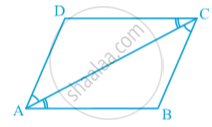
Observe that the diagonal AC divides parallelogram ABCD into two triangles, namely, ∆ ABC and ∆ CDA. We need to prove that these triangles are congruent.
In ∆ ABC and ∆ CDA, note that BC || AD and AC is a transversal.
So, ∠ BCA = ∠ DAC (Pair of alternate angles)
Also, AB || DC and AC is a transversal.
So, ∠ BAC = ∠ DCA (Pair of alternate angles)
and AC = CA (Common)
So, ∆ ABC ≅ ∆ CDA (ASA rule)
or, diagonal AC divides parallelogram ABCD into two congruent triangles ABC and CDA.
Now, measure the opposite sides of parallelogram ABCD.
You will find that AB = DC and AD = BC.
Theorem: If each pair of opposite sides of a quadrilateral is equal, then it is a parallelogram.
Proof: Let sides AB and CD of the quadrilateral ABCD be equal and also AD = BC in following fig.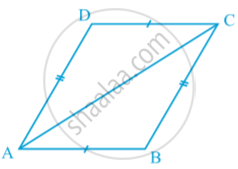
Draw diagonal AC. Clearly, ∆ ABC ≅ ∆ CDA
So, ∠ BAC = ∠ DCA
and ∠ BCA = ∠ DAC
Hence ABCD is a parallelogram.
Theorem: If in a quadrilateral, each pair of opposite angles is equal, then it is a parallelogram.
Proof: In quadrilateral ABCD
∠A = ∠D
`=>` ∠A +∠B +∠C + ∠D
Now, ∠A +∠B +∠C + ∠D = 360° (angle sum property of quadrilateral)
`=>` 2(∠A +∠B ) = 360°
`=> ` ∠A +∠B = 180°
`therefore` ∠A +∠B = ∠C + ∠D = 180°
Line AB intersects AD and BC at A and B respectively.
Such that ∠A +∠B = 180°
`therefore` AD || BC (Sum of consecutive interior angle is 180° ) ...(1)
∠A +∠B = 180°
∠A +∠D = 180° (∠B= ∠D)
`therefore` AB || CD ..(2)
From (1) and (2), we get
AB || CD and AD || BC
`therefore` ABCD is a parallelogram.
Theorem : If the diagonals of a quadrilateral bisect each other, then it is a parallelogram.
proof : 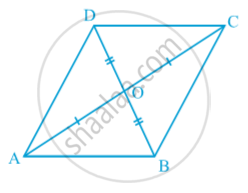
In ∆ AOD and ∆ COB (Given)
OD = OB (Given)
∠AOB = ∠COD (Vertically opposite angles are equal)
Therefore , ∆AOD ≅ ∆COB (By SAS criterion of congruence)
So, ∠OAD = ∠OCB ...(1) (C.P.C.T)
Now , lines AC intersects AD and BC at A and C respectively,
such that ∠OAD = ∠OCB ...[from(1)]
`therefore` ∠OAD and ∠ OCB form a pair of alternate interior angles are equal.
Thus, AD || BC
Similarly , we can prove that AB || DC
Hence , quadrilatera; ABCD is a parallelogram.
Concepts [10]
- Properties of Quadrilateral
- Another Condition for a Quadrilateral to Be a Parallelogram
- Theorem of Midpoints of Two Sides of a Triangle
- Property: The Opposite Sides of a Parallelogram Are of Equal Length.
- Theorem: A Diagonal of a Parallelogram Divides It into Two Congruent Triangles.
- Theorem : If Each Pair of Opposite Sides of a Quadrilateral is Equal, Then It is a Parallelogram.
- Property: The Opposite Angles of a Parallelogram Are of Equal Measure.
- Theorem: If in a Quadrilateral, Each Pair of Opposite Angles is Equal, Then It is a Parallelogram.
- Property: The diagonals of a parallelogram bisect each other. (at the point of their intersection)
- Theorem : If the Diagonals of a Quadrilateral Bisect Each Other, Then It is a Parallelogram
