Definitions [16]
The equation of the locus of a point is the algebraic relation which is satisfied by the coordinates of every point on the locus of the point.
Locus is the path traced by a moving point, which moves so as to satisfy a certain given condition/conditions.
The slope m of a line is m = tanθ
where θ is the inclination of the line with the positive x-axis.
x-intercept: Point where a line cuts the x-axis, y = 0
y-intercept: Point where a line cuts the y-axis, x = 0
An equation of the form ax + by + c = 0 represents a straight line and is known as a linear equation.
Find the equation of the line which passes through the point (3, 4) and is such that the portion of it intercepted between the axes is divided by the point in the ratio 2:3.
The equation of the line with intercepts a and b is \[\frac{x}{a} + \frac{y}{b} = 1\] .Since the line meets the coordinate axes at A and B, the coordinates are A (a, 0) and B (0, b).
Let the given point be P (3, 4).
Here,
\[AP : BP = 2 : 3\]
\[\therefore 3 = \frac{2 \times 0 + 3 \times a}{2 + 3}, 4 = \frac{2 \times b + 3 \times 0}{2 + 3}\]
\[ \Rightarrow 3a = 15, 2b = 20\]
\[ \Rightarrow a = 5, b = 10\]
Hence, the equation of the line is
\[\frac{x}{5} + \frac{y}{10} = 1\]
\[ \Rightarrow 2x + y = 10\]
A conic section is the locus of a point such that the ratio of its distance from a fixed point (focus) to a fixed line (directrix) is constant.
The straight line passing through the focus and perpendicular to the directrix is called the axis of the conic section.
The points of intersection of the conic section and the axis are called the vertices of the conic section.
The chord passing through the focus and perpendicular to the axis is called the latus rectum of the conic section.
A chord of a conic passing through the focus is called a focal chord.
A straight line drawn perpendicular to the axis and terminating at both ends of the curve is a double ordinate of the conic section.
The point which bisects every chord of the conic passing through it is called the centre of the conic section.
A parabola is the locus of a point which moves in a plane such that its distance from a fixed point (i.e. focus) is always equal to its distance from a fixed straight line (i.e. directrix).
A hyperbola is the locus of a point in a plane which moves in such a way that the ratio of its distance from a fixed point (i.e. focus) to its distance from a fixed line (i.e. directrix) is always constant and greater than unity.
An ellipse is the set of all points in a plane, the sum of whose distances from two fixed points in the plane is constant.
Formulae [17]
The distance between P(x1, y1) and Q(x2, y2) is
\[\sqrt{(x_2-x_1)^2+(y_2-y_1)^2}\]
The distance of a point P(x, y) from the origin is
\[\sqrt{x^2+y^2}\]
\[P\left(\frac{m_1x_2+m_2x_1}{m_1+m_2},\frac{m_1y_2+m_2y_1}{m_1+m_2}\right)\]
\[m=\frac{y_2-y_1}{x_2-x_1}\]
For line ax + by + c = 0
x-intercept:
\[\left(-\frac{c}{a},0\right)\]
y-intercept:
\[\left(0,-\frac{c}{b}\right)\]
If the direction ratios of two lines are:
First line: \[(a_1, b_1, c_1)\]
Second line: \[(a_2, b_2, c_2)\]
then the cosine of the angle \[\theta\] between them is:
If the direction cosines of the two lines are
\[(l_1, m_1, n_1)\] and \[(l_2, m_2, n_2)\], then:
If the direction ratios are \[(a_1, b_1, c_1)\] and \[(a_2, b_2, c_2)\], then:
For lines ax + by + c₁ = 0 and ax + by + c₂ = 0,
P = \[\left|\frac{c_{1}-c_{2}}{\sqrt{a^{2}+b^{2}}}\right|\]
If ax² + 2hxy + by² + 2gx + 2fy + c = 0 represents a pair of parallel straight lines, then the distance between them is given by
\[2\sqrt{\frac{g^{2}-ac}{a(a+b)}}\mathrm{or}2\sqrt{\frac{f^{2}-bc}{b(a+b)}}\]
For point (x₁, y₁) and line ax + by + c = 0,
\[p=\frac{|ax_1+by_1+c|}{\sqrt{a^2+b^2}}\]
From general form:
- Slope (m) = −a / b
- Y-intercept = −c / b
$$e = \frac{\text{distance from focus}}{\text{distance from directrix}}$$
If the lines are \[ \vec{r} = \vec{a}_{1} + \lambda\vec{b}_{1} \] and \[ \vec{r} = \vec{a}_{2} + \mu\vec{b}_{2}, \]
then \[ \vec{a}_{1}, \vec{a}_{2} \] are position vectors of points on the lines and \[ \vec{b}_{1}, \vec{b}_{2} \] are their direction vectors.
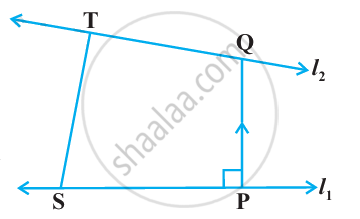
Vector Form:
\[\mathbf{d}=\left|\frac{(\overline{\mathbf{b}}_{1}\times\overline{\mathbf{b}}_{2}).(\overline{\mathbf{a}}_{2}-\overline{\mathbf{a}}_{1})}{\left|\overline{\mathbf{b}}_{1}\times\overline{\mathbf{b}}_{2}\right|}\right|\]
Cartesian Form:
\[\mathbf{d}=\left|\frac{ \begin{vmatrix} x_2-x_1 & y_2-y_1 & z_2-z_1 \\ \mathbf{a}_1 & \mathbf{b}_1 & \mathbf{c}_1 \\ \mathbf{a}_2 & \mathbf{b}_2 & \mathbf{c}_2 \end{vmatrix}}{\sqrt{\left(\mathbf{a}_1\mathbf{b}_2-\mathbf{a}_2\mathbf{b}_1\right)^2+\left(\mathbf{a}_1\mathbf{c}_2-\mathbf{a}_2\mathbf{c}_1\right)^2+\left(\mathbf{b}_1\mathbf{c}_2-\mathbf{b}_2\mathbf{c}_1\right)^2}}\right|\]
\[SD=\left|\frac{\left(a_{2}-a_{1}\right)\times b}{\left|b\right|}\right|\]
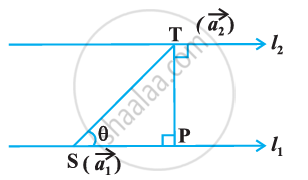
If ax² + 2hxy + by² + 2gx + 2fy + c = 0 represents a pair of parallel straight lines, then the distance between them is given by
\[2\sqrt{\frac{g^{2}-ac}{a(a+b)}}\mathrm{or}2\sqrt{\frac{f^{2}-bc}{b(a+b)}}\]
For point (x₁, y₁) and line ax + by + c = 0,
\[p=\frac{|ax_1+by_1+c|}{\sqrt{a^2+b^2}}\]
For lines ax + by + c₁ = 0 and ax + by + c₂ = 0,
P = \[\left|\frac{c_{1}-c_{2}}{\sqrt{a^{2}+b^{2}}}\right|\]
Theorems and Laws [7]
If the point (x, y) is equidistant from the points (a + b, b – a) and (a – b, a + b), prove that bx = ay.
Let P(x, y), Q(a + b, b – a) and R (a – b, a + b) be the given points. Then
PQ = PR ...(Given)
⇒ `sqrt({x - (a + b)}^2 + {y - (b - a)}^2) = sqrt({x - (a - b)}^2 + {y - (a + b)}^2`
⇒ `{x - (a + b)}^2 + {y - (b - a)}^2 = {x - (a - b)}^2 + {y - (a + b)}^2`
⇒ x2 – 2x(a + b) + (a + b)2 + y2 – 2y(b – a) + (b – a)2 = x2 + (a – b)2 – 2x(a – b) + y2 – 2(a + b) + (a + b)2
⇒ –2x(a + b) – 2y(b – a) = –2x(a – b) – 2y(a + b)
⇒ ax + bx + by – ay = ax – bx + ay + by
⇒ 2bx = 2ay
⇒ bx = ay
If a ≠ b ≠ 0, prove that the points (a, a2), (b, b2) (0, 0) will not be collinear.
Let A(a, a2), B(b, b2) and C(0, 0) be the coordinates of the given points.
We know that the area of triangle having vertices (x1, y1), (x2, y2) and (x3, y3) is ∣∣`1/2`[x1(y2−y3)+x2(y3−y1)+x3(y1−y2)]∣∣ square units.
So,
Area of ∆ABC
`= |1/2|a(b^2 - 0) + b(0 - a^2) + 0(a^2 - b^2)||`
`=|1/2(ab^2 - a^2b)|`
`= 1/2|ab(b -a)|`
`!= 0 (∵ a!= b != 0)`
Since the area of the triangle formed by the points (a, a2), (b, b2) and (0, 0) is not zero, so the given points are not collinear.
If the point P(x, y) is equidistant from the points A (5, 1) and B (1, 5), prove that x = y.
The distance d between two points `(x_1,y_1)` and `(x_2,y_2)` is given by the formula
`d = sqrt((x_1 - x_2)^2 + (y_1 - y_2)^2)`
The three given points are P(x, y), A(5, 1) and B(1, 5).
Now let us find the distance between ‘P’ and ‘A’.
`PA = sqrt((x - 5)^2 + (y - 1)^2)`
Now, let us find the distance between ‘P’ and ‘B’.
`PB = sqrt((x - 1)^2 + (y - 5)^2)`
It is given that both these distances are equal. So, let us equate both the above equations,
PA = PB
`sqrt((x - 5)^2 + (y -1)^2) = sqrt((x - 1)^2 + (y - 5)^2)`
Squaring on both sides of the equation we get,
`(x - 5)^2 + (y - 1)^2 = (x - 1)^2 + (y - 5)^2`
`=> x^2 + 25 - 10x + y^2 + 1 - 2y = x^2 + 1 - 2x + y^2 + 25 - 10y`
`=> 26 - 10x - 2y = 26 - 10y - 2x`
`=> 10y - 2y = 10x - 2x`
`=> 8y = 8x`
`=> y = x`
Hence we have proved that x = y.
If D, E, F are the midpoints of the sides BC, CA, AB of a triangle ABC, prove that `bar(AD) + bar(BE) + bar(CF) = bar0`.
Let `bara, barb, barc, bard, bare, barf` be the position vectors of the points A, B, C, D, E, F respectively.
Since D, E, F are the midpoints of BC, CA, AB respectively, by the midpoint formula
`bard = (barb + barc)/2, bare = (barc + bara)/2, barf = (bara + barb)/2`
∴ `bar(AD) + bar(BE) + bar(CF) = (bard - bara) + (bare - barb) + (barf - barc)`
= `((barb + barc)/2 - bara) + ((barc + bara)/2 - barb) + ((bara + barb)/2 - barc)`
= `1/2barb + 1/2barc - bara + 1/2barc + 1/2bara - barb + 1/2bara + 1/2barb - barc`
= `1/2(barb + barc - 2bara + bar c + bara - 2barb + bara + barb - 2barc)`
= `(bara + barb + barc) - (bara + barb + barc) = bar0`.
By vector method prove that the medians of a triangle are concurrent.

Let A, B and C be vertices of a triangle.
Let D, E and F be the mid-points of the sides BC, AC and AB respectively.
Let `bara, barb, barc, bard, bare` and `barf` be position vectors of points A, B, C, D, E and F respectively.
Therefore, by mid-point formula,
∴ `bard = (barb + barc)/2, bare = (bara + barc)/2` and `barf = (bara + barb)/2`
∴ `2bard = barb + barc, 2bare = bara + barc` and `2barf = bara + barb`
∴ `2bard + bara = bara + barb + barc`, similarly `2bare + barb = 2barf + barc = bara + barb + barc`
∴ `(2bard + bara)/3 = (2bare + barb)/3 = (2barf + barc)/3 = (bara + barb + barc)/3 = barg` ...(Say)
Then we have `barg = (bara + barb + barc)/3 = ((2)bard + (1)bara)/(2 + 1) = ((2)bare + (1)barb)/(2 + 1) = ((2)barf + (1)barc)/(2 + 1)`
If G is the point whose position vector is `barg`, then from the above equation it is clear that the point G lies on the medians AD, BE, CF and it divides each of the medians AD, BE, CF internally in the ratio 2 : 1.
Therefore, three medians are concurrent.
Let `A(bara)` and `B(barb)` are any two points in the space and `R(barr)` be a point on the line segment AB dividing it internally in the ratio m : n, then prove that `barr = (mbarb + nbara)/(m + n)`.
R is a point on the line segment AB(A – R – B) and `bar(AR)` and `bar(RB)` are in the same direction.
Point R divides AB internally in the ratio m : n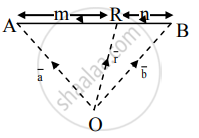
∴ `(AR)/(RB) = m/n`
∴ n(AR) = m(RB)
As `n(bar(AR))` and `m(bar(RB))` have same direction and magnitude,
`n(bar(AR)) = m(bar(RB))`
∴ `n(bar(OR) - bar(OA)) = m(bar(OB) - bar(OR))`
∴ `n(vecr - veca) = m(vecb - vecr)`
∴ `nvecr - nveca = mvecb - mvecr`
∴ `mvecr + nvecr = mvecb + nveca`
∴ `(m + n)vecr = mvecb + nveca`
∴ `vecr = (mvecb + nveca)/(m + n)`
Let `A(bara)` and `B(barb)` be any two points in the space and `R(barr)` be the third point on the line AB dividing the segment AB externally in the ratio m : n, then prove that `barr = (mbarb - nbara)/(m - n)`.
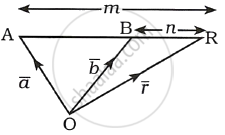
As the point R divides the line segment AB externally, we have either A-B-R or R-A-B.
Assume that A-B-R and `bar(AR) : bar(BR)` = m : n
∴ `(AR)/(BR) = m/n` so n(AR) = m(BR)
As `n(bar(AR))` and `m(bar(BR))` have same magnitude and direction,
∴ `n(bar(AR)) = m(bar(BR))`
∴ `n(barr - bara) = m(barr - barb)`
∴ `nbarr - nbara = mbarr - mbarb`
∴ `mbarr - nbarr = mbarb - nbara`
∴ `(m - n)barr = mbarb - nbara`
∴ `barr = (mbarb - nbara)/(m - n)`
Hence proved.
Key Points
- Step I: Take any point P(x, y) on the locus.
- Step II: Write down the geometrical condition of the locus.
- Step III: Convert the geometrical condition into an algebraic equation involving x and y.
- Step IV: Simplify the equation to get the required “equation of the locus”.
Nature of Slope
-
m > 0 → rising line
-
m < 0 → falling line
-
m = 0 → horizontal line
-
m = ∞→ vertical line
Parallel Lines
Two lines are parallel ⇔ , their slopes are equal, m1 = m2
Perpendicular Lines
Two lines are perpendicular ⇔
Collinearity of Three Points
Points A, B, and C are collinear
Method 1: Distance method
AB + BC = AC
Method 2: Slope method
Slope of AB = Slope of BC
-
x-intercept:
Right of origin → positive
Left of origin → negative -
y-intercept:
Above origin → positive
Below origin → negative
-
The angle between two lines depends only on their directions.
-
If lines do not pass through the origin, imagine parallel lines through the origin.
-
The dot-product formula is the main method for solving these questions.
-
In symmetric form, denominators give direction ratios.
-
Zero dot product means perpendicular lines.
-
Proportional direction ratios mean parallel lines.
-
The required angle is generally the acute angle.
| Form | Formula |
|---|---|
| X-axis | y = 0 |
| Y-axis | x = 0 |
| Parallel to the X-axis | y = b or y = -b |
| Parallel to the Y-axis | x = a or x = -a |
| Slope-point form | y − y₁ = m(x − x₁) |
| Two-point form | \[\frac{y-y_{1}}{y_{1}-y_{2}}=\frac{x-x_{1}}{x_{1}-x_{2}}\] |
| Slope-intercept form | y = mx + c |
| Intercept form | \[\frac{x}{\mathrm{a}}+\frac{y}{\mathrm{b}}=1\] |
| Normal form | x cosα + y sinα = p |
| Parametric form | \[\frac{x-x_{1}}{\cos\theta}=\frac{y-y_{1}}{\sin\theta}=r\] |
Position of a Point:
For line: ax₁ + by₁ + c
- If ax₁ + by₁ + c = 0 → Point lies on the line
- If ax₁ + by₁ + c < 0 → Point lies on one side (origin side)
- If ax₁ + by₁ + c > 0 → Point lies on other side
For Standard Circle: x² + y² = a²
| Sr. No. | Description | Formula |
|---|---|---|
| i. | Tangent at a point (x₁, y₁) | xx₁ + yy₁ = a² |
| ii. | Parametric form of tangent at P(θ) | x cosθ + y sinθ = a |
| iii. | Condition of tangency for the line y = mx + c | \[\mathrm{c=\pm a~\sqrt{1+m^{2}}}\] |
| Point of contact | \[\left(\frac{-\mathrm{a}^{2}\mathrm{m}}{\mathrm{c}},\frac{\mathrm{a}^{2}}{\mathrm{c}}\right)\] | |
| iv. | Equation of tangent in terms of its slope m | \[y=\mathrm{m}x\pm\mathrm{a}\sqrt{1+\mathrm{m}^{2}}\] |
| v. | Length of tangent from the point (x₁, y₁) | \[\sqrt{S_{1}}=\sqrt{x_{1}^{2}+y_{1}^{2}-a^{2}}\] |
| vi. | Equation of the Director circle | x² + y² = 2a² |
For General Circle: x² + y² + 2gx + 2fy + c = 0
| Sr. No. | Description | Formula |
|---|---|---|
| i. | Tangent at a point (x₁, y₁) | xx₁ + yy₁ + g(x + x₁) + f(y + y₁) + c = 0 |
| ii. | Length of tangent from the point (x₁, y₁) | \[\sqrt{S_{1}}=\sqrt{x_{1}^{2}+y_{1}^{2}+2gx_{1}+2fy_{1}+c}\] |
Number of Common Tangents:
| Case | Diagram | No. of Tangents | Condition |
|---|---|---|---|
| Disjoint circles | 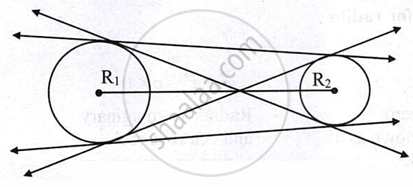 |
4 | d > r₁ + r₂ |
| Touch externally | 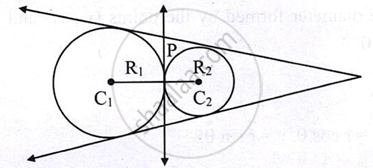 |
3 | d = r₁ + r₂ |
| Intersecting circles | 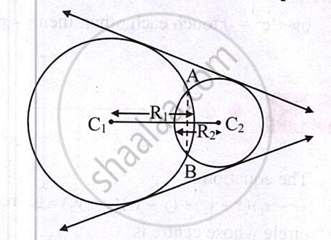 |
2 | d < r₁ + r₂ |
| Touch internally | 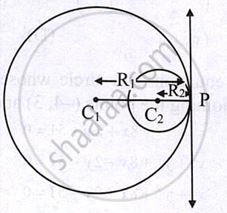 |
1 | d = \[\left|\mathbf{R}_{1}-\mathbf{R}_{2}\right|\] |
| Concentric circles | 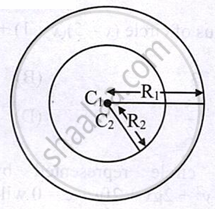 |
0 | d = 0 |
Equation of a pair of tangents:
(x² + y² − a²)(x₁² + y₁² − a²) = (xx₁ + yy₁ − a²)²
| Property | y² = 4ax | y² = −4ax | x² = 4ay | x² = −4ay |
|---|---|---|---|---|
| Vertex | (0, 0) | (0, 0) | (0, 0) | (0, 0) |
| Focus | (a, 0) | (−a, 0) | (0, a) | (0, −a) |
| Directrix | x + a = 0 | x − a = 0 | y + a = 0 | y − a = 0 |
| Axis | y = 0 | y = 0 | x = 0 | x = 0 |
| Axis of Symmetry | X-axis | X-axis | Y-axis | Y-axis |
| Eccentricity | 1 | 1 | 1 | 1 |
| Latus Rectum Length | 4a | 4a | 4a | 4a |
| Endpoints of Latus Rectum | (a, ±2a) | (−a, ±2a) | (±2a, a) | (±2a, −a) |
| Equation of Latus Rectum | x = a | x = −a | y = a | y = −a |
| Tangent at Vertex | x = 0 | x = 0 | y = 0 | y = 0 |
| Parametric Equations | x = at², y = 2at | x = −at², y = 2at | x = 2at, y = at² | x = 2at, y = −at² |
| Parametric Point | (at², 2at) | (−at², 2at) | (2at, at²) | (2at, −at²) |
| Focal Distance of P(x₁,y₁) | x₁ + a | a − x₁ | y₁ + a | a − y₁ |
| Property |
Standard Hyperbola \[\frac{x^{2}}{a^{2}}-\frac{y^{2}}{b^{2}}=1\] |
Conjugate Hyperbola \[\frac{y^{2}}{b^{2}}-\frac{x^{2}}{a^{2}}=1\] |
|---|---|---|
| Centre | (0, 0) | (0, 0) |
| Vertices | (±a, 0) | (0, ±b) |
| Transverse Axis Length | 2a | 2b |
| Conjugate Axis Length | 2b | 2a |
| Foci | (±ae, 0) | (0, ±be) |
| Eccentricity | \[\mathrm{e}=\frac{\sqrt{\mathrm{a}^{2}+\mathrm{b}^{2}}}{\mathrm{a}}\] | \[\mathrm{e}=\frac{\sqrt{\mathrm{b}^2+\mathrm{a}^2}}{\mathrm{b}}\] |
| Relation | \[\mathbf{b}^2=\mathbf{a}^2(\mathbf{e}^2-1)\] | \[\mathbf{a}^2=\mathbf{b}^2(\mathbf{e}^2-1)\] |
| Directrices | \[x=\pm\frac{\mathrm{a}}{\mathrm{e}}\] | \[y=\pm\frac{\mathrm{b}}{\mathrm{e}}\] |
| Length of Latus Rectum | \[\frac{2\mathrm{b}^2}{\mathrm{a}}\] | \[\frac{2\mathrm{a}^2}{\mathrm{b}}\] |
| Ends of Latus Rectum | \[\left(\pm ae,\pm\frac{b^{2}}{a}\right)\] | \[\left(\pm\frac{a^{2}}{b},\pm e\right)\] |
| Distance between Foci | 2ae | 2be |
| Difference of Focal Radii | 2a | 2b |
| Axis Equations | Transverse: y = 0, Conjugate: x = 0 | Transverse: x = 0, Conjugate: y = 0 |
| Parametric Equations | x = a secθ, y = b tanθ | x = a tanθ, y = b secθ |
| Parametric Point | (a secθ, b tanθ) | (a tanθ, b secθ) |
| Tangent at Vertex | x = ±a | y = ±b |
| Fundamental Terms | Horizontal Ellipse (a>b) | Vertical Ellipse (a<b) |
|---|---|---|
| Equation | \[\frac{x^{2}}{a^{2}}+\frac{y^{2}}{b^{2}}=1\] | \[\frac{x^{2}}{a^{2}}+\frac{y^{2}}{b^{2}}=1\] |
| Centre | (0,0) | (0,0) |
| Vertices | (±a,0) | (0,±b) |
| Length of major axis | 2a | 2b |
| Length of minor axis | 2b | 2a |
| Foci | (±ae,0) | (0, ±be) |
| Relation between (a,b,e) | \[\mathrm{b}^{2}=\mathrm{a}^{2}(1-\mathrm{e}^{2})\] | \[\mathbf{a}^{2}=\mathbf{b}^{2}(1-\mathbf{e}^{2})\] |
| Eccentricity | \[\mathrm{e}=\frac{\sqrt{\mathrm{a}^{2}-\mathrm{b}^{2}}}{\mathrm{a}}\] | \[\mathrm{e}=\frac{\sqrt{\mathrm{b}^{2}-\mathrm{a}^{2}}}{\mathrm{b}}\] |
| Equation of directrices | \[x=\pm\frac{\mathrm{a}}{\mathrm{e}}\] | \[y=\pm\frac{b}{e}\] |
| Distance between foci | 2ae | 2be |
| Distance between directrices | \[\frac{2a}{e}\] | \[\frac{2b}{e}\] |
| Length of latus rectum | \[\frac{2\mathrm{b}^2}{a}\] | \[\frac{2\mathrm{a}^2}{b}\] |
| Endpoints of the latus rectum | \[\left(\pm ae,\pm\frac{b^{2}}{a}\right)\] | \[\left(\pm\frac{a^{2}}{b},\pm be\right)\] |
| Equation of axes | Major: (y = 0), Minor: (x = 0) | Major: (x = 0), Minor: (y = 0) |
| Parametric equations | \[\begin{cases} x=a\cos\alpha \\ y=b\sin\alpha & \end{cases}\] | \[\begin{cases} x=a\cos\alpha \\ y=b\sin\alpha & \end{cases}\] |
| Focal distances | \[\mid SP\mid=\left(a-ex_{1}\right)\mathrm{and}\mid S^{\prime}P\mid=\left(a+ex_{1}\right)\] | \[\mid SP\mid=(b-ey_{1})\mathrm{~and}\mid S^{\prime}P\mid=(b+ey_{1})\] |
| Sum of focal radii | 2a | 2b |
| Equation of the tangent at the vertex | (x = ± a) | (y = ± b) |
-
Intersecting lines: SD = 0
-
Parallel lines: \[SD = \frac{|(\vec{a}_2 - \vec{a}_1) \times \vec{b}|}{|\vec{b}|}\]
-
Skew lines: \[SD = \frac{|(\vec{a}_2 - \vec{a}_1) \cdot (\vec{b}_1 \times \vec{b}_2)|}{|\vec{b}_1 \times \vec{b}_2|}\]
Concepts [38]
- Brief Review of Cartesian System of Rectanglar Co-ordinates
- Distance Formula
- Section Formula in Coordinate Geometry
- Locus
- Translation of Axes
- Concept of Slope (or, gradient)
- Parallel and Perpendicular Lines
- Intercepts on Axes
- Various Forms of the Equation of a Line
- Intersection of Two Lines
- Angle Between Two Lines
- Conditions for Concurrence of Three Lines
- Distance in Lines (Point & Parallel Lines)
- Equations of Line in Different Forms
- Equations of Internal and External by Sectors of Angles Between Two Lines Co-ordinate of the Centroid, Orthocentre, and Circumcentre of a Triangle
- Equations of Internal and External by Sectors of Angles Between Two Lines Co-ordinate of the Centroid, Orthocentre, and Circumcentre of a Triangle
- Equation of Family of Lines Passing Through the Point of Intersection of Two Lines
- Equations of a Circle in Standard Form
- Equations of a Circle in General Form
- Equation of a Circle When the Endpoints of a Diameter Are Given
- Point of Intersection of a Line and a Circle
- Equation of Tangent and Condition of Tangency
- Fundamentals of Conic Sections
- Parabola and its types
- Hyperbola and its Types
- Ellipse and its Types
- Condition for Y = mx + c to Be a Tangent and Point(s) of Tangency
- Results of Triangle
- Various Forms of Equation of a Line
- Shortest Distance Between Two Lines
- Bisector of the Angle Between the Two Lines
- Distance in Lines (Point & Parallel Lines)
- Foot of the Perpendicular
- Position of a Point with Respect to a Line
- Pedal Points
- Pair of Straight Lines
- Advanced Concept of Circle
- Standard Equation of a Circle
