- The word “gene” was coined by geneticist Wilhelm Johannsen in 1909 to simply describe what parents passed to their offspring. The detailed structure of DNA associated with genes was discovered much later.
- Genes are specific sequences of nucleotides on a chromosome, that encode particular proteins which are expressed in the form of some particular feature of the body.
- GENES are the specific parts (DNA segments) of a chromosome which determine the hereditary characteristics.
Definitions [16]
Definition: Mendelism
Mendelism refers to the principles of inheritance proposed by Gregor Mendel based on his experiments with pea plants. These principles explain that traits are inherited in a predictable manner through discrete hereditary units.
Definition: Genetics
Genetics is the study of heredity i.e. transmission of body features (both similarities and differences) from parents to offspring and the laws relating to such transmission.
Definition: Genes
Definition: Genome
GENOME is the full complement of DNA (including all genes and the intergenic regions) of an organism.
Define the following term:
Gene
Genes are specific sequences of nucleotides on a chromosome that encode particular proteins which are expressed in the form of some particular feature of the body. They are the units of heredity which are transferred from parents to offspring and are responsible for some specific characteristics of the offspring.
Definition: Autosomes
Autosomes are the kind of chromosomes which determine general body features like complexion, height, seed colour, etc. Humans have 22 pairs of autosomes.
Definition: Sex Chromosomes
Sex chromosomes (also called allosomes) are the kind of chromosomes that determine the sex of an organism. Every human has only 1 pair of sex chromosomes.
Definition: Sex determination
The biological mechanism by which the sex (male or female) of an individual is established based on genetic or chromosomal factors, is called sex determination.
Definition: Recessive Allele
The kind of allele whose expression is suppressed in presence of a dominant allele for a given gene. A recessive allele can only express itself in presence of the same recessive allele. e.g. The recessive allele for height in garden pea is dwarf.
Definition: Alleles
Every gene has two alternative forms for a character producing different effects. These alternative forms are called the alleles.
Definition: Dominant Allele
The kind of allele which expresses itself regardless of the presence of another allele/s for a given gene. e.g., The dominant allele for height in garden pea is tall.
Definition: Phenotype
The expressed shown character is called phenotype (phene: to show).
or
The observable characteristics which are genetically controlled.
Definition: Genotype
The genetic constitutions (pertaining to the kinds of genes possessed) are called genotype.
or
The set of genes present in the cells of an organism.
Definition: Sex-Linked Inheritance
Sex-linked inheritance is the appearance of a trait which is due to the presence of an allele exclusively either on the X chromosome or on the Y chromosome.
Definition: Criss-Cross Inheritance
Inheritance of X-linked genes, as in colour blindness and haemophilia is also called 'criss-cross inheritance'.
Definition: Monohybrid Experiments
Mendel's first experiments were with the varieties of garden pea that differed in only one visible character. These are known as monohybrid experiments.
Key Points
Key Points: Gregor Johann Mendel – Father of Genetics
- Gregor Johann Mendel (1822–1884), an Austrian monk, is known as the Father of Genetics for his pioneering work on heredity.
- He studied science and mathematics at the University of Vienna, which helped him apply a quantitative approach to biological problems.
- Mendel conducted systematic hybridization experiments on garden pea (Pisum sativum) from 1856 to 1863.
- From these experiments, he formulated the fundamental Laws of Inheritance, explaining how traits are transmitted across generations.
- Although his work was ignored during his lifetime, it was rediscovered in 1900, leading to widespread recognition and the foundation of modern genetics.
Key Points: Autosomes and Sex Chromosomes
- Chromosomes are classified into autosomes and sex chromosomes.
- In diploid organisms, the material presents autosomes as 2n − 2 and sex chromosomes as 2.
- Humans have 22 pairs of autosomes and 1 pair of sex chromosomes.
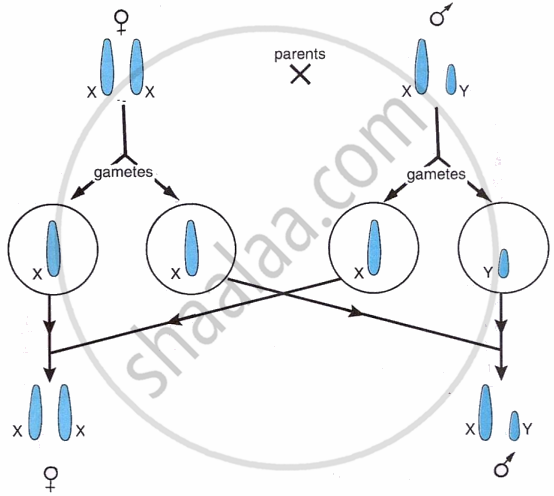
- XX = female and XY = male in humans.
- Heterogametic sex produces two kinds of gametes.
- Homogametic sex produces one kind of gamete.
- XO, XY, and WZ are major systems of sex determination discussed here.
Key Points: Sex Determination
- Sex determination: It is the mechanism by which an organism develops into a male or a female based on genetic factors.
- Types of organisms: Organisms may be bisexual (hermaphrodite), having both sex organs, or unisexual (dioecious), like humans, with separate sexes.
- Discovery: Henking (1891) discovered the X-body, later identified as the X chromosome involved in sex determination.
- XX–XY system: Females are XX (homogametic) and males are XY (heterogametic), seen in humans and Drosophila.
- ZW–ZZ system: Females are ZW (heterogametic) and males are ZZ (homogametic), seen in birds and some reptiles.
- Haplodiploidy: In honeybees, unfertilized eggs develop into haploid males and fertilised eggs into diploid females.
Key Points: Genes and Alleles
- Alleles are alternative forms of a gene.
- One allele is dominant, the other is recessive.
- Dominant allele expresses even if single (e.g., tall pea = "T").
- Recessive allele expresses only if both are recessive (e.g., dwarf = "tt").
- Homozygous = same alleles (AA/aa); Heterozygous = different alleles (Aa).
Key Points: Sex-linked Inheritance in Human Beings
- Human somatic cells possess 23 pairs of chromosomes, comprising 22 pairs of autosomes and one pair of sex chromosomes (XX in females and XY in males).
- The male gamete determines the sex of the offspring, as males produce two different types of gametes (X or Y) while females produce only one type (X).
- Sex-linked inheritance in humans follows the exact same pattern observed in Drosophila, with haemophilia and colour blindness being major examples of these traits.
Determination of sex by Y-chromosome in human beings:
Key Points: Monohybrid Cross
| Parameter | Monohybrid Cross |
|---|---|
| Meaning | Cross involving 1 pair of contrasting characters |
| Example | TT × tt (Tall × Dwarf) |
| Phenotypic Ratio | 3:1 (Tall: Dwarf) |
| Genotypic Ratio | 1: 2: 1 |
| Conclusion | Tallness is dominant; dwarfness is recessive |
Key Points: Applications and Beyond Mendel's Laws
Practical Applications
- Predicts Outcomes: Helps predict new trait combinations and frequencies in hybrid offspring.
- Breeding Utility: An essential foundation for plant and animal breeders.
- Crop Improvement: Enables the creation of new, desirable plant varieties through hybridization.
Post-Mendelian Genetics
- Terminology: Mendel’s discrete "factors" are what we now call genes.
- Limitations: Mendel’s original principles are broadly true but cannot explain every pattern of inheritance.
- Extensions: Later genetic complexities were resolved by modifying and extending Mendel's original framework.
Important Questions [4]
- Choose the Correct Answer from the Four Options Given Below : in a Human Male, a Sperm Will Contain :
- The sex chromosome in a human ovum is ______.
- A zygote which has Y chromosome inherited from the father will develop into a ______.
- Given below is a schematic representation of the inheritance of the shape of the seeds of garden peas. Answer the questions that follow: Which is the dominant and recessive allele of the trait?
Concepts [11]
- Gregor Johann Mendel – Father of Genetics
- Genes and Genetic
- Inheritance in Humans
- Autosomes and Sex Chromosomes
- Sex Determination
- Genes and their Alleles
- Genotype and Phenotype
- Inheritance of Human Traits and Their Genetic Basis
- Sex-Linked Inheritance in Human Beings
- Monohybrid Cross
- Applications and Beyond Mendel's Laws
