Definitions [5]
A ratio is the relationship between two quantities of the same kind with the same unit, obtained by dividing the first by the second.
Example:
The ratio between 15 kg and 20 kg
15 kg : 20 kg = `15/20` = `3/4` = 3:4.
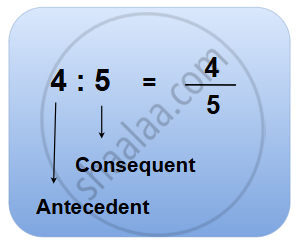
If the ratio between any two quantities of the same kind and having the same unit can be expressed exactly by the ratio between two integers, the quantities are said to be commensurable
Example:
\[2\frac{1}{3}:3\frac{1}{2}=\]\[\frac{7}{3}:\frac{7}{2}\] = 2:3→ ratio of integers → commensurable.
If the ratio cannot be expressed as a ratio of two integers, the quantities are said to be incommensurable.
Example:
\[\sqrt{3}\] : 5 cannot be written as a ratio of integers → incommensurable.
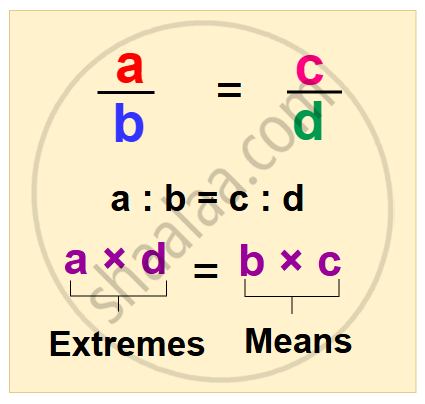
Four non-zero quantities, a, b, c, and d, are said to be in proportion (or are proportional) if:
a : b = c : d.
The above equation is expressed as a : b :: c : d
This is read as “a is to b as c is to d.”
Three numbers are in continued proportion if:
a:b, then a, b, and c are in continued proportion.
-
b is the mean proportional between a and c.
-
c is the third proportional to a and b.
Formulae [1]
a : b = b : c
\[\frac{a}{b}\] = \[\frac{b}{c}\]
⇒ b × b = a × c
⇒ `(b^2)` = ac and
b = \[\sqrt{ac}\]
Theorems and Laws [9]
If x : a = y : b, prove that `(x^4 + a^4)/(x^3 + a^3) + (y^4 + b^4)/(y^3 + b^3) = ((x + y)^4 + (a + b)^4)/((x+ y)^3 + (a + b)^3`
`x/a = y/b` = k (say)
x = ak, y = bk
L.H.S. = `(x^4 + a^4)/(x^3 + a^3) + (y^4 + b^4)/(y^3 + b^3)`
= `(a^4k^4 + a^4)/(a^3k^3 + a^3) + (b^4k^4 + b^4)/(b^3k^3 + b^3)`
= `(a^4(k^4 + 1))/(a^3(k^3 + 1)) + (b^4(k^4 + 1))/(b^3(k^3 + 1)`
= `(a(k^4 + 1))/(k^3 + 1) + (b(k^4 + 1))/(k^3 + 1)`
= `(a(k^4 + 1) + b(k^4 + 1))/(k^3 + 1)`
= `((k^4 + 1)(a + b))/(k^3 + 1)`
R.H.S. = `((x + y)^4 + (a + b)^4)/((x+ y)^3 + (a + b)^3`
= `((ak + bk)^4 + (a + b)^4)/((ak + bk)^3 + (a + b)^3`
= `(k^4(a + b)^4 + (a - b)^4)/(k^3(a + b)^3(a + b)^3`
= `((a + b)^4(k^4 + 1))/((a + b)^3(k^3 + 1)`
= `((a + b)(k^4 + 1))/(k^3 + 1)`
= `((k^4 + 1)(a + b))/(k^3 + 1)`
∴ L.H.S. = R.H.S.
Hence proved
If `x/a = y/b = z/c`, prove that `(3x^3 - 5y^3 + 4z^3)/(3a^3 - 5b^3 + 4c^3) = ((3x - 5y + 4z)/(3a - 5b + 4c))^3`.
`x/a = y/b = z/c` = k(say)
x = ak, y = bk, z = ck
L.H.S. = `(3x^3 5y^3 + 4z^3)/(3a^3 5b^3 + 4c^3)`
= `(3a^3k^3 - 5b^3k^3 + 4c^3k^3)/(3a^3 - 5b^3 + 4ac^3)`
= `(k^3(3a^3 - 5b^3 + 4c^3))/(3a^3 - 5b^3 + 4c^3`
= k3
R.H.S. = `((3x - 5y + 4z)/(3a - 5b + 4c))^3`
= `((3ak - 5bk + 4ck)/(3a - 5b + ac))^3`
= `((k(3a - 5b + 4c))/(3a - 5b + 4c))^3`
= (k)3
= k3
∴ L.H.S. = R.H.S.
If a, b, c, d are in continued proportion, prove that: `((a - b)/c + (a - c)/b)^2 - ((d - b)/c + (d - c)/b)^2 = (a - d)^2 (1/c^2 - 1/b^2)`.
a, b, c, d are in continued proportion
∴ `a/b = b/c = c/d` = k(say)
∴ c = dk, b = dk2, a = bk = dk2. k = dk3
L.H.S.
= `((a - b)/c + (a - c)/b)^2 - ((d - b)/c + (d - c)/b)^2`
= `((dk^3 - dk^2)/(dk) + (dk^3 - dk)/(dk^2))^2 - ((d - dk^2)/(dk) + (d - dk)/(dk^2))^2`
= `((dk^2(k - 1))/(dk) + (dk(k^2 - 1))/(dk^2))^2 - ((d(1 - k^2))/(dk) + (d( 1 - k^2))/(dk^2))^2`
= `((k(k - 1) + (k^2 - 1))/k)^2 - ((1 - k^2)/k + (1 - k)/k^2)^2`
= `((k^2(k - 1) + (k^2 - 1))/k)^2 - ((k (1- k^2) + 1 - k)/k^2)^2`
= `((k^3 - 1)^2)/k^2 - (-k^3 + 1)^2/k^4`
= `(k^3 - 1)^2/k^2 - (1 - k^3)^2/k^4`
= `((k^3 - 1)/k^2)^2 ((1 - 1)/k^2)`
= `((k^3 - 1)^2(k^2 - 1))/k^4`
= `((k^3 - 1)^2(k^2 - 1))/k^4`
R.H.S.
= `(a - d)^2(1 / c^2 - 1/b^2)`
= `(dk^3 - d)^2(1 / (d^2k^2) - (1)/(d^2k^4))`
= `d^2(k^3 - 1)^2((k^2 - 1)/(d^2k^4))`
= `((k^3 - 1)^2(k^2 - 1))/k^4`
∴ L.H.S. = R.H.S.
If `a/c = c/d = e/f` prove that: `(a^3 + c^3)^2/(b^3 + d^3)^2 = e^6/f^6`
`a/c = c/d = e/f` = k(say)
∴ a = bk, c = dk, e =fk
L.H.S.
= `(a^3 + c^3)^2/(b^3 + d^3)^2`
= `(b^3k^3 + d^3k^3)^2/(b^3 + d^3)^2`
= `[k^3(b^3 + d^3)]^2/(b^3 + a^3)^2`
= `(k^6(b^3 + d^3)^2)/(b^3 + d^3)^2`
= k6
R.H.S. = `e^6/f^6`
= `f^6k^6/f^6`
= k6
∴ L.H.S. = R.H.S.
If x, y, z are in continued proportion, prove that: `(x + y)^2/(y + z)^2 = x/z`.
x, y, z are in continued proportion
Let `x/y = y/z = k`
Then y = kz
x = yk
= kz × k
= k2z
Now L.H.S.
= `(x + y)^2/(y + z)^2`
= `(k^2 z + kz)^2/(kz + z)^2`
= `{kz(k + 1)}^2/{z(k + 1)}^2`
= `(k^2z^2(k + 1)^2)/(z^2(k + 1)^2)`
= k2
R.H.S. = `x/z`
= `(k^2z)/z`
= k2
∴ L.H.S. = R.H.S.
If x, y and z are in continued proportion, Prove that:
`x/(y^2.z^2) + y/(z^2.x^2) + z/(x^2.y^2) = 1/x^3 + 1/y^3 + 1/z^3`
Given: x, y and z are in continued proportion.
∴ `x/y = y/z`
⇒ y2 = xz
To prove: `x/(y^2.z^2) + y/(z^2.x^2) + z/(x^2.y^2) = 1/x^3 + 1/y^3 + 1/z^3`
Proof: Solving L.H.S.:
`x/(y^2.z^2) + y/(z^2.x^2) + z/(x^2.y^2)`
⇒ `(x^3 + y^3 + z^3)/(x^2.y^2.z^2)`
⇒ `(x^3 + y^3 + z^3)/(x^2.xz.z^2)`
⇒ `(x^3 + y^3 + z^3)/(x^3.z^3)`
⇒ `x^3/(x^3.z^3) + y^3/(x^3.z^3) + z^3/(x^3.z^3)`
⇒ `1/z^3 + y^3/(xz)^3 + 1/x^3`
⇒ `1/z^3 + y^3/(y^2)^3 + 1/x^3`
⇒ `1/z^3 + y^3/y^6 + 1/x^3`
⇒ `1/z^3 + 1/y^3 + 1/x^3`
Since L.H.S. = R.H.S.
Hence proved.
If a, b, c, d are in continued proportion, prove that: `(a^3 + b^3 + c^3)/(b^3 + c^3 + d^3) = a/d`
a, b, c, d are in continued proportion
∴ `a/b = b/c = c/d` = k(say)
∴ c = dk, b = ck = dk2, a = bk = dk3
L.H.S.
= `(a^3 + b^3 + c^3)/(b^3 + c^3 + d^3)`
= `((dk^3)^3 + (dk^2)^3 + (dk)^3)/((dk^2)^3 + (dk)^3 + d^3)`
= `(d^3k^9 + d^3k^6 + d^3k^3)/(d^3k^6 + d^3k^3 + d^3)`
= `(d^3k^3(k^6 + k^3 + 1))/(d^3(k^6 + k^3 + 1)`
= k3
R.H.S.
= `a/d`
= `(dk^3)/d`
= k3
∴ L.H.S. = R.H.S.
If a, b, c, d are in continued proportion, prove that: (a + d)(b + c) – (a + c)(b + d) = (b – c)2
a, b, c, d are in continued proportion
∴ `a/b = b/c = c/d` = k(say)
∴ c = dk, b = ck = dk. k = dk2,
a = bk = dk2. k = dk3
L.H.S. = (a + d)(b + c) – (a + c)(b + d)
= (dk3 + d) (dk2 + dk) – (dk3 + dk) (dk2 + d)
= d(k3 + 1) dk(k + 1) – dk (k2 + 1) d(k2 + 1)
= d2k(k + 1) (k3 + 1) – d2k (k2 + 1) (k2 + 1)
= d2k[k4 + k3 + k + 1 – k4 - 2k2 - 1]
= d2k[k3 – 2k2 + k]
= d2k2[k2 – 2k + 1]
= d2k2(k – 1)2
R.H.S. = (b – c)2
= (dk2 – dk)2
= d2k2(k – 1)2
∴ L.H.S. = R.H.S.
Hence proved.
If a + c = mb and `1/b + 1/d = m/c`, prove that a, b, c and d are in proportion.
a + c = mb and `1/b + 1/d = m/c`
a + c = mb ...(1)
`1/b + 1/d = m/c` ...(2)
Step 1: Simplify the second condition
`1/b + 1/d = m/c`
Take LCM of b and d:
`(d + b)/(bd) = m/c`
c(d + b) = mbd
cd + cb = mbd ...(3)
Step 2: Use the first condition
a + c = mb
Multiply both sides by d:
d(a + c) = mbd
ad + cd = mbd ...(4)
Step 3: Compare equations (3) and (4)
cd + cb = mbd
ad + cd = mbd
ad + cd = cd + cb
Subtract cdcdcd from both sides:
ad = cb
Step 4: Convert to ratio form
ad = bc
Divide both sides by bd:
`a/b = c/d`
Thus,
a : b = c : d
Hence, a, b, c and d are proportional.
Key Points
-
A ratio a: b is in lowest terms if the H.C.F. of a and b is 1.
-
To reduce a ratio to lowest terms, divide both terms by their H.C.F.
-
If ratio terms are fractions, multiply both terms by the L.C.M. of denominators to convert into whole numbers.
Increase / Decrease in a Ratio
- If a quantity increases or decreases in the ratio a:b, then
New value = `b / a` × Original value
Comparison of Ratios
-
if ad > bc
-
(a:b) = (c:d) if ad = bc
-
(a:b) < (c:d) if ad < bc
-
Compound ratio of a:b and c:d→ (ac):(bd)
-
Duplicate ratio of a:b → a2: b2
-
Triplicate ratio of a:b → a3: b3
-
Sub-duplicate ratio of a:b → \[\sqrt{a}\] : \[\sqrt{b}\]
-
Sub-triplicate ratio of a:b \[\to\sqrt[3]{a}:\sqrt[3]{b}\]
-
Reciprocal ratio of a:b → b:a (a ≠ 0, b ≠ 0)
-
Invertendo → invert → b : a = d : c
-
Alternendo → alternate → a : c = b : d
-
Componendo → add → (a + b) : b = (c + d) : d
-
Dividendo → subtract → (a - b) : b = (c - d) : d
-
Componendo & Dividendo → add & subtract → (a + b) : (a - b) = (c + d) : (c - d)
Important Questions [16]
- If (X - 9) : (3x + 6) is the Duplicate Ratio of 4 : 9, Find the Value of X.
- The 4th Term of a G.P. is 16 and the 7th Term is 128. Find the First Term and Common Ratio of the Series
- Using properties of proportion solve for x, given (sqrt(5x)+sqrt(2x -6))/(sqrt(5x)- sqrt(2x -6)) = 4
- If (3a + 2b) : (5a + 3b) = 18 : 29. Find a : B
- The monthly pocket money of Ravi and Sanjeev are in the ratio 5 : 7. Their expenditures are in the ratio 3 : 5. If each saves Rs. 80 every month, find their monthly pocket money.
- Calculate the ratio in which the line joining A(−4, 2) and B(3, 6) is divided by point P(x, 3). Also, find x length of AP.
- The following numbers, K + 3, K + 2, 3K – 7 and 2K – 3 are in proportion. Find K.
- The mean proportional between 4 and 9 is ______.
- What number must be added to each of the numbers 4, 6, 8, 11 in order to get the four numbers in proportion?
- If b is the mean proportion between a and c, show that: a4+a2b2+b4b4+b2c2+c4=a2c2.
- If (a + b)^3/(a - b)^3 = 64/27 (a) Find (a + b)/(a - b) (b) Hence using properties of proportion, find a : b.
- Using properties of proportion, solve for x. Given that x is positive: (2x + sqrt(4x^2 -1))/(2x - sqrt(4x^2 - 1)) = 4
- What least number must be added to each of the numbers 6, 15, 20 and 43 to make them proportional?
- Using the properties of proportion, solve for x, given x4+12x2=178.
- 6 is the Mean Proportion Between Two Numbers X and Y and 48 is the Third Proportional of X and Y. Find the Numbers.
- If X, Y, Z Are in Continued Proportion, Prove that `(X + Y)^2/(Y + Z)^2 = X/Z`
