Definitions [4]
f: X → Y is a function if each element of X is associated with a unique element of Y
- Domain (X): Set of all input values
- Codomain (Y): Set of all possible outputs
- Range: Set of actual output values of f
- Range ⊆ Codomain
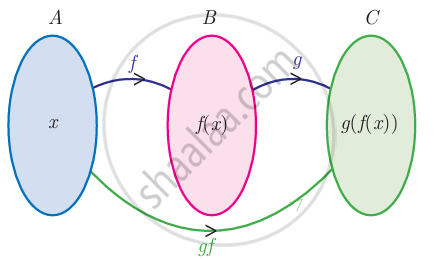
Let f: A → B and g: B → C be any two functions. Then, the composition of f and g, denoted by gof, is defined as a function gof: A → C given by
gof(x) = g[f(x)], ∀ x ∈ A
- Domain (gof) = Domain (f)
- g∘f(x) = g(f(x)) → first apply f, then g
Theorems and Laws [1]
Prove that the greatest integer function f : R → R, given by f(x) = [x], is neither one-one nor onto, where [x] denotes the greatest integer less than or equal to x.
f : R → R, given by f(x) = [x]
It is seen that f(1.2) = [1.2] = 1 and f(1.9) = [1.9] = 1.
∴ f(1.2) = f(1.9), but 1.2 ≠ 1.9.
∴ f is not one-one.
Now, consider 0.7 ∈ R.
It is known that f(x) = [x] is always an integer. Thus, there does not exist any element x ∈ R such that f(x) = 0.7.
∴ f is not onto.
Hence, the greatest integer function is neither one-one nor onto.
Key Points
| Type of Function | Condition | Key Idea |
|---|---|---|
| One-One (Injective) | f(x₁) = f(x₂) ⇒ x₁ = x₂ | Different inputs → different outputs |
| Onto (Surjective) | Range = Codomain | Every element of the codomain is mapped |
| Into Function | Range ⊂ Codomain | Some elements of the codomain are not mapped |
| Many-One Function | x₁ ≠ x₂ but f(x₁) = f(x₂) | Different inputs → same output |
| Bijective Function | One-one + Onto | Perfect mapping (1-1 and onto) |
| Function Type | Definition / Formula | Domain | Range |
|---|---|---|---|
| Inverse Function | f⁻¹ exists if f is bijective, f⁻¹(y) = x ⇔ f(x) = y |
Domain(f⁻¹) = Range(f) | Range(f⁻¹) = Domain(f) |
| Modulus (Absolute Value) | f(x) = |x| | R or (-∞, ∞) | [0, ∞) |
| Signum Function | sign(x) = { 1, if x > 0 0, if x = 0 −1, if x < 0 } |
R | {−1, 0, 1} |
| Greatest Integer (Step Function) | f(x) = [x] (greatest integer ≤ x) | R | I (integers) |
| Fractional Part Function | f(x) = {x} = x − [x] | R | [0, 1) |
| Even Function | f(−x) = f(x) | Depends | Depends |
| Odd Function | f(−x) = −f(x) | Depends | Depends |
| Periodic Function | f(x + T) = f(x), T = period | Depends | Depends |
-
In \[g \circ f\], first apply f, then apply g.
-
\[(g \circ f)(x) = g(f(x))\].
-
Composition is defined only when the output of the first function is acceptable as input to the second function.
-
In general, \[g \circ f \neq f \circ g\].
-
Composition is associative whenever defined.
-
Identity function leaves a function unchanged under composition.
| Operation | Result | Domain |
|---|---|---|
| Addition | (f + g)(x) = f(x) + g(x), ∀ x ∈ D₁ ∩ D₂ | D₁ ∩ D₂ |
| Subtraction | (f − g)(x) = f(x) − g(x), ∀ x ∈ D₁ ∩ D₂ | D₁ ∩ D₂ |
| Multiplication | (fg)(x) = f(x) · g(x), ∀ x ∈ D₁ ∩ D₂ | D₁ ∩ D₂ |
| Quotient | \[\frac{f}{g}(x)=\frac{f(x)}{g(x)}\], ∀ x ∈ D₁ ∩ D₂ (g(x) ≠ 0) | D₁ ∩ D₂ − {x : g(x) = 0} |
| Multiplication by a scalar | (cf)(x) = cf(x), ∀ x ∈ D₁ | D₁ |
