(English Medium)
Academic Year: 2024-2025
Date & Time: 17th March 2025, 11:00 am
Duration: 2h
Advertisements
- Answers to this Paper must be written on the paper provided separately.
- You will not be allowed to write during the first 15 minutes.
- This time is to be spent in reading the question paper.
- The time given at the head of this Paper is the time allowed for writing the answers.
- Section A is compulsory. Attempt any four questions from Section B.
- The intended marks for questions or parts of questions are given in brackets [ ].
A body is acted upon by two equal and opposite forces, that are NOT along the same straight line. The body will ______.
remain stationary
have only rotational motion
have only rectilinear motion
have both rectilinear and rotational motion
Chapter:
Which among the following is a vector quantity?
work
power
energy
moment of couple
Chapter:
What is the correct energy transformation during burning of a candle?
heat → kinetic + potential
heat → chemical + light
chemical → heat + light
mechanical → chemical + heat
Chapter:
When a ray of light passes from one optical medium to another, which of the following physical quantities does NOT change?
Amplitude of the wave
Frequency of the wave
Wavelength of the wave
Speed of the wave
Chapter:
Which one of the following combinations is the correct ascending order of electromagnetic waves in terms of wavelength?
gamma-rays, visible light, microwaves
microwaves, visible light, gamma-rays
gamma-rays, microwaves, visible light
microwaves, gamma-rays, visible light
Chapter:
For a lever, a graph is plotted with load on Y-axis and effort on X-axis. Which of the following represents the slope of the graph?
Mechanical advantage
Velocity ratio
1/Velocity ratio
1/Mechanical advantage
Chapter:
For a real image formed by a convex lens, the ratio of I : O = 2 : 5, then the object is ______.
(I is the height of the image and O is the height of the object)
between O and F
beyond 2F
at F
between F and 2F
Chapter:
A ray of light is incident normally on a face of an equilateral prism. The ray gets totally reflected at the second refracting surface. The total deviation produced in the path of the ray is ______.
30°
60°
90°
120°
Chapter:
In a closed circuit containing a bulb and a cell, the electromotive force (ε) and the terminal voltage (V) is related as.
(Given I is current and r is internal resistance.)
V = ε + Ir
V = ε − Ir
V = ε ÷ Ir
V = ε × Ir
Chapter:
A metal piece of mass 5 g has thermal capacity 2.5 JK−1. If the mass of the metal is tripled, then its specific heat capacity will be ______.
7.5 JK−1
2.5 JK−1
1.5 Jg−1K−1
0.5 Jg−1K−1
Chapter:
Assertion (A): As the level of water in a tall measuring cylinder kept under running tap rises, the pitch of sound gradually increases.
Reason (R): Frequency of sound is inversly proportional to the length of the water column.
Both (A) and (R) are true and (R) is correct explanation of (A).
Both (A) and (R) are true and (R) is not the correct explanation of (A).
(A) is true but (R) is false.
(A) is false but (R) is true.
Chapter:
In the given circuits Y and Z, the resistors, R1 and R2, are connected in:
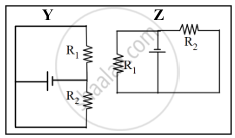
series in both the circuits
parallel in both the circuits
parallel in Y and series in Z
series in Y and parallel in Z
Chapter:
A radioactive element P emits one α-particle and transforms to a new element Q. What will be the position of the element Q in the periodic table?
One group to the left of P
One group to the right of P
Two groups to the right of P
Two groups to the left of P
Chapter:
Each of the substances given below is supplied with same amount of heat. Which one will attain the highest temperature?
| Substance | Lead | Aluminium | Copper | Iron |
| Specific heat capacity (cal/g°C) | 0.031 | 0.21 | 0.095 | 0.115 |
Aluminium
Copper
Iron
Lead
Chapter:
The following figure shows a small bar magnet falling freely through a copper ring. For the observer at A, the direction of the induced current will be:
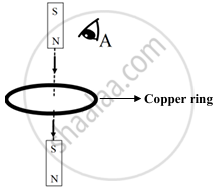
clockwise when magnet is above and below the ring.
anticlockwise when magnet is above and below the ring.
anticlockwise when magnet is above the ring and clockwise when the magnet is below the ring.
clockwise when magnet is above the ring and anticlockwise when the magnet is below the ring.
Chapter:
In uniform circular motion the centrifugal force acts ______.
towards the centre
away from the centre
along the tangential direction
Chapter:
Advertisements
Refractive index of a medium is independent of ______.
temperature
angle of incidence
wavelength of light
Chapter:
Heat absorbed during change of phase depends on ______ of the substance.
mass
change in temperature
specific heat capacity
Chapter:
Emf of a cell is ______ the terminal voltage when the cell is in open circuit.
greater than
less than
equal to
Chapter:
In a step-up transformer the turns ratio is ______.
more than 1
less than 1
equal to 1
Chapter:
The nuclear radiation with lowest ionizing power is ______.
α
β
γ
Chapter:
A non-uniform kite is hanging freely from the branch of a tree as shown. Study the figure and answer the following:
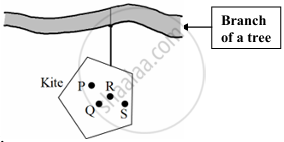
- Fill in the blank.
______ is the most probable position of its centre of gravity.- P
- Q
- R
- S
- Support your answer to (a) with a reason.
Chapter:
The displacement-time graph of a sound wave produced by a vibrating wire is shown below.
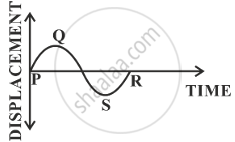
- How will you adjust the tension in the wire, to reduce the length of PR?
- Which characteristic of sound is affected by the reduction in the length of PR?
Chapter:
A ray of light enters a rectangular glass slab submerged in water at an angle of incidence 55°. Does this ray undergo total internal reflection when it moves from water to glass? Justify your answer. (The critical angle for glass-water interface is 54°.)
Chapter:
According to the NEW colour convention which colour of wire is connected to the metal body of the appliance?
Chapter:
According to the NEW colour convention which colour of wire is connected to the switch of the appliance?
Chapter:
Which of the two, alternating current or direct current, produces a varying magnetic field when it flows through a conductor?
Chapter:
State the frequency of the alternating current supply in India.
Chapter:
Calcuate the amount of heat absorbed by 200 g of paraffin wax to melt completely at its melting point.
[Specific latent heat of fusion of paraffin wax = 146 Jg−1]
Chapter:
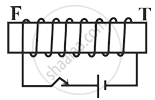
Copper wire is wound around a steel bar FT. Current is allowed to pass through the coil for some time and then the bar is removed.
- Draw only the magnetised bar FT and mark its poles.
- Trace two magnetic lines of force around FT clearly indicating the direction.
Chapter:
A current flows through a metallic conductor for a long period of time. State the change you would expect in its resistance.
Chapter:
A current flows through a metallic conductor for a long period of time. Statethe change you would expect in its resistivity.
Chapter:
Curium is a radioactive element with the symbol \[\ce{^247_96{Cm}}\] named in honour of Madam Curie. The graph of number of protons vs number of neutrons for some elements are shown below:
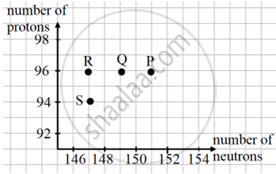
- Which point on the graph indicates the element Cm?
- Which point on the graph indicates daughter nucleus after Cm undergoes radioactive decay of 1 α followed by 2 β?
- State the mass number of the daughter nucleus.
Chapter:
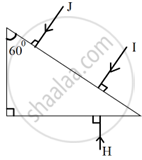
- Out of the three rays (I, J, H) shown in the diagram, which ray will suffer Total Internal Reflection while inside the prism? (Critical angle of the prism is 42°.)
- Copy the diagram to complete the path of the ray which you have named in (a) till it comes out of the prism.
Chapter:
Advertisements
A rectangular glass block of refractive index 1.5 has an air bubble trapped inside it as shown in the diagram. When seen from the surface AB, it appears to be 4 cm deep.
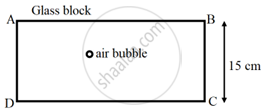
- Calculate the actual depth of the air bubble from the surface AB.
- For which colour of light, blue or yellow, the apparent depth will be greater?
- Turning the glass block upside down, DOES NOT change the apparent depth of the air bubble. State True or False.
Chapter:
- An object is placed at 2F position of a convex lens. Draw a ray diagram showing the formation of the image.
- How will the size of the image change if we, ONLY replace the lens in the above arrangement with another lens of a greater focal length?
Chapter:
An object is placed in front of a concave lens at a distance of 45 cm from it. If its image is formed at a distance of 30 cm from the lens, calculate the focal length of the lens.
Chapter:
Two rays PQ and RS are incident on a rectangular glass block as shown in the diagram. Observe the diagram and answer the questions that follow.
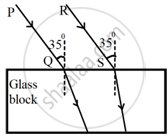
Which of these two rays will:
- have greater lateral displacement on emerging out of the block?
- travel with greater speed in the block?
- scatter more in the atmosphere?
Chapter:
Name the radiation for which a quartz prism is used to study the spectrum.
Chapter:
Name the radiations which are used in remote sensing devices.
Chapter:
Name the radiations which are used in traffic signals in India.
Chapter:
State any one property which is common to all electromagnetic waves.
Chapter:
Akash takes a uniform meter scale and suspends a weight of 2 N at one end ‘X’ and a weight of 5 N on the other end ‘Y’. He then balances the ruler horizontally on a knife edge placed at 70 cm from X. Draw a diagram of the arrangement and calculate the weight of the ruler.
Chapter:
Three levers X, Y, Z of equal lengths are shown in the diagram.
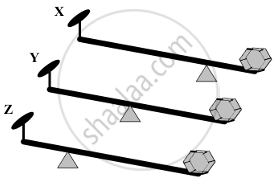
- Which class of lever do these belong to?
- Among these (X, Y or Z) which one will give the maximum mechanical advantage? Justify your answer.
Chapter:
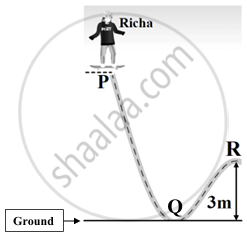
Richa weighing 40 kgf leaves point P on her skateboard and reaches point Q on the ground with velocity 10 ms−1. Calculate:
- the kinetic energy of Richa at point Q.
- the vertical height of point P above the ground. (Use g as 10 m/s2 and neglect friction)
- the kinetic energy of Richa at point R. (While moving from Q to R, she loses 500 J of energy against friction.)
Chapter:
Draw a block and tackle system of pulleys with velocity ratio equal to 3.
Chapter:
A submarine in the sea, sends ultrasonic ping and a stopwatch is started simultaneously. The stopwatch stops on receiving the reflected wave from an obstacle and reads 1 minute 40 seconds. Calculate the distance of the obstacle from the submarine. (Speed of sound in water 1500 ms−1.)
Chapter:
The diagrams given below show two sound boxes A and B with wires of same length (l) and tension (10 kgf) but different cross-sectional areas. Simultaneously, vibrating tuning forks of frequency 300 Hz are placed on the boxes A and B. The paper rider falls off in case of B but not in case of A.
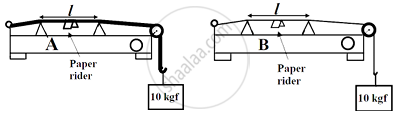
- Name and explain the phenomenon responsible for the falling off of the paper rider in B.
- The wire A resonates with a tuning fork of frequency ‘f’. Is ‘f’ greater than, less than or equal to 300 Hz? Justify your answer.
Chapter:
The diagram shows wiring in a meter room of a building.
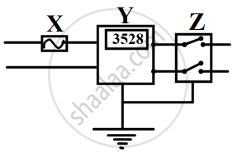
- What is the current rating of device X?
- What is the difference between the switch Z shown in the diagram and the switches you use to operate different appliances at home?
- What is the unit of the physical quantity displayed in Y?
Chapter:
Study the diagram given below and answer the questions that follow:
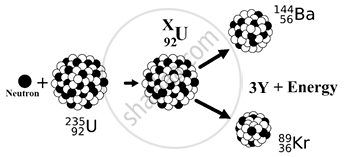
- Name the process depicted in the diagram.
- What is the value of X?
- Identify Y, the missing product of the reaction.
Chapter:
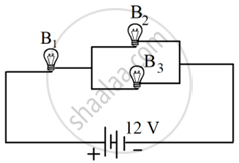
Three identical bulbs B1, B2, and B3 each of power rating 18 W, 12 V are connected to a battery of 12 V.
- Calculate:
- the resistance of each bulb
- the current drawn from the cell
- If the bulb B3 is removed from the circuit, then will the brightness of the bulb B1 increase, decrease or remain the same?
Chapter:
30 g of ice at 0°C is used to bring down the temperature of a certain mass of water at 70°C to 20°C. Find the mass of water. [Specific heat capacity of water = 4.2 Jg°C−1 and specific latent heat of ice = 336 Jg−1.]
Chapter:
- A certain amount of heat will warm 1 g of material X by 10°C and 1 g of material Y by 40°C. Which material has higher specific heat capacity?
- Which material, X or Y, would you select to make a calorimeter?
- The specific heat capacity of a substance remains the same when it changes its state from solid to liquid. State True or False.
Chapter:
A copper rod PQ carrying current is kept in a magnetic field as shown in the diagram.
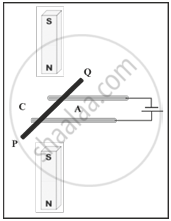
- The copper rod PQ will move towards C. State True or False.
- Name the law used to determine the direction of motion of PQ.
- What will be the effect on the force experienced, if the rod PQ is replacedby another copper rod of same length but of greater cross-sectional area?
- Justify your answer in (c).
Chapter:
Other Solutions
Submit Question Paper
Help us maintain new question papers on Shaalaa.com, so we can continue to help studentsonly jpg, png and pdf files
CISCE previous year question papers ICSE Class 10 Physics with solutions 2024 - 2025
Previous year Question paper for CISCE ICSE Class 10 -2025 is solved by experts. Solved question papers gives you the chance to check yourself after your mock test.
By referring the question paper Solutions for Physics, you can scale your preparation level and work on your weak areas. It will also help the candidates in developing the time-management skills. Practice makes perfect, and there is no better way to practice than to attempt previous year question paper solutions of CISCE ICSE Class 10 .
How CISCE ICSE Class 10 Question Paper solutions Help Students ?
• Question paper solutions for Physics will helps students to prepare for exam.
• Question paper with answer will boost students confidence in exam time and also give you an idea About the important questions and topics to be prepared for the board exam.
• For finding solution of question papers no need to refer so multiple sources like textbook or guides.
