ISC (Science)
Academic Year: 2025-2026
Date: मार्च 2026
Advertisements
Instructions to Candidates:
- You are allowed an additional fifteen minutes for only reading the question paper.
- You must NOT start writing during reading time.
- This question paper has 11 printed pages. It has eighteen questions in all.
- Answer all questions.
- There are four sections in the paper: A, B, C and D. Internal choices have been provided in one question each in Sections B, C and D.
- Section A consists of one question each carrying one/two mark(s).
- Section B consists of seven questions each carrying two marks.
- Section C consists of seven questions each carrying three marks.
- Section D consists of three questions each carrying five marks.
- Diagrams should be drawn wherever necessary using a pencil only.
- The intended marks for questions are given in brackets [ ].
Anita is suffering from dry and scaly lesions on various parts of the body. What is the biological name of the causative fungus?
Chapter:
If the number of chromosomes in an endosperm is 12, then what will be the number of chromosomes in a megaspore mother cell?
Chapter:
Renu was conducting an experiment. She started with a single DNA strand and ran six cycles of PCR to produce a number of molecules of DNA.
Chapter:
At what stage of embryonic development can the zygote be introduced in the Fallopian tube in ZIFT?
Chapter:
When a cross is made between tall plants with yellow seeds (TtYy) and tall plants with green seeds (Ttyy), what proportion of the phenotype in the offspring could be expected to be tall plants with green seeds?
Chapter:
A research scholar isolated a new restriction enzyme from Thermus aquaticus strain YT3. It was the fourth restriction enzyme discovered from this strain. Propose a scientifically accurate name for this enzyme using the standard nomenclature rules.
Chapter:
Construct a pyramid of numbers for an ecosystem in which a single large aquatic plant supports a population of small herbivorous fish, which are consumed by a larger population of predatory fish such as kingfish.
Chapter:
Observe the relation between the first two words and then complete the analogy.
Chikungunya : Aedes : : Malaria : ______.
Chapter:
A young boy named Arjun has sickle-shaped red blood cells. He experiences frequent fatigue and shows signs of damage to his kidney. Genetic analysis reveals a single point mutation in the gene coding for β-globin.
Which one of the following genetic phenomena is most likely responsible for the multiple symptoms observed in Arjun?
Polygenic inheritance
Codominance
Pleiotropy
Incomplete dominance
Chapter:
Kiwi is a dioecious species. Which of the following methods can be definitely ruled out as a possible mode of pollination in that case?
(P) Cleistogamous autogamy
(Q) Chasmogamous autogamy
(R) Geitonogamy
(S) Xenogamy
Only (P) and (R)
Only (P) and (Q)
Only (Q) and (S)
Only (P), (Q) and (R)
Chapter:
Assertion: An amino acid in a polypeptide chain is not always altered even due to a change in the third nitrogenous base of a codon.
Reason: The amino acid does not change due to degeneracy of the genetic code.
Both Assertion and Reason are true and Reason is the correct explanation for Assertion.
Both Assertion and Reason are true but Reason is not the correct explanation for Assertion.
Assertion is true and Reason is false.
Both Assertion and Reason are false.
Chapter:
Assertion: ‘Bt’ toxin gene has been cloned from the bacteria E. coli and expressed in plants to provide resistance from insects without the need of insecticides.
Reason: ‘Bt’ toxin is produced in a crystalline state by the above-mentioned bacterium.
Both Assertion and Reason are true and Reason is the correct explanation for Assertion.
Both Assertion and Reason are true but Reason is not the correct explanation for Assertion.
Assertion is true and Reason is false.
Both Assertion and Reason are false.
Chapter:
Why are tendrils of vine (Vitis) and pea (Pisum) considered to be analogous organs?
Chapter:
Ravi wanted to grow rice in his field. He was very concerned about environmental degradation, so he did not want to use chemical fertilisers. Suggest a suitable biological method to Ravi.
Chapter:
Rule of Equivalence states that in DNA, adenine equals thymine and guanine equals cytosine. This is due to base pairing in the double helix. thus, purines equal pyrimidines. Which scientist offered this concept?
Chapter:
A bilobed, dithecous anther has 100 microspore mother cells per microsporangium. How many male gametophytes can this anther produce?
Chapter:
Advertisements
The diagram given below represents a specific stage of the gestation period. Identify the structure labelled “B”.

Chapter:
Give a reason for the following statement:
Sameer drew a diagram of human sperm and showed it to his teacher. The teacher rejected the diagram.

Chapter:
Give a reason for the following statement:
Even under similar environmental conditions, decomposition of the exoskeleton of millipedes occurs more slowly than that of leaves.
Chapter:
Construct an ideal pyramid of energy when 1000,000 joules of sunlight is available. Label all its trophic levels.
Chapter:
The graph given below is based on the data collected from a survey conducted on the species richness of a group of mammals in three different climatic regions of the world: Brazil, France and Norway. Brazil has nearly 540 species of mammals, France has nearly 303 species of mammals and Norway has 65 species of mammals.
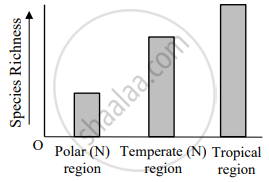
- Based on the species richness, identify the location of these countries in the respective climatic regions shown in the graph.
- In which climatic region will you place India?
Chapter:
Given below is the relationship between the HIV levels in the blood and helper T-cell count in a person detected with AIDS. Study the relationship and answer the questions that follow.
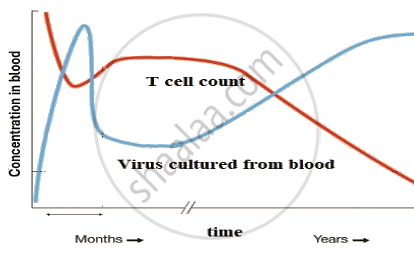
- Describe the trend observed between viral load and immune response following initial infection.
- Is the virus permanently eliminated from the body? Justify your answer.
Chapter:
As a volunteer for an awareness programme in rural areas, you have been asked to design a poster on sexual health, highlighting birth control options available to males.
What two contraceptive methods for males will you highlight in the poster that have negligible chances of failure? Mention the working principle for each method.
Chapter:
Study the diagram given below and answer the following questions:
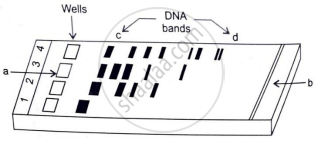
- Identify the anode end in the diagram.
- How are these DNA fragments visualised?
Chapter:
Microbes, especially yeasts, have been used from time immemorial for the production of beverages like wine, beer, whisky brandy, or rum. Depending on the type of raw materials used for fermentation and the type of processing (with or without distillation), different types of alcoholic drinks are obtained.
- Mention the scientific name of the organism used to prepare fermented beverages.
- Name any one beverage obtained without distillation of fermented broth.
Chapter:
Ryan had developed a GM organism. Which government organisation will he approach to obtain the clearance for its mass production?
Chapter:
Which bioactive product is used for the treatment of emphysema?
Chapter:
In a barn, there were 30 rats. 5 more rats entered the barn and 6 of the rats were eaten by the cats in one week. If 8 rats were born during the same period, and during the same time, 7 rats left the barn, find the resultant rat population in the barn at the end of one week.
Chapter:
Study the pedigree chart given below, which shows the pattern of blood group inheritance in a family.
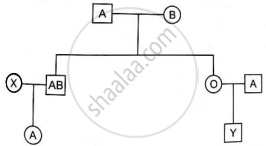
- State the genotypes of the following:
- Parents
- The individual ‘X’ in the second generation.
- State the possible blood group(s) of the individual ‘Y’ in the 3rd generation.
Chapter:
Advertisements
Darwin’s finches are the best example of adaptive radiation. Justify.
Chapter:
The recessive allele ‘b’ occurs with a frequency of 0.8 in a population of moths that is in Hardy Weinberg Equilibrium. What is the frequency of homozygous dominant individuals?
Chapter:
List any two differences between homo habilis and homo erectus.
Chapter:
Medical interns Arun and Sam are undergoing training in a hospital. They were assigned three patient cases to review. While they successfully diagnosed the diseases in cases B and C, they could not recall the names of the causative agents. Additionally, they were unable to diagnose the disease of patient A.
The table given below shows their diagnosis.
| S. No. | Patient | Symptoms | Disease | Causative agent |
| (a) | A | Enlarged lymph nodes, headache | ----------- | Yersinia pestis |
| (b) | B | Cough with greenish or yellow mucus, difficulty in breathing | Pneumonia | ----------- |
| (c) | C | Lower limbs excessively swollen | Elephantiasis | ----------- |
Identify the disease affecting patient ‘A’. Mention the biological name of the causative agents responsible for the diseases in patients ‘B’ and ‘C’.
Chapter:
A twenty-year old boy, Reshu has become addicted to alcohol.
Mention any two possible reasons for his alcohol addiction.
Chapter:
A twenty-year old boy, Reshu has become addicted to alcohol.
Suggest any one measure by which addiction can be prevented.
Chapter:
A scientist is attempting to create a recombinant DNA molecule by combining a plasmid vector and a foreign DNA. A plasmid DNA and a linear DNA of the same size have a single site for the restriction enzyme EcoRI. When cut by the same RE and separated by gel electrophoresis, the plasmid shows one DNA band, and the linear DNA shows two bands.
- What causes the difference between the number of DNA bands generated from the plasmid and from the linear DNA?
- What is the advantage of using agarose in gel electrophoresis?
- How does EcoRI differ from an exonuclease?
Chapter:
Study the diagram given below that shows the modes of pollination and answer the questions that follow.
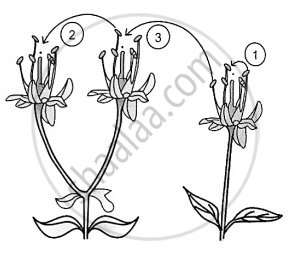
- The given diagram shows three methods of pollination in plants. What are the technical terms used for pollen transfer methods labelled ‘2’ and ‘3’?
- How does Salvia achieve pollination successfully?
Chapter:
A population pyramid is a graphic representation of the distribution of a population by age groups. Diagrammatically represent the three kinds of age pyramids.
Chapter:
During a field excursion, a group of class XII students visited Kaziranga National Park and observed efforts to protect the Indian rhinoceros in its natural habitat. They also toured a botanical garden and a gene bank, where they saw endangered plant species and preserved seeds.
Based on this context, answer the following questions:
- Name and define the two types of conservation methods mentioned above.
- What is cryopreservation?
- Is captive breeding an ex-situ or an in-situ strategy? Justify your answer with a reason.
Chapter:
Write a brief note on Griffith’s experiment. What was the conclusion drawn from this experiment?
Chapter:
Name the parts ‘A’ and ‘B’ of the transcription unit shown below.
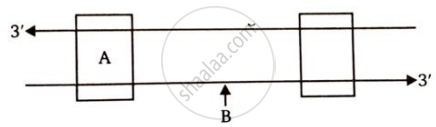
Chapter:
Study the diagram given below and answer the questions that follow.
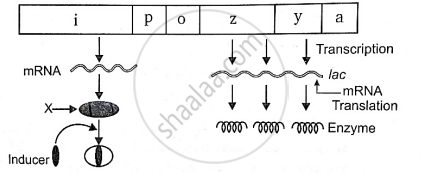
- Name the molecule ‘X’ synthesised by the ‘I’ gene. How does this molecule get inactivated?
- Name the enzymes coded respectively by genes z, y, and a.
- Which enzyme binds to the operator to initiate transcription?
Chapter:
The following graph represents the relative concentrations of the four hormones present in the blood plasma of a woman during her menstrual cycle. Identify the hormones A, B, C and D.
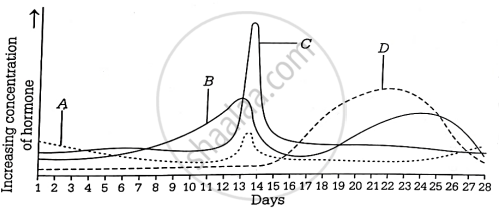
Chapter:
During a fertility consultation, a woman mentions her menstrual cycle lasts for 33 daysregularly. To help her conceive, the doctor advised her to track ovulation. On which day of the menstrual cycle is she most likely to ovulate?
Chapter:
Submit Question Paper
Help us maintain new question papers on Shaalaa.com, so we can continue to help studentsonly jpg, png and pdf files
CISCE previous year question papers ISC Class 12 Biology (Theory) with solutions 2025 - 2026
Previous year Question paper for CISCE ISC Class 12 -2026 is solved by experts. Solved question papers gives you the chance to check yourself after your mock test.
By referring the question paper Solutions for Biology (Theory), you can scale your preparation level and work on your weak areas. It will also help the candidates in developing the time-management skills. Practice makes perfect, and there is no better way to practice than to attempt previous year question paper solutions of CISCE ISC Class 12.
How CISCE ISC Class 12 Question Paper solutions Help Students ?
• Question paper solutions for Biology (Theory) will helps students to prepare for exam.
• Question paper with answer will boost students confidence in exam time and also give you an idea About the important questions and topics to be prepared for the board exam.
• For finding solution of question papers no need to refer so multiple sources like textbook or guides.
