English Medium
Academic Year: 2025-2026
Date: मार्च 2026
Advertisements
General Instructions:
- There are 38 questions in the Question paper. All questions are compulsory.
- The question paper has Four Section - A - History, B - Geography, C- Political Science, and D - Economics.
- Each Section is of 20 Marks and has MCQs, VSA, SA, LAs and CBQ.
- Very Short Answer Type Questions (VSA), carry 2 marks each. Answers to each question should not exceed 40 words.
- Short Answer Type Questions (SA), carry 3 marks each. Answers to each question should not exceed 60 words.
- Long answer type questions (LA), carry 5 marks each. Answers to each question should not exceed 120 words.
- There are case based questions (CBQ) with three sub questions and are of 4 marks each. Answers to each question should not exceed 100 words.
- The map-based questions carry 5 marks with two parts - Q9. In Section A - History (2 marks) and Q19. In Section B - Geography (3 marks)
- There is no overall choice in the question paper. However, an internal choice has been provided in few questions. Only one of the choices in such questions must be attempted.
- In addition to this, NOTE that a separate question has been provided for Visually Impaired candidates in lieu of questions having visual inputs, map etc. Such questions are to be attempted by Visually Impaired candidates only.
Match the following and choose the correct option:
| Column I | Column II | ||
| A | Frederic Sorrieu | 1 | Torch of enlightenments |
| B | Statue of Liberty | 2 | Shattered remains of absolutist Institutions |
| C | Foreground in front of the Statue of Liberty | 3 | Democratic and Social Republics |
| D | Sorrieu’s utopian vision | 4 | French Artist |
A - 4, B - 1, C - 2, D - 3
A - 2, B - 4, C - 4, D - 1
A - 1, B - 2, C - 4, D - 3
A - 4, B - 1, C - 3, D - 4
Chapter:
Identify and name the leader shown in the picture given below:
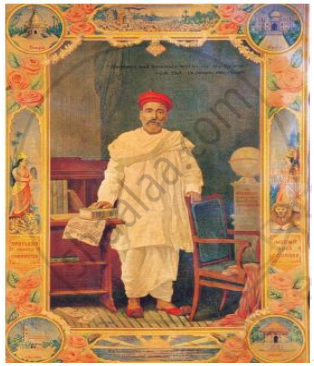
Lala Lajpat Rai
Bal Gangadhar Tilak
Gopal Krishan Gokhale
Raja Rammohan Roy
Chapter:
Thousands of people fled Europe for America in the 19th century due to ______.
Widespread poverty and deadly diseases.
Frequent famines and poor living conditions.
Continuous wars and political instability.
Harsh climate and repeated natural disasters.
Chapter:
Louise-Sebastien Mercier proclaimed “Tremble, therefore, tyrants of the world! Tremble before the virtual writer!” Who are referred to as the tyrants in this context?
Educated classes who wanted to change the society
Absolutist institutions like monarchy and church
Authors of the new books
Printing press
Chapter:
“The Silk route was a good example of vibrant premodern trade and cultural links between distant parts of the world.” Explain the statement with any two examples.
Chapter:
‘Sometimes the new crops could make the difference between life and death.’ Explain the statement with any two examples.
Chapter:
‘A variety of cultural processes played an important role in developing a sense of nationalism in India.’ Support the statement with suitable examples.
Chapter:
Salt March ‘became an effective tool of resistance against colonialism.’ Analyse the statement with suitable reasons.
Chapter:
‘In Britain the formation of the nation-state was not the result of a sudden upheaval or revolution but was the result of a long-drawn-out process.’ Analyse this statement with suitable reasons.
Chapter:
The Treaty of Vienna was drawn up in 1815 with the object of undoing most of the changes that had come about in Europe during the Napoleonic Wars.’ Highlight the significant provisions of this treaty.
Chapter:
Read the given text and answer the following questions:
|
Why Newspapers? Krishnaji Trimbuck Ranade inhabitant of Poona intends to publish a Newspaper in the Marathi Language with a view of affording useful information on every topic of local interest. It will be open for free discussion on subjects of general utility, scientific investigation and the speculations connected with the antiquities, statistics, curiosities, history and geography of the country and of the Deccan especially... the patronage and support of all interested in the diffusion of knowledge and Welfare of the People is earnestly solicited. Bombay Telegraph and Courier, 6 January 1849 “The task of the native newspapers and political associations is identical to the role of the Opposition in the House of Commons in Parliament in England. That is to critically examine government policy to suggest improvements by removing those parts that will not be to the benefit of the people and also by ensuring speedy implementation. These associations ought to carefully study the particular issues, gather diverse relevant information on the nation as well as on what are the possible and desirable improvements, and this will surely earn it considerable influence”. Native Opinion, 3 April 1870 |
- Explain the main reason for publishing newspapers by Krishna ji. (1)
- How was the task of native newspaper and political association seen identical to the role of the opposition? (1)
- Analyze the reasons for the popularity of newspapers during the 19th century. (2)
Chapter:
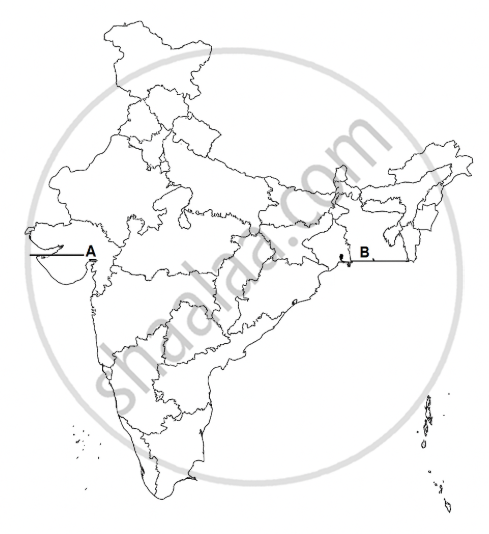
Two places A and B have been marked on the given outline map of India. Identify them and write their correct names on the lines marked on the map.
- The place where the Civil Disobedience Movement was launched.
- The city where Indian National Congress session was held in September 1920.
Chapter:
What is essential for resource development to contribute to overall development?
The availability of resources alone is enough.
The presence of foreign invaders and their governance.
Technological development and institutional changes.
Only human resources can contribute to development.
Chapter:
Identify the appropriate option to fill in the empty boxes:
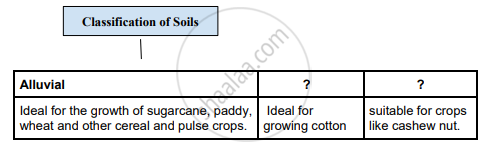
Black soil, Red and Yellow soils
Laterite soil, Black soil
Red and Yellow soils and Black soil
Black soil and Laterite soil
Chapter:
A total of 628 tigers died in India during the past five years due to natural causes and other reasons, including poaching, according to government data. Meanwhile, 349 people were killed in tiger attacks during this period, with one state alone recording 200 deaths.
Which of the following is the most significant indirect consequence of poaching on the tiger population?
Reduction in the prey species, dwindling tigers food supply.
Increase in human-wildlife conflicts in protected areas.
Rise in the tiger population.
Decrease in tourism revenue in national parks.
Chapter:
Advertisements
Based on the classification of forests, which of the following statements would most likely apply to places like Jammu and Kashmir, Andhra Pradesh, and Kerala, etc.?
These places mostly have forests managed as reserved or protected forests for conservation.
They rely on unclassed forests and local community management for forest conservation.
They have forest resources and primarily focus on industrial development.
There are no classified forests and forest management is entirely left to private ownership.
Chapter:
Which one of the following states has made rooftop water harvesting compulsory in India?
Haryana
Punjab
Assam
Tamil Nadu
Chapter:
Which of the following statements best evaluates the overall goal of the Pradhan Mantri Krishi Sinchaee Yojana?
Addressing the negative ecological effects of large dams by reducing water usage.
To provide better irrigation systems and sustainable water conservation practices for farmers.
Shifting farmers from traditional crops to more commercial, water-intensive crops.
Preserve the natural river flow and prevent the fragmentation of aquatic ecosystems.
Chapter:
Rice is grown as a commercial crop in Haryana and Punjab, but as a subsistence crop in Odisha. Using your understanding of geographical factors and economic practices, explain why rice cultivation differs in these regions.
Chapter:
Person P is willing to establish a mineral based industry. He has been advised to set up a bauxite industry in Odisha as a suitable way to make a profitable venture. Analyse the possible reasons behind the advice given to her.
Chapter:
‘Coal is the most important and abundant fossil fuel in India.’ Justify the statement by evaluating the significant role it plays in the growth of the Indian economy in its different forms.
Chapter:
Read the given text and answer the following questions:
|
Global pollution is rising due to rapid economic growth, population increases, and insufficient environmental management. This poses serious health risks for people and ecosystems, particularly in low- and middle-income countries. Contributing to these challenges, the global economy relies on deeply intertwined supply chains, sustained by more than 100 billion tons of raw materials entering the system each year. Intensive material consumption depletes natural resources and causes negative environmental impacts at every stage of the product lifecycle. Global waste is expected to increase to 3.4 billion tons by 2050. Pollution of all types hinders development outcomes. Exposure to air pollution, water pollution, and hazardous chemicals and wastes like mercury, lead and persistent organic pollutants (POPs) causes debilitating and fatal illnesses, creates harmful living conditions, and destroys ecosystems. Pollution undermines sustainable economic growth, exacerbates poverty and inequality in both urban and rural areas, and significantly contributes to climate change. Poor people, who cannot afford to protect themselves from the negative impacts of pollution, end up suffering the most. Pollution is the largest environmental cause of disease and premature death. It is estimated to be several times more deaths than from AIDS, tuberculosis, and malaria combined. Global health crises, such as the COVID-19 pandemic, are reminders of the strong linkages between environment and health and of the need to address such linkages systematically. |
- Why do you think global waste is expected to increase by 2050?
- How do manufacturing industries cause pollution of different types? Explain with examples.
- Is it correct to consider pollution as a possible cause for the worsening of the current global trends of poverty and inequality? Justify.
Chapter:
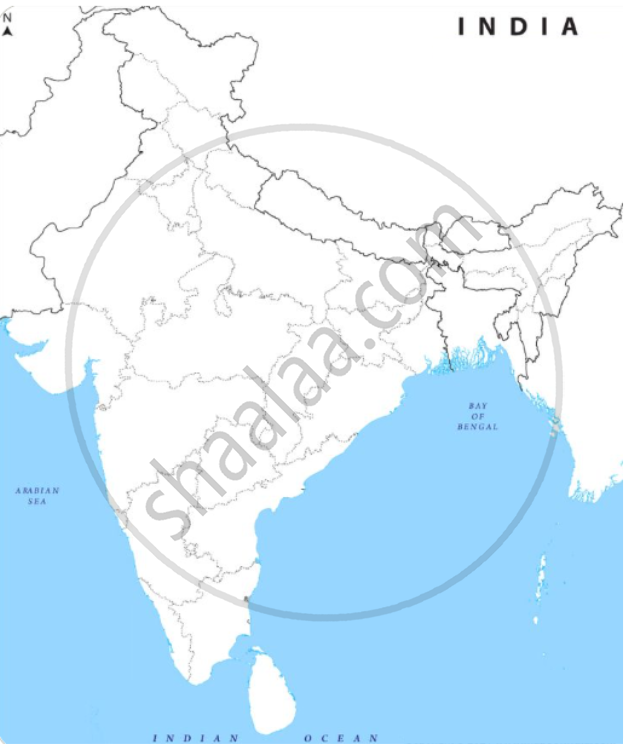
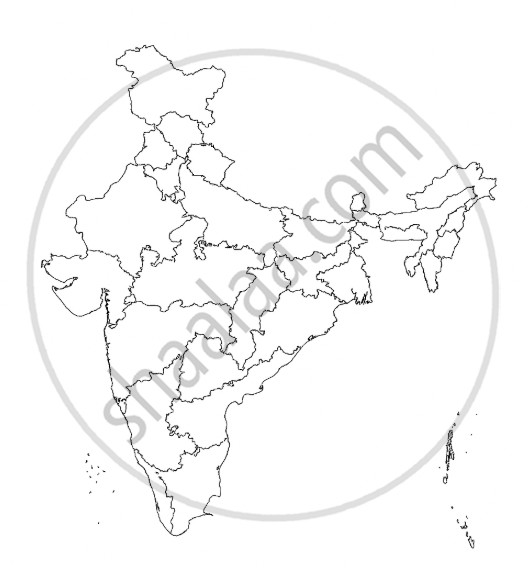
On the outline map of India, locate and label the following with a suitable symbol:
The dam in the Sutlej-Beas river basin, which is being used both for hydel power production and irrigation.
Chapter:
On the outline map of India, locate and label the following with a suitable symbol:
The dam in the Mahanadi basin that integrates conservation of water with flood control.
Chapter:
On the outline map of India, locate and label the following with suitable symbols:
- A major sea port in West Bengal.
- An international airport in Tamil Nadu.
- An international airport in Punjab.
Chapter:
Which of the following statement(s) are true with respect to the ethnic composition of Belgium?
- 59 percent of the total population of Belgium lives in the Wallonia region and speaks French.
- 40 percent live in the Flemish region and speak Dutch.
- One percent of the Belgians speak German.
- In the capital city Brussels, 80 percent people speak French while 20 percent are Dutch speaking.
I and II
III and IV
I, II and III
I and IV
Chapter:
The cartoon below depicts Germany’s government that was formed after the 2005 elections. It included the two major parties of the country, namely the Christian Democratic Union and the Social Democratic Party. The two parties are historically competing with each other. Which of the following options best explains the cartoon?
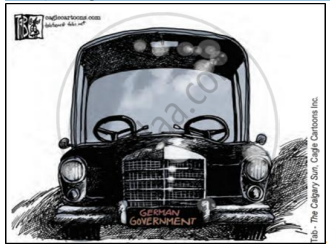
Coalition Government
Two Party System
Democratic government
Bi-party system
Chapter:
Suppose the Government of India plans to issue new currency notes of different denominations in order to curb the influence of black money. The Government of one state is opposed to this policy of the Central Government. Can the state government stop the union government from implementing this policy?
Yes, because currency is the subject of the state list.
No, because currency is a subject of the union list.
Yes, because the approval of both the governments is necessary to implement this change.
No, because any such change must be approved by the local government also.
Chapter:
Assertion (A): Exclusive attention to caste can produce negative results in democracy.
Reason (R): It can divert attention from other important issues thus leading to tensions, conflicts and even violence.
Both A and R are true, and R is the correct explanation of A.
Both A and R are true, but R is not the correct explanation of A.
A is true but R is false.
A is false but R is true.
Chapter:
Describe any five features of federalism.
Chapter: [2] Federalism [3.2] Federalism
Advertisements
‘Women in India face discrimination, disadvantages and oppression in many ways.’ Highlight any two aspects of life where you witness this inequality.
Chapter:
‘Democracy leads to peaceful and harmonious life among citizens in every sphere.’ Support this statement with suitable arguments.
Chapter:
‘Political parties play a significant role in the effective working of a democracy.’ Explain.
Chapter:
Analyse how the issue of leadership succession poses a challenge to political parties in India.
Chapter:
Read the given text and answer the following questions:
| Sri Lanka emerged as an independent country in 1948. The leaders of the Sinhala community sought to secure dominance over government by virtue of their majority. As a result, the democratically elected government adopted a series of MAJORITARIAN measures to establish Sinhala supremacy. Over the years, it created feelings of alienation among the Sri Lankan Tamils. They felt that none of the major political parties led by the Buddhist Sinhala leaders was sensitive to their language and culture. As a result, the relations between the Sinhala and Tamil communities strained over time. On the other hand, the Belgian leaders took a different path. They recognised the existence of regional differences and cultural diversities. Between 1970 and 1993, they amended their constitution four times to work out an arrangement that would enable everyone to live together within the same country. |
- State any two demands of Tamils in Sri Lanka. (1)
- State the results of the Majoritarian Government in Sri Lanka. (1)
- Explain any two provisions of the Belgian model of power sharing. (2)
Chapter:
Underemployment is caused when ______.
More workers are employed than actually required.
Fewer workers are employed than actually required.
Workers are paid more than their actual output.
Jobs are given only to highly educated workers.
Chapter:
What can be inferred about the limitations of using per capita income (average income) to compare well-being across countries? Choose the correct option as the answer.
It shows how equally or unequally income is distributed among the people in a country.
The only measure needed to understand a country’s development is per capita income.
It gives a basic idea of economic well-being but hides the income inequality.
It only reflects the industrial growth of a country and does not consider other important factors.
Chapter:
Which of the following examples best demonstrates how the tertiary sector supports both the primary and secondary sectors?
Farmers grow vegetables and sell them directly to consumers, with no transportation or storage involved.
A factory makes shoes and uses raw materials like leather to create the product, relying on transport and retail stores to distribute the shoes.
A bakery bakes bread and uses delivery services to send the bread to local shops for sale, without any direct involvement of raw materials.
A company produces furniture from wood, but does not require any transport or retail services to sell the product.
Chapter:
Which one of the following issues currency notes in India?
Finance Ministry
Reserve Bank of India
State Bank of India
Central Bank of India
Chapter:
Person Z tries to explain how the requirement of a double coincidence of wants in a barter system limits trade and exchange. Which of the following justification do you think will be used by him/her?
It makes trade more complicated, as each person must have what the other person wants, limiting the pool of potential trade partners.
The barter system allows trade to be conducted more efficiently since both parties already know what they need from the transaction.
It increases the number of exchanges because each person can trade for exactly what they want.
The system creates value for goods by ensuring that both parties have a direct need for each other’s goods.
Chapter:
Recognize and choose the option that correctly matches the effects and consequent outcomes of globalization.
| Column A (Effects of globalisation) |
Column B (Outcomes) |
| 1. Increased foreign investment | i. Expansion of global markets and access to technology. |
| 2. Cultural exchange and awareness | ii. Loss of traditional jobs due to automation and cheaper labor elsewhere. |
| 3. Technological exchange and awareness | iii. Spread of cultural practices, ideas, and values across borders |
| 4. Growth of multinational corporations |
iv. Large companies becoming dominant players in global markets. |
Choose the correct option:
1 - iii, 2 - ii, 3 - i, 4 - iv
1 - iv, 2 - ii, 3 - i, 4 - iii
1 - ii, 2 - iv, 3 - iii, 4 - i
1 - i, 2 - iii, 3 - ii, 4 - iv
Chapter:
Evaluate the utility of public services in contributing to the overall well-being of individuals and society.
Chapter:
‘Expanding access to loans in the formal sector is important, yet it is equally critical that these loans are accessible to all people for national development.’ Justify the statement.
Chapter:
Highlight the significant three factors that have contributed to the growth of globalisation.
Chapter:
A research student spoke with two people, M and N to learn about their work-related differences. On the basis of the interview conducted with both of them, the student concludes that while person M was working in an organized sector, person N was an employee of a workplace that was functioning in an unorganised way. Analyse the key differences between the two sectors that must have enabled the research student to come to this conclusion.
Chapter:
Privatisation can have both positive and negative effects on the economy. Support the statement with argument.
Chapter:
Other Solutions
Submit Question Paper
Help us maintain new question papers on Shaalaa.com, so we can continue to help studentsonly jpg, png and pdf files
CBSE previous year question papers Class 10 Social Science with solutions 2025 - 2026
Previous year Question paper for CBSE Class 10 Social Science-2026 is solved by experts. Solved question papers gives you the chance to check yourself after your mock test.
By referring the question paper Solutions for Social Science, you can scale your preparation level and work on your weak areas. It will also help the candidates in developing the time-management skills. Practice makes perfect, and there is no better way to practice than to attempt previous year question paper solutions of CBSE Class 10.
How CBSE Class 10 Question Paper solutions Help Students ?
• Question paper solutions for Social Science will helps students to prepare for exam.
• Question paper with answer will boost students confidence in exam time and also give you an idea About the important questions and topics to be prepared for the board exam.
• For finding solution of question papers no need to refer so multiple sources like textbook or guides.
