English Medium
Academic Year: 2025-2026
Date & Time: 7th March 2026, 10:30 am
Duration: 3h
Advertisements
GENERAL INSTRUCTIONS:
Read the following instructions carefully and strictly follow them:
- This question paper contains 38 questions. All questions are compulsory.
- Question paper is divided into FOUR sections – A, B, C and D. Each Section carries 20 marks.
- Section A: History
- Section B: Geography
- Section C: Political Science
- Section D: Economics
- This question paper has MCQs, VSAs, SAs, LAs and C/SBQs.
- Very Short Answer (VSA) type questions carry 2 marks each. Answer to each question should not exceed 40 words.
- Short Answer (SA) type questions carry 3 marks each. Answer to each question should not exceed 60 words.
- Long Answer (LA) type questions carry 5 marks each. Answer to each question should not exceed 120 words.
- There are Case/Source Based questions (C/SBQs) of 4 marks each having three sub-questions. Answer to each question should not exceed 100 words.
- The Map-Based question divided into two parts -
- Section A: 2 marks
- Section B: 3 marks
- Answers should be as per the weightage of the questions. All section/subject wise questions must be attempted in the correct order in the answer-book.
- Instructions are given with each section and question, wherever necessary.
- There is no overall choice in the question paper. However, an internal choice has been provided in few questions. Only one of the choices in such questions has to be attempted.
- In addition to this, note that a separate question has been provided for Visually Impaired Candidates in lieu of questions having visual inputs and map etc. Such questions are to be attempted by Visually Impaired Candidates only.
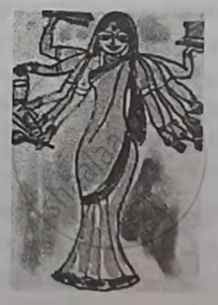
The given image shows a famous painting. Choose the painter of this art work from the following options:
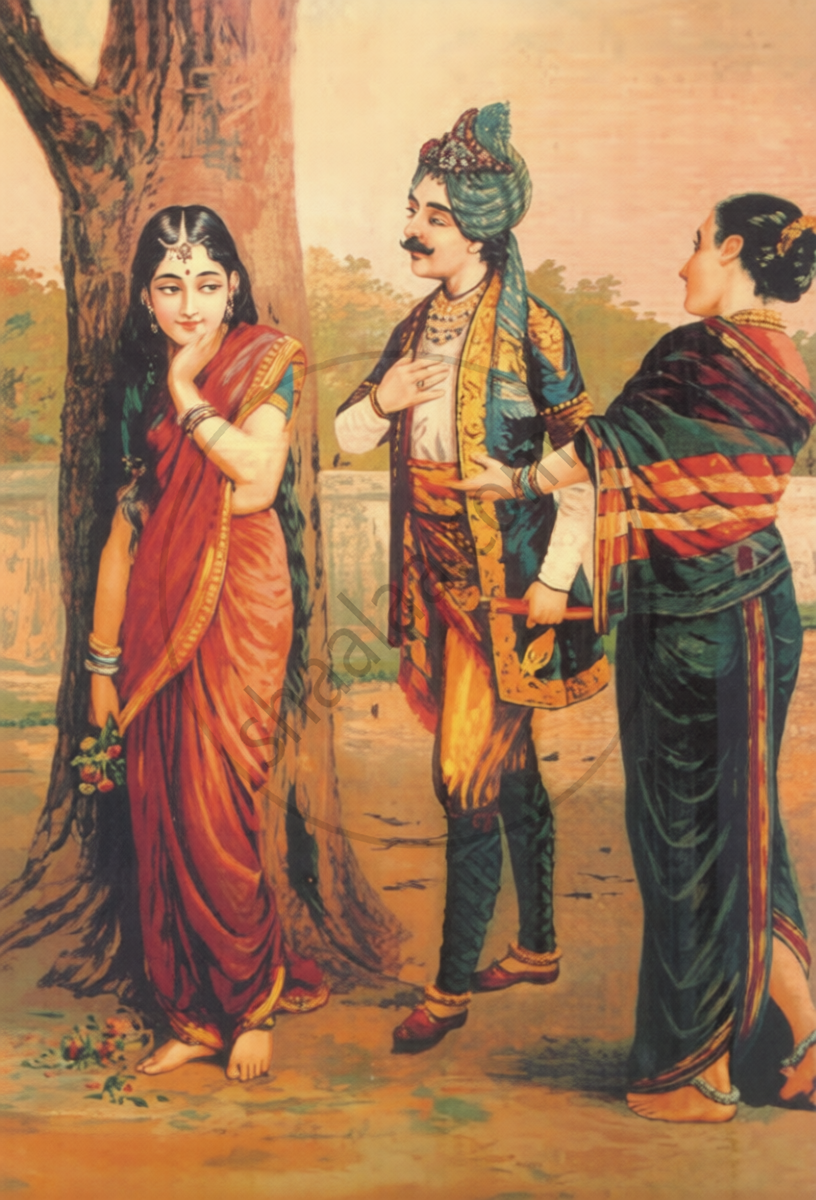
Satyendranath Bishi
Abanindranath Tagore
Rabindranath Tagore
Raja Ravi Verma
Chapter:
Which one of the following pairs is correctly matched?
| Column - A (Writer) |
Column - B (Contribution) |
| Sudarshan Chakra | Anandmath |
| Column - A (Writer) |
Column - B (Contribution) |
| Kashi Baba | Sacchi Kavitayen |
| Column - A (Writer) |
Column - B (Contribution) |
| Bal Gangadhar Tilak | Kesari |
| Column - A (Writer) |
Column - B (Contribution) |
| Pandita Ramabai | Amar Jiban |
Chapter:
Assertion (A): The Indian subcontinent was a crucial point in 'Indian Ocean trade flows' during sixteenth century.
Reason (R): Its geographical location connected East-West Asia and Europe.
Both, (A) and (R) are true and (R) is the correct explanation of (A).
Both, (A) and (R) are true, but (R) is not the correct explanation of (A).
(A) is true, but (R) is false.
(A) is false, but (R) is true.
Chapter:
Arrange the following in chronological order and choose the correct option:
- Gandhi-Irwin Pact
- Rowlatt Act
- Poona Pact
- Khilafat Movement
I, III, IV and II
II, IV, III and I
II, IV, I and III
I, III, II and IV
Chapter:
How had globalization begun long before sixteenth century? Explain.
Chapter:
Chapter:
Explain the role of Johann Gutenberg in the spread of print culture in Europe.
Chapter:
Explain the role of print in the expansion of protestant reformation.
Chapter:
“Otto Von Bismarck was the architect of the unification of Germany.” Examine the statement.
Chapter:
“The 1830’s were years of great economic hardship in Europe.” Examine the statement.
Chapter:
Read the given source carefully and answer the questions that follow:
|
‘To the altar of this revolution we have brought our youth as incense’ Many nationalists thought that the struggle against the British could not be won through non-violence. In the year 1928, the Hindustan Socialist Republican Army (HSRA) was founded at a meeting in Ferozeshah Kotla ground in Delhi. Amongst its leaders were Bhagat Singh, Jatin Das and Ajoy Ghosh. In a series of dramatic actions in different parts of India, the HSRA targeted some of the symbols of British power. In April 1929, Bhagat Singh and Batukeshwar Dutta threw a bomb in the Legislative Assembly. In the same year there was an attempt to blow up the train that Lord Irwin was travelling in. Bhagat Singh was 23 when he was tried and executed by the colonial government. During his trial, Bhagat Singh stated that he did not wish to glorify ‘the cult of the bomb and pistol’ but wanted a revolution in society- ‘Revolution is the inalienable right of mankind. Freedom is the imprescriptible birthright of all. The labourer is the real sustainer of society. To the altar of this revolution we have brought our youth as incense, for no sacrifice is too great for so magnificent a cause. We are content. We await the advent of revolution. Inquilab Zindabad!’ |
- Why is the formation of ‘Hindustan Socialist Republican Army (HSRA)’ considered as a turning point in the freedom struggle of India? (1)
- How did Bhagat Singh’s trial speeches transform him from a revolutionary to a philosopher of freedom? (1)
- In what way did Bhagat Singh redefine the meaning of ‘revolution’ for his generation? Explain. (2)
Chapter:
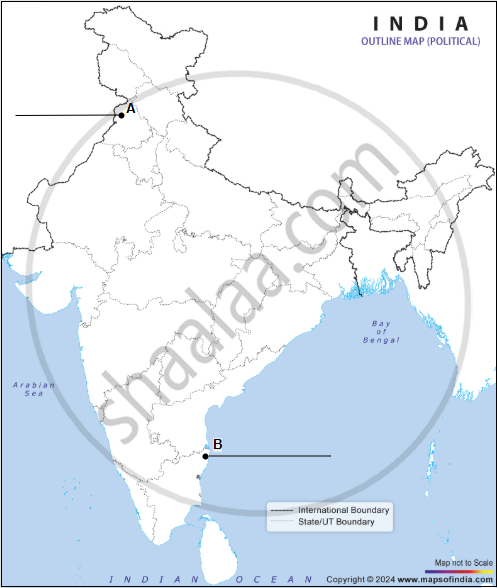
Two places (A) and (B) have been marked on the given political outline map of India. Identify them based on the information given below and write their correct names on the lines marked on the map near them:
- The place where General Dyer ordered firing upon a peaceful gathering on 13 April, 1919. (1)
- The place where the Session of Indian National Congress was held in the year 1927. (1)
Chapter:
Identify the state related with the Chipko movement:
Arunachal Pradesh
Madhya Pradesh
Uttarakhand
Chapter:
Match Column - I with Column - II and choose the correct option:
| Column - I (Types of Farming) |
Column - II (Features) |
| I. Primitive subsistence farming | (a) Use of modern inputs with less labour |
| II. Intensive subsistence farming | (b) Single crop cultivation on large scale |
| III. Commercial farming | (c) Slash and burn cultivation |
| IV. Plantation farming | (d) Labour intensive cultivation |
I - (c), II - (a), III - (d), IV - (b)
I - (a), II - (b), III - (d), IV - (c)
I - (c), II - (d), III - (a), IV - (b)
I - (d), II - (c), III - (b), IV - (a)
Chapter:
Choose the appropriate option to fill in the blank:
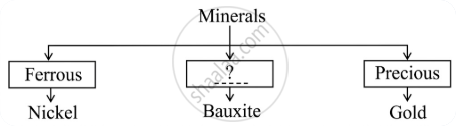
Energy Minerals
Non-Metallic Minerals
Non-Ferrous Minerals
Precious Minerals
Chapter:
Advertisements
Choose the correct option related to the factors that determined the land use pattern in India:
Political and Religious factors
Cultural and Geological factors
Economical and Historical factors
Physical and Human factors
Chapter:
| Column - A (National Parks) |
Column - B (States) |
| Periyar | Madhya Pradesh |
| Column - A (National Parks) |
Column - B (States) |
| Manas | Assam |
| Column - A (National Parks) |
Column - B (States) |
| Bandhavgarh | Rajasthan |
| Column - A (National Parks) |
Column - B (States) |
| Corbett | Uttar Pradesh |
Chapter:
Identify the correct soil from the given options to complete the flow chart:

Alluvial soil
Laterite soil
Red soil
Chapter:
Suggest any two measures for better productivity and organic farming.
Chapter:
Examine the role of nuclear energy in meeting growing demand of power.
Chapter:
Examine the potential of geothermal energy as a renewable power source.
Chapter:
Read the given source carefully and answer the questions that follow:
|
Floods Basic safety precautions to be taken:
During Floods
|
- Suggest one precaution before using water after floods. (1)
- Mention any two measures related to protection of food items during floods. (1)
- Suggest two actions to be taken before leaving the house during a flood warning. (2)
Chapter:
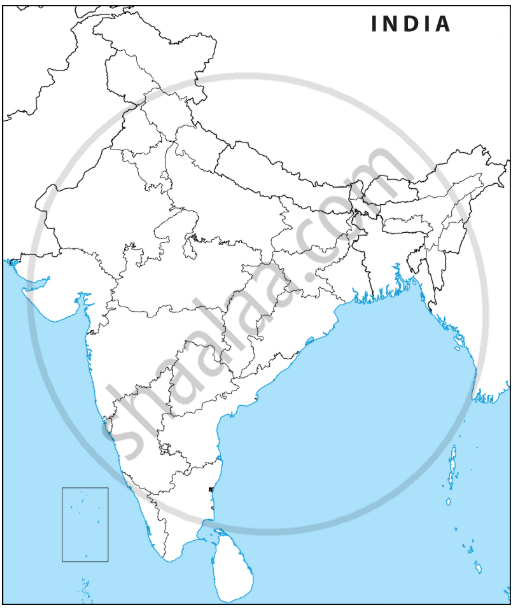
On the given outline map of India, locate and label any three of the following with suitable symbols:
- The dam built on Mahanadi river. (1)
- Nuclear power plant located in Uttar Pradesh. (1)
- Software technology park located in Maharashtra. (1)
- Major sea port located in Gujarat. (1)
Chapter:
Find the odd one out regarding the Political Parties of India:
Indian National Congress and Communist Party of India (M)
Rashtriya Janta Dal and Lok Jan Shakti Party
Indian National Lok Dal and Jan Nayak Janta Party
Rashtriya Lok Dal and Jan Satta Dal
Chapter:
Assertion (A): Both, Sri Lanka and Belgium faced challenges of ethnic and linguistic diversity.
Reason (R): Sri Lanka had majority of Tamils whereas Belgium had majority of French speaking people.
Both, (A) and (R) are true, and (R) is the correct explanation of (A).
Both, (A) and (R) are true, but (R) is not the correct explanation of (A).
(A) is true, but (R) is false.
(A) is false, but (R) is true.
Chapter:
Read the following statements regarding decentralization step India took in the year 1992 and choose the correct option:
- Mandatory regular elections for local bodies
- Two-third seats reserved for women
- Formation of the State Election Commission
- Seats reserved for Schedule Castes and Schedule Tribes
I, II and III are correct.
I, III and IV are correct.
II, III and IV are correct.
I, II and IV are correct.
Chapter:
Look at the given picture carefully and choose the most appropriate option:
Which of the following values is being reflected through this picture?
Unity and integration
Equality and Justice
Multitasking and Dedication
Religions and Rituals
Chapter:
Describe any five features of federalism.
Chapter: [2] Federalism [3.2] Federalism
Suggest any two ways to support women in education in rural areas.
Chapter:
“Political parties perform a series of functions in the democracy.” Explain the statement with examples.
Chapter:
Advertisements
Answer the following question.
"Democracies lead to peaceful and harmonious life among citizens." Justify this statement.
Chapter: [8] Challenges to Democracy
“Democracy is based on the idea of deliberations and negotiations.” Examine the statement.
Chapter:
Read the given source carefully and answer the questions that follow:
|
POWER SHARING Power sharing arrangements can also be seen in the way political parties, pressure groups and movements control or influence those in power. In a democracy, the citizens must have freedom to choose among various contenders for power. In contemporary democracies, this takes the form of competition among different parties. Such competition ensures that power does not remain in one hand. In the long run, power is shared among different political parties that represent different ideologies and social groups. Sometimes this kind of sharing can be direct, when two or more parties form an alliance to contest elections. If their alliance is elected, they form a coalition government and thus share power. In a democracy, we find interest groups, such as those of traders, businessmen, industrialists, farmers and industrial workers. They also will have a share in governmental power, either through participation in governmental committees or bringing influence on the decision-making process. |
- How do pressure groups influence the government? (1)
- How do social groups benefit from power sharing? (1)
- Explain the contributions of citizens in the power sharing process? (2)
Chapter:
Which of the following organisations publishes the ‘Human Development Report’?
World Trade Organisation
World Health Organisation
United Nations Environmental Program
United Nations Development Program
Chapter:
Which one of the following best describes liberalisation?
Protecting domestic industries
Banning foreign companies
Removal of restrictions on trade
Restricting foreign investment
Chapter:
Read the following case and choose the correct option:
| Swapna owns a small farm in her village. She wants to take loan to meet the expense of cultivation. |
From which of the following sources should Swapna take the loan?
Reserve Bank of India
Nearest nationalised bank
Moneylender of the village
Agricultural trader
Chapter:
Match Column - I with Column - II and choose the correct option:
| Column - I (Sectors on the basis of ownership) |
Column - II (Examples) |
| a. Public Sector | (i) Amul Dairy |
| b. Private Sector | (ii) Maruti Suzuki |
| c. Joint Sector | (iii) Oil and Natural Gas Corporation |
| d. Cooperative Sector | (iv) Airtel Limited |
a - (ii), b - (iv), c - (iii), d - (i)
a - (iii), b - (ii), c - (i), d - (iv)
a - (iii), b - (iv), c - (ii), d - (i)
a - (i), b - (iii), c - (iv), d - (ii)
Chapter:
Study the data of a State given below and answer the question that follow:
Educational achievement of rural population of State
| Category | Males | Females |
| I. Literacy rate of rural population | 76% | 54% |
| II. Literacy rate of rural children in age group of 10-14 years | 90% | 87% |
| III. Percentage of rural children aged 10-14 years attending school | 85% | 82% |
If rural children aged 10-14 years are considered, then how many female children are attending school?
90
85
82
83
Chapter:
Literacy Rate is expressed as a proportion of the literate population in the age group ______ and above.
7 years
8 years
9 years
10 years
Chapter:
“New technology has helped the world to become connected.” Justify the statement with suitable arguments.
Chapter:
Why is it necessary to expand formal sources of credit in rural areas? Explain.
Chapter:
Why is sustainable development essential? Explain with examples.
Chapter:
Describe the public work programs in job creation at rural areas.
Chapter:
Describe the Public work programs in job creation at urban areas.
Chapter:
Describe the role of primary sector in the rural areas.
Chapter:
Other Solutions
Submit Question Paper
Help us maintain new question papers on Shaalaa.com, so we can continue to help studentsonly jpg, png and pdf files
CBSE previous year question papers Class 10 Social Science with solutions 2025 - 2026
Previous year Question paper for CBSE Class 10 Social Science-2026 is solved by experts. Solved question papers gives you the chance to check yourself after your mock test.
By referring the question paper Solutions for Social Science, you can scale your preparation level and work on your weak areas. It will also help the candidates in developing the time-management skills. Practice makes perfect, and there is no better way to practice than to attempt previous year question paper solutions of CBSE Class 10.
How CBSE Class 10 Question Paper solutions Help Students ?
• Question paper solutions for Social Science will helps students to prepare for exam.
• Question paper with answer will boost students confidence in exam time and also give you an idea About the important questions and topics to be prepared for the board exam.
• For finding solution of question papers no need to refer so multiple sources like textbook or guides.
