English Medium
Academic Year: 2019-2020
Date & Time: 18th March 2020, 10:30 am
Duration: 3h
Advertisements
General Instructions:
Read the following instructions very carefully and strictly follow them:
- This question paper comprises four section - A, B, C and D. There are 35 questions in the question paper. All questions
are compulsory. - Section A: Q. No. 1 to 20 comprises of 20 are very short answer type questions, carrying 1 mark each.
- Section B: Q. No. 21 to 28 are short answer type questions, carrying 3 marks each. Answer to each question should
not exceed 80 words. - Section C: Q. No. 29 to 34 are long answer type questions, carrying 5 marks each. Answer to each questions should
not exceed 120 words. - Section D: Q. No. 35 is map based carrying 6 marks with two parts 35 (a) from History (2 marks) and 35 (b) from
Geograplly (4 marks). - Answer should be brief and to the point, also the above word limit be adhered to as far as possible.
- There is no overall choice in the question paper. However, an internal choice has been provided in few questions. Only one of the choice in such questions have to be attempted.
- Attach MAP along with your answer-book.
- In addition to this, separate instructions are given with each section and question, wherever necessary.
Which of the following revolutions is called as the first expression of ‘Nationalism’?
French Revolution
Russian Revolution
Glorious Revolution
The Revolution of the liberals
Chapter:
Why was the Inland Emigration Act of 1859 troublesome for plantation workers?
Chapter:
Why was the Vernacular Press Act passed in 1878?
Chapter:
Why was ‘Gulamgiri’ book written by Jyotibha Phule in 1871?
Chapter:
Buddhist missionaries from China introduced hand-printing technology into ______ around A.D. 768-770.
Chapter:
By 1448, Gutenberg perfected the system of printing. The first book he printed was the ______.
Chapter:
Why was reading of manuscripts not easy in India?
Manuscripts were highly expensive.
Manuscripts were widely spread out.
Manuscripts were written in English and Hindi.
Manuscripts were fragile.
Chapter:
Who were called ‘Chapmen’?
Book seller
Paper seller
Workers of printing press
Seller of ‘penny chap books’
Chapter:
| Types of Resources | Examples |
| ? | Biotic and Abiotic |
Chapter:
| Types of Resources | Examples |
| ? | Renewable and non-renewable |
Chapter:
Which is the oldest artificial sea port of lndia?
Chapter:
Which is the deepest, landlocked and well protected sea port of India?
Chapter:
In which of the following States in kalpakkam Nuclear Power Plant located?
Gujarat
Odisha
Kerala
Tamil Nadu
Chapter:
Choose the correct option from columns A and B.
| A | B |
| Chandrapur thermal power plant | Odisha |
| A | B |
| Mayurbhanj iron ore mines | Amarkantak |
| A | B |
| Kalol oil fields | Gujarat |
| A | B |
| Bauxite mines | Jharkhand |
Chapter:
______ industry is used for manufacturing aircraft, utensils and wires?
Chapter:
Advertisements
Which one of the following is a major caste group of Sri Lanka?
Christian and Tamil
Buddhist and Hindu
Sinhali and Tamil
Sinhali and Christian
Chapter:
State any one step taken in Belgium to rule out the problem of regional differences and cultural diversities.
Chapter:
Modern democracies maintain check and balance system. Identify the correct option based on the horizontal power sharing arrangement.
Central government, state government, local bodies.
Legislature, executive, judiciary.
Among different social groups.
Among different pressure groups.
Chapter:
Suggest any one way to protect women from domestic oppression.
Chapter:
Suggest any one way to create communal harmony among various communities of India.
Chapter:
Choose the incorrect option from column A and column B.
| Column A Category of person |
Column B Developmental goals/Aspirations |
| Landless rural labourers | More days of work and better wages |
| Column A Category of person |
Column B Developmental goals/Aspirations |
| Prosperous farmers from Punjab | Availability of other sources of irrigation |
| Column A Category of person |
Column B Developmental goals/Aspirations |
| Farmers who depend only on rain for growing crops | Assured a higher support prices for their crops |
| Column A Category of person |
Column B Developmental goals/Aspirations |
| A rural woman from a land owning family | Regular job and high wag s to increase her income |
Chapter:
Study the table and answer the question given below.
| Some comparative data on Haryana, Kerala and Bihar | |||
| State | Infant Mortality Rate per 1,000 live births (2016) | Literacy Rate% 2011 | Net Attendance Ratio (per 100 persons) secondary stage (age 14 and 15 years) 2013-14 |
| Haryana | 33 | 82 | 61 |
| Kerala | 10 | 94 | 83 |
| Bihar | 38 | 62 | 43 |
In comparison to Kerala which state has the highest infant mortality rate.
Chapter:
Suggest any one way to create employment in semi-rural areas.
Chapter:
How is Pubic sector different from Private Sector?
Chapter:
Read the source given below and answer the questions that follows:
|
SOURCE: The Movement in the Towns The movement started with middle-class participation in the cities. Thousands of students left government-controlled schools and colleges, headmasters and teachers resigned, and lawyers gave up their legal practices. The council elections were boycotted in most provinces except Madras, where the Justice Party, the party of the non-Brahmans, felt that entering the council was one way of gaining some power-something that usually only Brahmans had access to. The effects of non-cooperation on the economic front were more dramatic. Foreign goods were boycotted, liquor shops picketed, and foreign cloth burnt in huge bonfires. The import of foreign cloth halved between 1921 and 1922, its value dropping from Rs. 102 crore to Rs. 57 crore. In many places merchants and traders refused to trade in foreign goods or finance foreign trade. As the boycott movement spread, and people began discarding imported clothes and wearing only Indian ones, production of Indian textile mills and handlooms went up. |
- Explain the role of ‘Justice Party’ in boycotting of council elections.
- How was effects of ‘non-cooperation on the economic front’ dramatic?
- Explain the effect of ‘Boycott’ movement on ‘foreign textile trade.’
Chapter:
Explain any three effects of population growth in England in the late eighteenth century.
Chapter:
Why did the export of Indian textile decline at the beginning off the nineteenth century? Explain any three reasons.
Chapter:
Describe the importance of judicious use of resources.
Chapter:
Describe the different steps of ‘resource planning.’
Chapter:
Why are efficient means of transport pre-requisites for the fast development of the country? Explain
Chapter: [7] Life Lines of National Economy
What are the characteristics of a federal state?
Chapter:
Advertisements
Mention any three features of ‘secularism’ described in the Indian Constitution.
Chapter:
Mention the problem of ‘Casteism’ in Indian politics.
Chapter:
Suggest any three ways to maintain Body Mass Index (BMI).
Chapter:
“Tertiary sector activities help in the development of the primary and secondary sectors.” Evaluate the statement.
Chapter:
“Primary sector was the most important sector of economic activity at initial stages of development.” Evaluate the statement.
Chapter:
How did ideas of national unity in early nineteenth century Europe allied to the ideology of liberalism? Explain.
Chapter:
How did Greek war of independence mobilise nationalist feelings among the educated elite across Europe? Explain.
Chapter:
Why is agriculture called the backbone of India’s economic system?
Chapter:
Describe any five functions of political party.
Chapter:
‘Democratic system is better than any other form of government.’ Support the statement with examples.
Chapter:
“Bank plays an important role in the economic development of the country.” Support the statement with examples.
Chapter:
“Credit sometimes pushes the borrower into a situation from which recovery is very painful.” Support the statement with examples.
Chapter:
Read the source given below and answer the question that follow:
|
Production across countries. Until the middle of the twentieth century, production was largely organised within countries. What crossed the boundaries of these countries were raw material, food stuff and finished products. Colonies such as India exported raw materials and foods stuff and imported finished goods. Trade was the main channel connecting distant countries. This was before large companies called multinational corporations (MNCs) emerged on the scene. |
How are MNCs major force in connecting the countries of the world?
Chapter:
Read the source given below and answer the question that follow:
|
Foreign trade and integration of markets Foreign trade creates an opportunity for the producers to reach beyond the domestic markets, i.e., markets of their own countries. Producers can sell their produce not only in markets located within the country but can also compete in markets located in other countries of the world. Similarly, for the buyers, import of goods produced in another country is one way of expanding the choice of goods beyond what is domestically produced. |
How does foreign trade become a main channel in connecting countries?
Chapter:
Read the source given below and answer the question that follow:
|
Impact of globalisation in India Globalisation and greater competition among producers - both local and foreign producers - has been of advantage to consumers, particularly the well-off sections in the urban areas. There is greater choice before these consumers who now enjoy improved quality and lower prices for several products. As a result, these people today, enjoy much higher standard of living than was possible earlier. |
How is globalisation beneficial for consumers?
Chapter:
Two places A and B are marked on the given political outline map of India. Identify them and write their correct names on the lines drawn near them.
- The place where Indian National Congress Session was held.
- The place where the movement of Indigo planters was started.
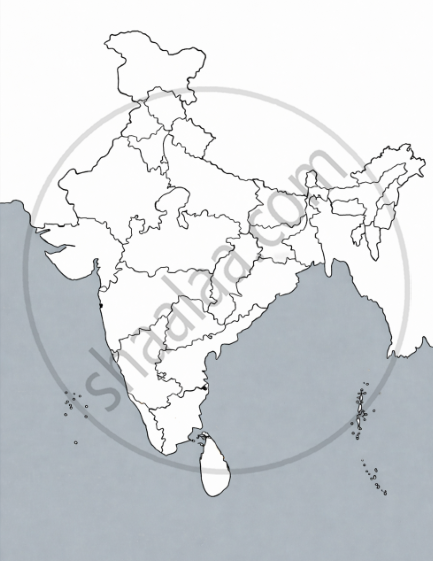
Chapter:
Locate and label any four of the following with appropriate symbols on the same given political outline map of India.
| (i) Sardar Sarovar | Dam |
| (ii) Bhilai | Iron and Steel Plant |
| (iii) Pune | Software Technology Park |
| (iv) Koehl | Major Sea Port |
| (v) Indore | Cotton Textile Industry |
| (vi) Naraura | Nuclear Power Plant |
Chapter:
Other Solutions
Submit Question Paper
Help us maintain new question papers on Shaalaa.com, so we can continue to help studentsonly jpg, png and pdf files
CBSE previous year question papers Class 10 Social Science with solutions 2019 - 2020
Previous year Question paper for CBSE Class 10 Social Science-2020 is solved by experts. Solved question papers gives you the chance to check yourself after your mock test.
By referring the question paper Solutions for Social Science, you can scale your preparation level and work on your weak areas. It will also help the candidates in developing the time-management skills. Practice makes perfect, and there is no better way to practice than to attempt previous year question paper solutions of CBSE Class 10.
How CBSE Class 10 Question Paper solutions Help Students ?
• Question paper solutions for Social Science will helps students to prepare for exam.
• Question paper with answer will boost students confidence in exam time and also give you an idea About the important questions and topics to be prepared for the board exam.
• For finding solution of question papers no need to refer so multiple sources like textbook or guides.
