Science (English Medium)
Academic Year: 2025-2026
Date & Time: 20th February 2026, 10:30 am
Duration: 3h
Advertisements
General Instructions:
Read the following instructions very carefully and strictly follow them:
- This question paper contains 33 questions. All questions are compulsory.
- This question paper is divided into five sections - Sections A, B, C, D and E.
- In Section A: Questions no. 1 to 16 are Multiple Choice type questions. Each question carries 1 mark.
- In Section B: Questions no. 17 to 21 are Very Short Answer type questions. Each question carries 2 marks.
- In Section C: Questions no. 22 to 28 are Short Answer type questions. Each question carries 3 marks.
- In Section D: Questions no. 29 and 30 are case study-based questions. Each question carries 4 marks.
- In Section E: Question numbers 31 to 33 are Long Answer type questions. Each question carries 5 marks.
- There is no overall choice given in the question paper. However, an internal choice has been provided in few questions in all the Sections except Section A.
- Kindly note that there is a separate question paper for Visually Impaired candidates.
- Use of calculator is not allowed.
You may use the following values of physical constants wherever necessary:
c = 3 × 10⁸ m/s
h = 6.63 × 10⁻³⁴ Js
e = 1.6 × 10⁻¹⁹ C
μ0 = 4π × 10−7 T m A−1
ε0 = 8.854 × 10⁻¹² C2 N−1 m−2
`1/(4 pi epsilon_0)` = 9 × 10⁹ N m2 C−2
Mass of electron (me) = 9.1 × 10⁻³¹ kg.
Mass of neutron = 1.675 × 10⁻²⁷ kg.
Mass of proton = 1.673 × 10⁻²⁷ kg.
Avogadro’s number = 6.023 × 10²³ per gram mole
Boltzmann’s constant = 1.38 × 10⁻²³ JK−1
Two small identical metallic balls having charges q and −2q are kept far at a separation r. They are brought in contact and then separated at distance `r/2`. Compared to the initial force F, they will now ______.
attract with a force `F/2`.
repel with a force `F/2`.
repel with a force F.
attract with a force F.
Chapter:
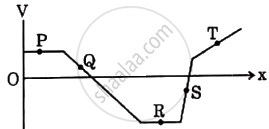
The figure represents the variation of the electric potential V at a point in a region of space as a function of its position along the x-axis. A charged particle will experience the maximum force at:
P
Q
R
S
Chapter:
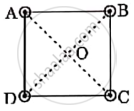
Four long straight thin wires are held vertically at the corners A, B, C and D of a square of side ‘a’, kept on a table and carry equal current ‘I’. The wire at A carries current in an upward direction, whereas the current in the remaining wires flows in downward direction. The net magnetic field at the centre of the square will have the magnitude:
`(mu_0 I)/(pi a)` and directed along OC
`(mu_0 I)/(pi a sqrt 2)` and directed along OD
`(mu_0 I sqrt2)/(pi a)` and directed along ОВ
`(2 mu_0 I)/(pi a)` and directed along OA
Chapter:
The magnetic flux through a loop placed in a magnetic field can be changed by changing:
area of the loop only.
the value of magnetic field only.
orientation of the loop in the magnetic field only.
any one or more of the factors given in the above options.
Chapter:
Which of the following statements is not true for electric energy in AC form compared to that in DC form?
Production of AC is economical.
AC сan be easily and efficiently converted from one voltage to the other.
AC can be transmitted economically over long distances.
AC is less dangerous.
Chapter:
The magnetic field in a plane electromagnetic wave travelling in glass (n = 1.5) is given by
By = (2 × 10⁻⁷ T) sin (αx + 1.5 × 10¹¹ t)
where x is in metres and t is in seconds. The value of α is:
0.5 × 10³ m−1
6.0 × 10² m−1
7.5 × 10² m−1
1.5 × 10³ m−1
Chapter:
Light of which of the following colours will have the maximum energy in a photon associated with it?
Red light
Yellow light
Green light
Blue light
Chapter:
Nuclides with the same number of neutrons are called ______.
Isobars
Isotones
Isotopes
Isomers
Chapter:
The radius of a nucleus of mass number 125 is ______.
6.0 fm
30 fm
72 fm
150 fm
Chapter:
The energy of an electron in an orbit in hydrogen atom is −3.4 eV. Its angular momentum in the orbit will be ______.
`(3 h)/(2 pi)`
`(2 h)/pi`
`h/pi`
`h/(2 pi)`
Chapter:
A good diode checked by a multimeter should indicate ______.
high resistance in reverse bias and a low resistance in forward bias.
high resistance in both forward bias and reverse bias.
low resistance in both reverse bias and forward bias.
high resistance in forward bias and low resistance in reverse bias.
Chapter:
The rms and the average value of an ac voltage V = V0 sin ωt volt over a cycle respectively will be ______.
`V_0/2, V_0/sqrt 2`
`V_0/pi, V_0/2`
`V_0/sqrt2`, 0
V0, `V_0/sqrt 2`
Chapter:
Assertion (A): Induced emf produced in a coil will be more when the magnetic flux linked with the coil is more.
Reason (R): Induced emf produced is directly proportional to the magnetic flux.
Both Assertion (A) and Reason (R) are true and Reason (R) is the correct explanation of the Assertion (A).
Both Assertion (A) and Reason (R) are true, but Reason (R) is not the correct explanation of the Assertion (A).
Assertion (A) is true, but Reason (R) is false.
Both Assertion (A) and Reason (R) are false.
Chapter:
Assertion (A): In Young’s double-slit experiment, the fringe width for dark and bright fringes is the same.
Reason (R): Fringe width is given by β = `(lambda D)/d`, where symbols have their usual meanings.
Both Assertion (A) and Reason (R) are true and Reason (R) is the correct explanation of the Assertion (A).
Both Assertion (A) and Reason (R) are true, but Reason (R) is not the correct explanation of the Assertion (A).
Assertion (A) is true, but Reason (R) is false.
Both Assertion (A) and Reason (R) are false.
Chapter:
Assertion (A): Energy is released when heavy nuclei undergo fission or light nuclei undergo fusion.
Reason (R): For heavy nuclei, binding energy per nucleon increases with increasing Z while for light nuclei, it decreases with increasing Z.
Both Assertion (A) and Reason (R) are true and Reason (R) is the correct explanation of the Assertion (A).
Both Assertion (A) and Reason (R) are true, but Reason (R) is not the correct explanation of the Assertion (A).
Assertion (A) is true, but Reason (R) is false.
Both Assertion (A) and Reason (R) are false.
Chapter:
Assertion (A): Photoelectric effect is a spontaneous phenomenon.
Reason (R): According to the wave picture of radiation, an electron would take hours/days to absorb sufficient energy to overcome the work function and come out from a metal surface.
Both Assertion (A) and Reason (R) are true and Reason (R) is the correct explanation of the Assertion (A).
Both Assertion (A) and Reason (R) are true, but Reason (R) is not the correct explanation of the Assertion (A).
Assertion (A) is true, but Reason (R) is false.
Both Assertion (A) and Reason (R) are false.
Chapter:
Advertisements
An electric iron rated 2.2 kW, 220 V is operated at 110 V supply. Find:
- its resistance, and
- heat produced by it in 10 minutes.
Chapter:
A current of 4.0 A flows through a wire of length 1 m and cross-sectional area 1.0 mm2, when potential difference of 2 V is applied across its ends.
Calculate the resistivity of the material of the wire.
Chapter:
A plane circular coil is rotated about its vertical diameter with a constant angular speed ω in a uniform horizontal magnetic field. Initially the plane of the coil is parallel to the magnetic field. Draw plots showing the variation of the following physical quantities as a function of ωt, where t represents time elapsed:
- Magnetic flux Φ linked with the coil, and
- emf induced in the coil.
Chapter:
A tank is filled with a liquid to a height of 12.5 m. The apparent depth of a needle lying at the bottom of the tank is measured to be 9.0 m. Calculate the speed of light in the liquid.
Chapter:
Two thin lenses of focal length f1 and f2 are placed in contact with each other coaxially. Prove that the focal length f of the combination is given by f = `(f_1 f_2)/(f_1 + f_2)`.
Chapter:
Suppose a pure Si crystal has 5 × 1028 atoms per m3. It is doped with 5 × 10²² atoms per m3 of Arsenic. Calculate majority and minority carrier concentration in the doped silicon.
(Given: ni = 1.5 × 10¹⁶ m−3)
Chapter:
Two parallel plate capacitors X and Y are connected in series to a 6 V battery. They have the same plate area and same plate separation but capacitor X has air between its plates, whereas capacitor Y contains a material of dielectric constant 4.
- Calculate the capacitances of X and Y, if the equivalent capacitance of the combination of X and Y is 4 µF.
- Calculate the potential difference across the plates of X and Y.
Chapter:
Write the expression for the magnetic field due to a current element in vector form. Consider a 1 cm segment of a wire, centered at the origin, carrying a current of 10 A in positive x-direction. Calculate the magnetic field `vec B` at a point (1 m, 1 m, 0).
Chapter:
A long solenoid of length L and radius r1 having N1 turns is surrounded symmetrically by a coil of radius r2 (> r1) having N2 turns (N2 ≪ N1) around its mid-point. Derive an expression for the mutual inductance of solenoid and coil. Is M12 = M21 valid in this case?
Chapter:
Considering the case of charging of a capacitor, show that id = `epsilon_0 (d phi_E)/dt`. What is the value of id for a conductor across which a constant voltage is applied?
Chapter:
Write any two characteristic features of nuclear forces?
Chapter:
If both the number of protons and the neutrons are conserved in each nuclear reaction, in what way is mass converted into energy (or vice versa) in a nuclear reaction? Explain.
Chapter:
Draw the number of scattered particles versus the scattering angle graph for scattering of alpha particles by a thin foil. Write two important conclusions that can be drawn from this plot.
Chapter:
If Bohr’s quantization postulate (angular momentum = `(n h)/(2 pi)`) is a basic law of nature, it should be equally valid for the case of planetary motion also. Why, then, do we never speak of quantization of orbits of planets around the Sun? Explain.
Chapter:
Photoemission of electrons occurs from a metal (Φ0 = 1.96 eV) when light of frequency 64 × 1014 Hz is incident on it. Calculate:
- Energy of a photon in the incident light,
- The maximum kinetic energy of the emitted electrons, and
- The stopping potential.
Chapter:
Advertisements
Draw the circuit diagram of a full wave rectifier. Explain its working showing its input and output waveforms.
Chapter:
Read the following paragraph and answer the questions that follow.
|
The electric potential (V) and electric field (E) are closely related concepts in electrostatics. The electric field is a vector quantity that represents the force per unit charge at a given point in space, whereas electric potential is a scalar quantity that represents the potential energy per unit charge at a given point in space. Electric field and electric potential are related by the equations Er = `(-d V)/(d r)` and `vec E = E_r hat r`, i.e., electric field is the negative gradient of the electric potential. This means that electric field points in the direction of decreasing potential and its magnitude is the rate of change of potential with distance. The electric field is the force that drives a unit charge to move from higher potential region to lower potential region and electric potential difference between the two points determines the work done in moving a unit charge from one point to the other point.
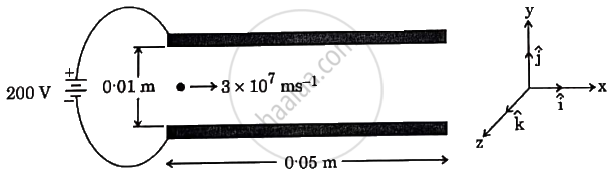
A pair of square conducting plates having sides of length 0.05 m are arranged parallel to each other in x-y plane. They are 0.01 m apart along z-axis and are connected to a 200 V power supply as shown in the figure. An electron enters with a speed of 3 × 10⁷ ms−1 horizontally and symmetrically in the space between the two plates. Neglect the effect of gravity on the electron. |
(i) The electric field `vec E` in the region between the plates is ______.
- `(2 xx 10^2 V/m)hat k`
- `-(2 xx 10^2 V/m)hat k`
- `(2 xx 10^4 V/m) hat k`
- `-(2 xx 10^4 V/m)hat k`
(ii) In the region between the plates, the electron moves with an acceleration `vec a` given by ______.
- `-(3.5 xx 10^15 ms^-2)hat k`
- `(3.5 xx 10^15 ms^-2)hat k`
- `(3.5 xx 10^13 ms^-2)hat i`
- `-(3.5 xx 10^13 ms^-2)hat i`
(iii) (a) Time interval during which an electron moves through the region between the plates is ______.
- 9.0 × 10⁻⁹ s
- 1.67 × 10⁻⁸ s
- 1.67 × 10⁻⁹ s
- 2.17 × 10⁻⁹ s
OR
(b) The vertical displacement of the electron which travels through the region between the plates is ______.
- 10 mm
- 4.9 mm
- 5.9 mm
- 3.0 mm
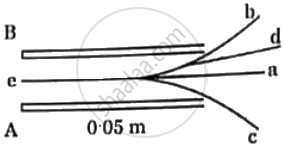
(iv) Which one of the following is the path traced by the electron in between the two plates?
- a
- b
- c
- d
Chapter:
Read the following paragraphs and answer the questions that follow.
|
In a Young’s double-slit experiment, the two slits behave as coherent sources. When coherent light waves superpose over each other they create an interference pattern of successive bright and dark regions due to constructive and destructive interference. Two slits 2 mm apart are illuminated by a source of monochromatic light and the interference pattern is observed on a screen 5.0 m away from the slits as shown in the figure.
|
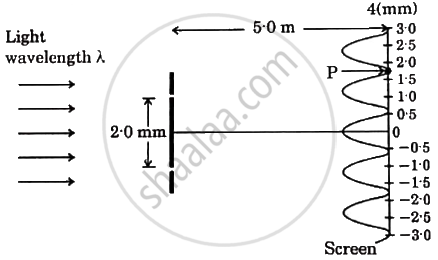
(i) What property of light does this interference experiment demonstrate?
- Wave nature of light
- Particle nature of light
- Transverse nature of light
- Both wave nature and transverse nature of light
(ii) (a) The wavelength of light used in this experiment is ______.
- 720 nm
- 590 nm
- 480 nm
- 364 nm
OR
(b) The fringe width in the interference pattern formed on the screen is ______.
- 1.2 mm
- 0.2 mm
- 4.2 mm
- 6.8 mm
(iii) The path difference between the two waves meeting at point P, where there is a minimum in the interference pattern is ______.
- 8.1 × 10⁻⁷ m
- 7.2 × 10⁻⁷ m
- 6.5 × 10⁻⁷ m
- 6.0 × 10⁻⁷ m
(iv) When the experiment is performed in a liquid of refractive index greater than 1, then fringe pattern will ______.
- disappear
- become blurred
- be widened
- be compressed
Chapter:
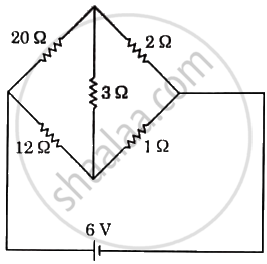
Using Kirchhoff’s laws, obtain the equation of the balanced state in Wheatstone Bridge.
Chapter:
Determine the current in the 3 Ω branch of a Wheatstone Bridge in the circuit shown in the figure.
Chapter:
Consider a cylindrical conductor of length l and area of cross-section A. Current I is maintained in the conductor and electrons drift with velocity vd `(|vec v_d| = (e|vec E|)/m tau)`, (where symbols have their usual meanings). Show that the conductivity σ of the material of the conductor is given by σ = `(n e^2)/m tau`.
Chapter:
The resistance of a metal wire at 20°C is 1.05 Ω and at 100°C is 1.38 Ω. Determine the temperature coefficient of resistivity of this metal.
Chapter:
A rectangular loop of sides a and b carrying current I is placed in a magnetic field `vec B` such that its area vector `vec A` makes an angle θ with `vec B`. With the help of a suitable diagram, show that the torque `vec tau` acting on the loop is given by `vec tau = vec m xx vec B`, where `vec m(= I vec A)` is the magnetic dipole moment of the loop.
Chapter:
A circular coil of 100 turns and radius `(10/sqrt pi)` cm carrying current of 5.0 A is suspended vertically in a uniform horizontal magnetic field of 2.0 T. The field makes an angle 30° with the normal to the coil. Calculate:
- the magnetic dipole moment of the coil, and
- the magnitude of the counter torque that must be applied to prevent the coil from turning.
Chapter:
Derive an expression for the force `vec F` acting on a conductor of length L and area of cross-section A carrying current I and placed in a magnetic field `vec B`.
Chapter:
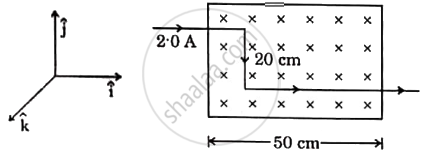
A part of a wire carrying 2.0 A current and bent at 90° at two points is placed in a region of uniform magnetic field `vec B = -(0.50 T)vec k`, as shown in the figure. Calculate the magnitude of the net force acting on the wire.
Chapter:
A parallel beam of monochromatic light falls normally on a single slit of width ‘a’ and a diffraction pattern is observed on a screen placed at distance D from the slits. Explain:
- the formation of maxima and minima in the diffraction pattern.
- why the maxima go on becoming weaker and weaker with its increasing number (n)?
Chapter:
State two points of difference between the interference patterns obtained in Young’s double slit experiment and the diffraction pattern due to a single slit.
Chapter: [10] Wave Optics
Explain the construction and working of a ‘Compound Microscope’.
Chapter: [9] Ray Optics and Optical Instruments
The real image of an object placed between f and 2f from a convex lens can be seen on a screen placed at the image location. If the screen is removed, is the image still there? Explain.
Chapter:
You have learnt that plane and convex mirrors produce virtual images of objects. Can they produce real images under some circumstances? Explain.
Chapter: [9] Ray Optics and Optical Instruments
Other Solutions
Submit Question Paper
Help us maintain new question papers on Shaalaa.com, so we can continue to help studentsonly jpg, png and pdf files
CBSE previous year question papers Class 12 Physics with solutions 2025 - 2026
Previous year Question paper for CBSE Class 12 Physics-2026 is solved by experts. Solved question papers gives you the chance to check yourself after your mock test.
By referring the question paper Solutions for Physics, you can scale your preparation level and work on your weak areas. It will also help the candidates in developing the time-management skills. Practice makes perfect, and there is no better way to practice than to attempt previous year question paper solutions of CBSE Class 12.
How CBSE Class 12 Question Paper solutions Help Students ?
• Question paper solutions for Physics will helps students to prepare for exam.
• Question paper with answer will boost students confidence in exam time and also give you an idea About the important questions and topics to be prepared for the board exam.
• For finding solution of question papers no need to refer so multiple sources like textbook or guides.
