Advertisements
Advertisements
प्रश्न
Four long straight thin wires are held vertically at the corners A, B, C and D of a square of side ‘a’, kept on a table and carry equal current ‘I’. The wire at A carries current in an upward direction, whereas the current in the remaining wires flows in downward direction. The net magnetic field at the centre of the square will have the magnitude:
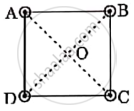
विकल्प
`(mu_0 I)/(pi a)` and directed along OC
`(mu_0 I)/(pi a sqrt 2)` and directed along OD
`(mu_0 I sqrt2)/(pi a)` and directed along ОВ
`(2 mu_0 I)/(pi a)` and directed along OA
Advertisements
उत्तर
`bb((mu_0 I sqrt2)/(pi a) "and directed along ОВ")`
Explanation:
Magnetic field due to a long straight current-carrying wire:
B = `(mu_0 I)/(2 pi r)`
Distance from centre to each corner:
r = `a/sqrt 2`
Thus field due to each wire:
B0 = `(mu_0 I)/(2 pi r)`
= `(mu_0 I)/(2 pi(a/sqrt 2))`
= `(mu_0 I sqrt 2)/(2 pi a)`
Each magnetic field makes a 45° angle with the diagonals. Effective components add vectorially, giving:
Bnet = 2B0
= `2 xx (mu_0 I sqrt 2)/(2 pi a)`
= `(mu_0 I sqrt 2)/(pi a)`
From vector addition, the resultant is along the diagonal OB.
