Advertisements
Advertisements
प्रश्न
Read the following paragraph and answer the questions that follow.
|
The electric potential (V) and electric field (E) are closely related concepts in electrostatics. The electric field is a vector quantity that represents the force per unit charge at a given point in space, whereas electric potential is a scalar quantity that represents the potential energy per unit charge at a given point in space. Electric field and electric potential are related by the equations Er = `(-d V)/(d r)` and `vec E = E_r hat r`, i.e., electric field is the negative gradient of the electric potential. This means that electric field points in the direction of decreasing potential and its magnitude is the rate of change of potential with distance. The electric field is the force that drives a unit charge to move from higher potential region to lower potential region and electric potential difference between the two points determines the work done in moving a unit charge from one point to the other point.
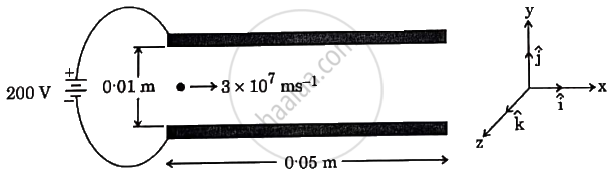
A pair of square conducting plates having sides of length 0.05 m are arranged parallel to each other in x-y plane. They are 0.01 m apart along z-axis and are connected to a 200 V power supply as shown in the figure. An electron enters with a speed of 3 × 10⁷ ms−1 horizontally and symmetrically in the space between the two plates. Neglect the effect of gravity on the electron. |
(i) The electric field `vec E` in the region between the plates is ______.
- `(2 xx 10^2 V/m)hat k`
- `-(2 xx 10^2 V/m)hat k`
- `(2 xx 10^4 V/m) hat k`
- `-(2 xx 10^4 V/m)hat k`
(ii) In the region between the plates, the electron moves with an acceleration `vec a` given by ______.
- `-(3.5 xx 10^15 ms^-2)hat k`
- `(3.5 xx 10^15 ms^-2)hat k`
- `(3.5 xx 10^13 ms^-2)hat i`
- `-(3.5 xx 10^13 ms^-2)hat i`
(iii) (a) Time interval during which an electron moves through the region between the plates is ______.
- 9.0 × 10⁻⁹ s
- 1.67 × 10⁻⁸ s
- 1.67 × 10⁻⁹ s
- 2.17 × 10⁻⁹ s
OR
(b) The vertical displacement of the electron which travels through the region between the plates is ______.
- 10 mm
- 4.9 mm
- 5.9 mm
- 3.0 mm
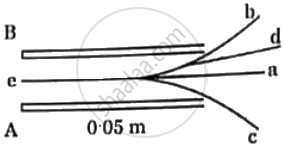
(iv) Which one of the following is the path traced by the electron in between the two plates?
- a
- b
- c
- d
Advertisements
उत्तर
(i) The electric field `vec E` in the region between the plates is `bbunderline((2 xx 10^4 V/m) hat k)`.
Explanation:
The electric field points from the higher potential plate to the lower potential plate.
V = 200 V
d = 0.01m
For parallel plates (E) = `V/d`
= `200/0.01`
= 2 × 10⁴ V/m
From the figure, field is along +z direction. Unit vector along z-axis is `hat k`.
∴ `vec E = 2 xx 10^4 hat k` V/m
(ii) In the region between the plates, the electron moves with an acceleration `vec a` given by `bbunderline(-(3.5 xx 10^15 ms^-2)hat k)`.
Explanation:
Force on a charge in an electric field `(vec F) = q vec E`
Acceleration `(vec a) = (q vec E)/m`
For electron:
q = −e
From the previous result:
`vec E = 2 xx 10^4 hat k` V/m
By using electron charge and mass:
e = 1.6 × 10⁻¹⁹ C
me = 9.1 × 10⁻³¹ kg
a = `(e E)/m`
= `(1.6 xx 10^-19 xx 2 xx 10^4)/(9.1 xx 10^-31)`
= `(3.2 xx 10^-15)/(9.1 xx 10^-31)`
≈ 3.5 × 10¹⁵ m s−2
An electron has a negative charge, so acceleration is opposite to the field. Field is along `+hat k` gives acceleration along `-hat k`.
∴ `vec a = -3.5 xx 10^15 hat k m s^-2`
(iii) (a) Time interval during which an electron moves through the region between the plates is 1.67 × 10⁻⁹ s.
Explanation:
Given: Plate length = 0.05 m
vx = 3 × 10⁷ m/s
Time of travel (t) = `"distance"/"velocity"`
= `0.05/(3 xx 10^7)`
= `(5 xx 10^-2)/(3 xx 10^7)`
= 1.67 × 10⁻⁹ s
OR
(b) The vertical displacement of the electron which travels through the region between the plates is 4.9 mm.
Explanation:
Electron experiences vertical acceleration due to electric field, while horizontal motion is uniform.
a = 3.5 × 10¹⁵ m s−2
t = 1.67 × 10⁻⁹ s
Vertical displacement (y) = `1/2 at^2`
= `1/2 xx 3.5 xx 10^15 xx (1.67 xx 10^-9)^2`
= 0.5 × 3.5 × 2.79 × 10−3
≈ 4.9 × 10⁻³ m
∴ y = 4.9 mm
(iv) c
Explanation:
An electron enters horizontally with velocity along the x-axis and experiences no force in the horizontal direction, giving uniform motion. Constant vertical acceleration due to the electric field produces projectile-like motion. The motion is similar to uniform velocity in the x-direction and uniform acceleration in the vertical direction. Hence, the trajectory is a parabola.
From earlier results, the electric field is along `+hat k`, and the electron (negative charge) accelerates opposite. The path should start horizontally and curve downward gradually (parabolic path).
