Advertisements
Advertisements
प्रश्न
Write the name and chemical formula of the simplest organic acid.
Advertisements
उत्तर
The simplest organic acid is formic acid (methanoic acid) with the chemical formula HCOOH.
APPEARS IN
संबंधित प्रश्न
Consider the following comments about saponification reactions:
I. Heat is evolved in these reactions.
II. For quick precipitation of soap, sodium chloride is added to the reaction mixtures.
III. Saponification reactions are a special kind of neutralisation reactions.
IV. Soaps are basic salts of long-chain fatty acids.
The correct comments are
(a) I, II and III
(b) II, III and IV
(c) I, II and IV
(d) Only I and IV
Complete the following chemical equations: C2H5OH+O2→
Choose the correct alternative and rewrite the following:
Acetic acid ..................
Write the IUPAC names, common names and formulae of the first two members of the homologous series of carboxylic acids.
Draw the structure for the following compound.
Ethanoic acid
Name the gas evolved when ethanoic acid is added to sodium carbonate. How would you prove the presence of this gas?
How would you distinguish experimentally between an alcohol and carboxylic acid on the basis of a chemical property?
How is ethanoic acid obtained from ethanol? Write down the chemical equation of the reaction involved.
Esters are sweet-smelling substances and are used in making perfumes. Describe an activity for the preparation of an ester with the help of a well labelled diagram. Write an equation for the chemical reaction involved in the formation of the ester. Also write the names of all the substances involved in the process of esterification.
The substance which can produce brisk effervescence with baking soda solution is:
(a) ethanol
(b) vegetable oil
(c) vinegar
(d) soap solution(b) hydrocarbon ends directed towards the centre and ionic ends directed outwards
In a soap micelle, the soap molecules are arranged radially with the hydrocarbon ends, i.e. hydrophobic, directed towards the centre; and, ionic ends, i.e. hydrophilic, directed outwards.
Write the IUPAC name of the following:
\[\begin{array}{cc}
\ce{CH3}\\
|\\
\ce{CH3 -C -CH3}\\
|\\
\ce{CH3}
\end{array}\]
A student puts a drop of acetic acid first on a blue litmus paper and then on a red litmus paper. He would observe that
(A) the red litmus paper turns colourless and there is no change in the blue litmus paper.
(B) the red litmus paper turns blue and the blue litmus paper turns red.
(C) there is no change in the red litmus paper and the blue litmus paper turns red.
(D) there is no change in the blue litmus paper and the red litmus paper turns blue.
Convert ethane to acetic acid.
Explain the following reaction with an example.
Saponification
What are catalysts?
Observe the figure and write the answers to the following questions.
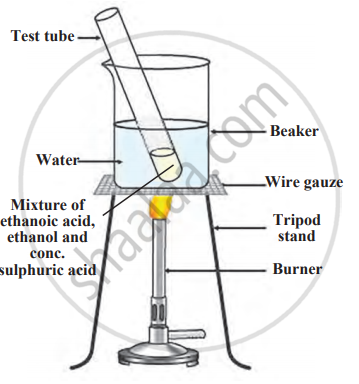
- Write the name of the reaction shown in the following figure.
- Write the above chemical reaction in the form of a balanced equation.
- Write the name of the product produced in the above reaction, write a use.
- Write the name of the catalyst used in the above reaction.
Vinegar is a solution of ______.
Which of the following substance produces brisk effervescence with baking soda solution?
What happens when a small piece of sodium is dropped in ethanol? Write the equation for this reaction.
Give the balanced chemical equation of the following reaction:
Oxidation of ethanol by acidified potassium dichromate.
