Advertisements
Advertisements
प्रश्न
Name the gas evolved when ethanoic acid is added to sodium carbonate. How would you prove the presence of this gas?
Advertisements
उत्तर
Carbon dioxide evolves when ethanoic acid is added to sodium carbonate.
2CH3COOH + Na2CO3 → 2CH3COONa + CO2 + H2O
When the gas evolved during this reaction, is passed through the lime water in a test tube, the latter turns milky. This indicates that the gas evolved is carbon dioxide.
APPEARS IN
संबंधित प्रश्न
While studying saponification reaction for the preparation of soap, a teacher suggested to a student to add a small quantity of common salt to the reaction mixture. The function of common salt in this reaction is to
(A) reduce the alkalinity of the soap
(B) reduce the acidity of the soap
(C) enhance the cleansing capacity of soap
(D) favour precipitation of soap
Choose the correct alternative and rewrite the following:
Acetic acid ..................
When zinc powder is added to acetic acid ______________
(a) the mixture becomes warm
(b) a gas is evolved
(c) the colour of the mixture becomes yellow
(d) a solid settles at the bottom
Give the name and structural formula of one homologue of HCOOH.
What type of compound is formed when a carboxylic acid reacts with an alcohol in the presence of conc. H2SO4?
When ethanoic acid reacts with sodium hydrogen carbonate, then a salt X is formed and a gas Y is evolved. Name the salt X and gas. Y Describe an activity with the help of a labelled diagram of the apparatus used to prove that the evolved gas is the one which you have named. Also write the chemical equation of the reaction involved.
An organic acid X is a liquid, which often freezes during winter time in cold countries, having the molecular formula C2H4O2. On warming it with methanol in the presence of a few drops of concentrated sulphuric acid, a compound Y with a sweet smell is formed.
(a) Identify X and Y. Also write their formulae showing the functional group present in them.
(b) Write a chemical equation for the reaction involved.
What do you notice when acetic acid reacts with alkalies?
Name the substance used to change acetic acid to acetic anhydride?
On adding acetic acid to sodium hydrogen carbonate in a test tube, a student observes
(A) no reaction
(B) a colourless gas with pungent smell
(C) bubbles of a colourless and odourless gas
(D) a strong smell of vinegar
Which one of the following are the correct observations about acetic acid?
(A) It turns blue litmus red and smells like vinegar
(B) It turns blue litmus red and smells like burning sulphur
(C) It turns res litmus blue and smells like vinegar
(D) It turns red litmus blue and has a fruity smell
How Will You Carry Out the Following Conversions?
Ehane to acitic acid
Using appropriate catalysts, ethane can be oxidized to an alcohol. Name the alcohol formed when ethane is oxidized.
State how the following conversions can be carried out:
Ethene to Ethyl alcohol.
Write a balanced chemical equation for the following:
A mixture of sodalime and sodium acetate is heated.
Observe the figure and write the answers to the following questions.
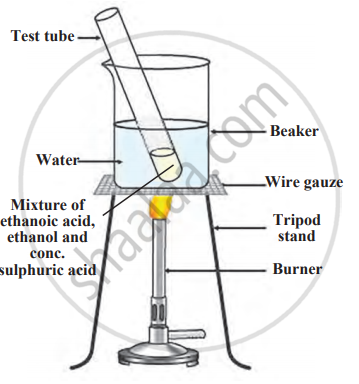
- Write the name of the reaction shown in the following figure.
- Write the above chemical reaction in the form of a balanced equation.
- Write the name of the product produced in the above reaction, write a use.
- Write the name of the catalyst used in the above reaction.
Ester is formed by the reaction between ______.
Why is glacial acetic acid called so?
Raina while doing certain reactions observed that heating of substance ‘X’ with a vinegar-like smell with a substance ‘Y’ (which is used as an industrial solvent.) in the presence of conc. Sulphuric acid in a water bath gives a sweet-smelling liquid ‘Z’ having molecular formula C4H8O2. When heated with caustic soda (NaOH), ‘Z’ gives back the sodium salt and the compound ‘Y’.
Identify ‘X’, ‘Y’, and ‘Z’. Illustrate the changes with the help of suitable chemical equations.
A spatula full of sodium carbonate is taken in a test tube and 2 mL of dilute ethanoic acid is added to it.
Write a chemical equation for the reaction.
