Advertisements
Advertisements
प्रश्न
With reference to elements – define the term ‘molecule’. Give two examples each of a monoatomic, diatomic & polyatomic molecule.
Advertisements
उत्तर
Molecule: Atoms of the same element or different elements combine to form a molecule. It is the smallest particle of a substance – which can normally exist independently and can retain, the physical and chemical properties of the substance.
Examples
Monoatomic molecule: Metals – Na, Mg, etc.
Diatomic molecule: H2, O2, N2.
Polyatomic molecule: O3, P4.
APPEARS IN
संबंधित प्रश्न
State four differences between compounds and mixtures.
Indicate whether the following statement is true or false:
Molecules can exist independently.
Tick (√) the correct alternative from the choice given for the following statement.
All pure substances have
Select the correct answer from the choice given below.
An impure substance
Write the names of elements from the following symbol:
Si
Select the correct answer to the statement given below:
A metalloid
The diagram represents fractional distillation for the separation of mixtures. Answer the following :
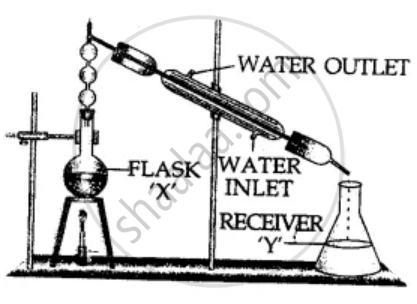
- Can two immiscible liquids be separated by this process?
- Separation of liquids by this process is based on which physical property?
- If methyl alcohol & water are to be separated, which liquid would remain in flask ‘X’ after condensation.
- Give a reason for the above answer.
- State the purpose of the fractionating column in the apparatus.
Select the correct answer from the choice given below to complete the sentence :
Compounds are ____________ in nature.
Name the element which is used for making computer chips.
What is the Latin name of Sodium?
