Advertisements
Advertisements
प्रश्न
Give three differences between elements & compounds with relevant examples.
Advertisements
उत्तर
Three differences between elements and compounds :
Element :
- They contain one kind of atoms only e.g. element (Na) Sodium and [Cl] chlorine.
- The elements have their own set of properties e.g. [H] Hydrogen is combustible.
- They cannot be broken down into two or simpler substances by physical or chemical means.
Compound :
- They contain two or more kinds of atoms, e.g. compound — water [H2O].
- The Properties of compounds are entirely new i.e. water [H20] is a liquid and can extinguish the fire.
- It cannot be broken down into two or simpler substances by chemical means.
APPEARS IN
संबंधित प्रश्न
Give one example for the following type of mixtures
solid-solid homogenous mixture.
State the number of atoms of C6H12O6
Name: Three different forms of carbon
Name: Two substances used to make electric wires
Answer the following question:
Why are copper and aluminium used to make electric wires?
Classify substances into pure and impure substances in the form of a chart or tabulation.
Select the correct answer from the choice given below.
The unreactive non-metallic element
Give a reason for the following statement:
Components in a mixture are present in varying proportions and not in a fixed proportion.
Select the correct answer from A, B, C, D & E for the statement given below :
A non-metal that is lustrous.
Higher Order Thinking Skills.
In the diagram given below, the circle, square and triangle represent the atoms of different elements.
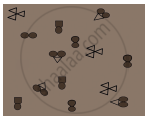
Identify all combinations that represent
- molecule of a compound
- molecule of an element consisting of two atoms
- molecule of an element consisting of three atoms
