Advertisements
Advertisements
प्रश्न
Will the angular momentum of a planet be conserved? Justify your answer.
Advertisements
उत्तर
The torque experienced by the Earth due to the gravitational force of the Sun is given by,
`vecτ = vec"r" xx vec"F" = vec"r" xx (-("GM"_"S""M"_"E")/"r"^2 hat"r") = 0`
Since `vec"r" = "r", hat"r", (hat"r" xx hat"r") = 0`
So `vecτ = ("d" vec"L")/"dt" = 0`
It implies that angular momentum `vec"L"` is a constant vector. Hence L is conserved.
APPEARS IN
संबंधित प्रश्न
If the masses of the Earth and Sun suddenly double, the gravitational force between them will ___________.
A planet moving along an elliptical orbit is closest to the Sun at distance r1 and farthest away at a distance of r2. If v1 and v2 are linear speeds at these points respectively. Then the ratio `"v"_1/"v"_2` is
If the distance between the Earth and Sun were to be doubled from its present value, the number of days in a year would be ___________.
The work done by the Sun’s gravitational force on the Earth is __________.
Define the gravitational field.
What is meant by the superposition of the gravitational field?
Define gravitational potential energy.
If the ratio of the orbital distance of two planets `"d"_1/"d"_2` = 2, what is the ratio of gravitational field experienced by these two planets?
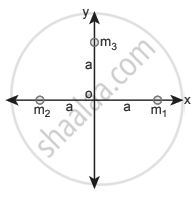
Calculate the gravitational field at point O due to three masses m1, m2 and m3 whose positions are given by the following figure. If the masses m1 and m2 are equal what is the change in a gravitational field at the point O?
What is the gravitational potential energy of the Earth and Sun? The Earth to Sun distance is around 150 million km. The mass of the Earth is 5.9 × 1024 kg and the mass of the Sun is 1.9 × 1030 kg.
