Advertisements
Advertisements
प्रश्न
Why do the grown-ups tell the children not to talk with their mouth full?
Advertisements
उत्तर
The grown-ups tell the children not to talk with their mouth ful of food because it is bad manners to talk while eating.
संबंधित प्रश्न
Why does the world remember Einstein as a “world citizen”?
Read the comic strip based on. H.G. Wells' novells.


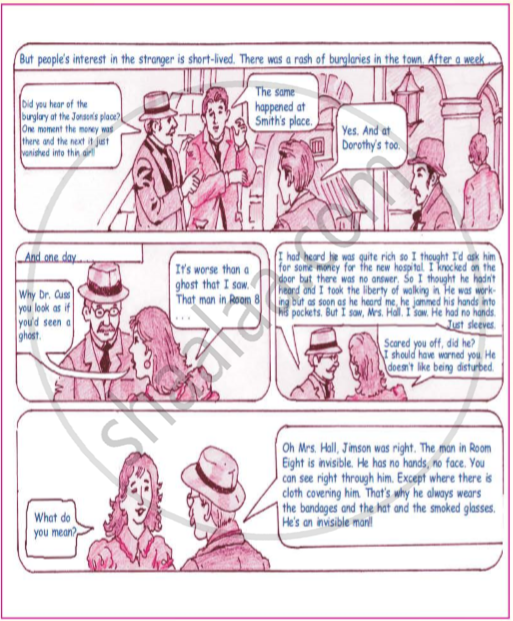
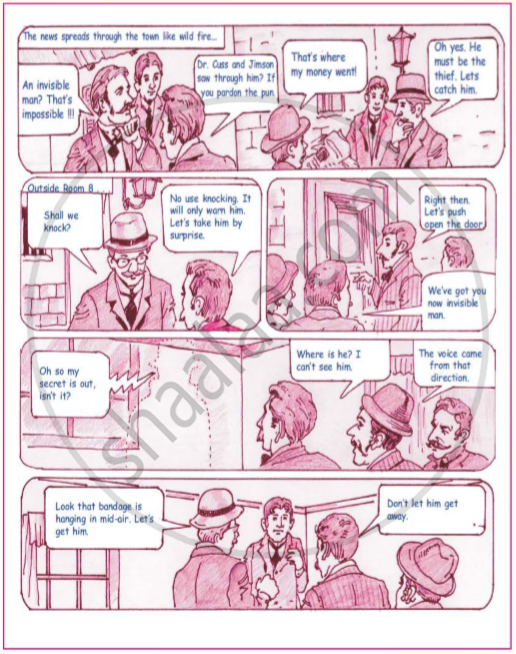
Answer the questions by ticking the correct option.
(a) The strange-looking man wanted ....
(i) the best room at the inn.
(ii} a room with a fire and a good lock.
(iii} a room with a good view.
(iv) a room where he could work quietly.
(b) Jimson was suspicious of the stranger because ...
(i} he did not answer Jimson's questions.
(ii} he did not want to talk about the weather.
(iii} he kept his back turned towards Jimson at all times.
(iv) he shouted atJimson when he entered his room.
(c) The people of the town gossiped about the stranger as ...
(i} he did not go out or talk to anyone in the town.
(ii} he had met with an accident and his face was bandaged.
(iii} he was new to the town and behaved rudely.
(iv) he stayed in his room and did not show his face to anyone.
(d) 'There was a rush of burglaries in the town. This means that ________
(i} there were many robberies in the town.
(ii) a few people in the town had seen a rob her.
(iii} the burglaries in the town were done in a rush.
(iv) the burglar was a rash and careless man.
(e) Although Jimson and Dr Cuss are suspicious of the strange guest, Mrs Hall tolerates him because ....
(i} she is not superstitious or ignorant.
(ii) she is sorry for the stranger who is bandaged.
(iii} the stranger is paying her a good amount of money for the room.
(iv} the stranger is polite and kind to Mrs Hall at all times.
(f) The stranger who was staying at the inn can be described as being ....
(I} violent
(ii} upright
(iii} dishonest
(iv) sensible
"They say it was a shocking sight
After the field was won;
For many thousand bodies here
Lay rotting in the sun;
But things like that, you know, must be
After a famous victory.
"Great praise the Duke of Marlbro'won,
And our good Prince Eugene."
"Why,'twas a very wicked thing!"
Said little Wilhelmine.
"Nay...nay...my little girl,"quoth he,
"It was a famous victory.
"And everybody praised the Duke
Who this great fight did win."
"But what good came of it at last?"
Quoth little Peterkin.
"Why that I cannot tell,"said he,
"But 'twas a famous victory."
Read the lines given above and answer the question that follow.
How do the skulls symbolize the theme in “The Battle of Blenheim”?
Oh yes, we know it keeps them still,
They don't climb out the window sill,
They never fight or kick or punch,
They leave you free to cook the lunch
And wash the dishes in the sink....
But did you ever stop to think,
To wonder just exactly what
This does to your beloved tot?
IT ROTS THE SENSE IN THE HEAD!
IT KILLS IMAGINATION DEAD!
IT CLOGS AND CLUTTERS UP THE MIND!
IT MAKES A CHILD SO DULL AND BLIND
HE CAN NO LONGER UNDERSTAND
A FANTASY, A FAIRYLAND!
HIS BRAIN BECOMES AS SOFT AS CHEESE!
HIS POWERS OF THINKING RUST AND FREEZE!
HE CANNOT THINK - HE ONLY SEES!
Read the lines given above and answer the question given below.
Explain with reference to context.
The athletes had come from all over the country
To run for the gold, for the silver and bronze
Many weeks and months of training
All coming down to these games.
The spectators gathered around the old field
To cheer on all the young women and men
The final event of the day was approaching
Excitement grew high to begin.
Read the lines given above and answer the following question:
What do the words ‘gold’, ‘silver’ and ‘bronze’ stand for in the poem?
Sibia sprang.
From boulder to boulder she came leaping like a rock goat. Sometimes it had seemed difficult to cross these stones, especially the big gap in the middle where the river coursed through like a bulge of glass. But now she came on wings, choosing her footing in midair without even thinking about it, and in one moment she was beside the shrieking woman. In the boiling bloody water, the face of the crocodile, fastened round her leg, was tugging to and fro, and smiling. His eyes rolled on to Sibia. One slap of the tail could kill her. He struck. Up shot the water, twenty feet, and fell like a silver chain. Again! The rock jumped under the blow. But in the daily heroism of the jungle, as common as a thorn tree, Sibia did not hesitate. She aimed at the reptile’s eyes. With all the force of her little body, she drove the hayfork at the eyes, and one prong went in—right in— while its pair scratched past on the horny cheek. The crocodile reared up in convulsion, till half his lizard body was out of the river, the tail and nose nearly meeting over his stony back. Then he crashed back, exploding the water, and in an uproar of bloody foam he disappeared. He would die. Not yet, but presently, though his death would not be known for days; not till his stomach, blown with gas, floated him. Then perhaps he would be found upside down among the logs at the timber boom, with pus in his eye. Sibia got arms round the fainting woman, and somehow dragged her from the water.
Read the extract given below and answer the question that follow.
Why does Sibia think of the two brass vessels when the Gujar woman is attacked?
Then there it lay in her wet palm, perfect, even pierced ready for use, with the sunset shuffled about inside it like gold—?dust. All her heart went up in flames of joy. After a bit she twisted it into the top of her skirt against her tummy so she would know if it burst through the poor cloth and fell. Then she picked up her fork and sickle and the heavy grass and set off home. Ai! Ai! What a day! Her barefeet smudged out the wriggle— ?mark of snakes in the dust; there was the thin singing of malaria mosquitoes among the trees now; and this track was much used at night by a morose old makna elephant—the Tuskless One; but Sibia was not thinking of any of them. The stars came out: she did not notice. On the way back she met her mother, out of breath, come to look for her, and scolding. “I did not see till I was home, that you were not there. I thought something must have happened to you.” And Sibia, bursting with her story, cried “Something did). I found a blue bead for my necklace, look!”
Read the extract given below and answer the question that follow.
Is the Ending Appropriate?
So after that, dimly, dimly, she sensed it, she was different and they knew her difference and kept away. There was talk that her father and mother were taking her back to Earth next year; it seemed vital to her that they do so, though it would mean the loss of thousands of dollars to her family. And so, the children hated her for all these reasons of big and little consequence. They hated her pale snow face, her waiting silence, her thinness, and her possible future. “Get away 1” The boy gave her another push. “What’re you waiting for?”Then, for the first time, she turned and looked at him. And what she was waiting for was in her eyes. “Well, don’t wait around here !” cried the boy savagely. “You won’t see nothing!” Her lips moved. “Nothing 1” he cried. “It was all a joke, wasn’t it?” He turned to the other children. “Nothing’s happening today. Is it ?”
Read the extract given below and answer the question that follow.
What was Margot waiting for? Why did William say it was a joke?
Why do the worker ants carry the grubs about?
A camel can do without water for days together. What is the reason given in the text?
The following sentences has two blanks. Fill in the blanks with appropriate forms of the word given in brackets.
I didn’t notice any serious_________ of opinion among the debaters, although they_________ from one another over small points. (differ)
Why did Soapy like to go to the prison?
Why did the farmer bring a baby mongoose into the house?
‘The monkey was scared and depressed’. Why? .
Who oiled the motor?
Is it good to play with snakes which are not very dangerous?
Word in the box given below indicates a large number of… For example, ‘a herd of cows’ refers to many cows.
Complete the following phrase with a suitable word from the box.
a _________________ of ships
Make noun from the word given below by adding –ness, ity, ty or y
honest ___________.
Multiple Choice Question:
What does the expression Whatif mean?
Which of the following statements is used by Angelou to describe the caged bird?
