Advertisements
Advertisements
प्रश्न
Why do some states of India have higher rates of work participation than others?
Advertisements
उत्तर
The work participation rate is the number of people engaged in economic activities. Some states of India like Himachal Pradesh, Sikkim, Chhattisgarh, Andhra Pradesh, etc. tend to have higher work participation rates. The work participation rate tends to be higher in the areas of lower levels of economic development since the number of manual workers is needed to perform the subsistence or near subsistence economic activities in the absence of other opportunities.
APPEARS IN
संबंधित प्रश्न
Give geographical reasons:
Literacy rate of a country is an indicator of its socio-economic development.
A person who can write, read and do mathematical calculations in the country is known as ______.
Give geographical reason
Demographic dividend increases when proportion of working population increases.
Identify the incorrect factor:
Regions having sex ratio more than one thousand.
Identify the incorrect factor
Pull factors of migration:
Observe the following graph and answer the question given below

Question:
- Which region has the highest literacy rate?
- Which region has the lowest literacy rate?
- In which region does women fare better than men in literacy rate?
- Write a concluding paragraph about the graph.
- Which is the type of graph?
Which states have a large rural population in India? Give one reason for such a large rural population.
‘The agricultural sector has the largest share of Indian workers.’ – Explain.
Which regions have an unfavorable sex ratio towards women?
Describe the main characteristics of each of the major groups of human occupations in the world.
Which state has the lowest literacy rate?
Which state has the highest % of the rural population?
A worker is known as main worker, who works atleast ____________.
Which one of the following country lowest sex ratio in the world?
How many types of Age-Sex Pyramid?
Bell shaped Pyramid refers to ______.
According to the UNO, how many countries have sex ratio unfavourable for females?
Study the given graph carefully and answer the following question:
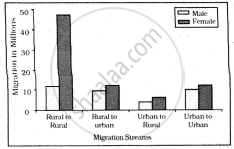
Intra-state Migration by place of Last Residence Indicating Migration Streams India, 2011
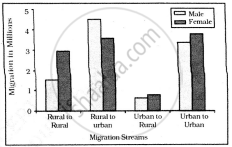
Inter-state Migration by Place of Last Residence Indicating Migration Streams India, 2011
Which stream of migration shows the lowest trend in interstate migration?
Study the given graph carefully and answer the following question:
Intra-state Migration by place of Last Residence Indicating Migration Streams India, 2011
Inter-state Migration by Place of Last Residence Indicating Migration Streams India, 2011
What is the main cause of female migration from rural to urban?
Study the given graph carefully and answer the following question:
Intra-state Migration by place of Last Residence Indicating Migration Streams India, 2011
Inter-state Migration by Place of Last Residence Indicating Migration Streams India, 2011
Which stream of migration shows the lowest trend in intra-state migration?
The highest sex ratio is found in:
Mining is a ______.
Arrange according to increase in age :
- Adults
- Children
- Old people
- Young people
Which one of the following is the largest linguistic group of India?
Write a short note on:
Demographic dividend.
Which one of the following is the largest linguistic group of India?
Which one of the following is the largest linguistic group of India?
Which one of the following is the largest linguistic group of India?
