Advertisements
Advertisements
प्रश्न
Why did the bearded man press his stomach with his hand?
Advertisements
उत्तर
The bearded man pressed his stomach because he was wounded and wanted to stop blood flowing out from his wound.
संबंधित प्रश्न
Tick the right answer.
When something is considered auspicious, (welcome it/avoid it).
Thinking about the Poem
How many common features can you find in stanza 2? Pick out the words.
Read these sentences from the story.
1. We will go to the old man.
2. Iwillopenmyhands.
3. It will flyaway.
4. I will crush the butterfly.
The modal will is used to talk about a temporary event in progress at some
point in future.
Will is used to denote _________ time.
Did you know?
There are different constructions in English which can be used to refer to
future time.
1. Use of the simple present tense.
a. The IPL begins on 20th April.
b. If the newly introduced vaccine works, AIDS can be cured.
2. Use of shall/will
Will/shall is used to make a prediction about future events, in
advertisements, posters etc.
e.g. a. You will win the 1st prize.
b. The Nano car will be on the roads soon.
c. You shall lead a happy life.
3. Use of going to
Going to is normally used to refer to future events in two cases
(a) If there is a present indication of the future event.
e.g. India is going to emerge as a Super Power in 2020.
(b) to express intention
e.g. Smitha is going to marry Akshay.
4. Use of present continuous tense (be+ verb+ ing)
Present continuous tense is used to refer to future events that have been
already planned.
e.g. a. I'm meeting the Project Manger this evening.
b. I'm sorry I can't meet you tomorrow. I'm visiting my friend.
5. Use of be + about to + infinitive.
e.g. The train is about to leave.
6. Useofbe+to+v
e.g. Obama is to visit India in October.
Read the following passage carefully and answer the questions that follow:
Every Monday, on his way back from work, Bipin Chowdhury would drop in at New Market to buy books. He had to buy at least five at a time to last him through the week. He lived alone, was not a good mixer, had few friends, and didn't like spending time in idle chat. Those who called in· the evening got through their business quickly and left. Those who didn't show signs of leaving would be told around eight o'clock by Bipin Babu that he was under doctor's orders to have dinner at eight-thirty. After dinner, he would rest for half an hour and then tum in with a book. This was a routine that had persisted unbroken for years
Today, Bipin Babu had the feeling that someone was observing him from close quarters. He turned around and found himself looking at a round-faced, meek-looking man who now broke into a smile.
"I don't suppose you recognize me." Bipin Babu felt ill at ease. It didn't seem that he had ever encountered this man before. The face seemed quite unfamiliar.
"Have we met before ?" asked Bipin Babu.
The man looked greatly surprised. "We met every day for a whole week. I arranged for a car to take you to the Hudroo falls. My name is Parimal Chose."
"Ranchi?"
Now Bipin Babu realized this man was making a mistake. Bipin Babu had never been to Ranchi. He smiled and said, "Do you know who I am?"
The man raised his eyebrows, and said, "Who doesn't know Bipin Chowdhury ?"
Bipin Babu turned towards the bookshelves and said, "You've to make a mistake. I've never been to Ranchi."
The man now laughed aloud.
"What are you saying, Mr. Chowdhury? You had a fall in Hudroo and cut your right knee. I brought you iodine. I had fixed up a car for you to go to Netarhat the next day, but you couldn't because of the pain in the knee. Can't you recall anything? Someone else you know was also in Ranchi at that time. Mr. Dinesh Mukherjee. You stayed in a bungalow. You said you didn't like hotel food. I'll tell you more; you always carried a bag with your books in it on your sightseeing trips. Am I right or not ?"
Bipin Babu spoke quietly, his eyes still on the books. "Which month in Nineteen fifty-eight are you talking about?"
The man said, "October."
"No, sir," said Bipin Babu. "I spent October Nineteen fifty-eight with a friend in Kanpur. You're making a mistake. Good day."
But the man didn't go, nor did he stop talking.
"Very strange. One evening I had tea with you on the verandah of your bungalow.
You spoke about your family. You said you had no children, and that you had lost your wife a decade ago."
When Bipin Babu had paid for the books and was leaving the shop, the man was still looking at him in utter disbelief.
Bipin Babu's car was safely parked in Bertram Street. He told the driver as he got into the car, "Just drive by the Ganga, will you, Sitaram." Driving up the Strand Road, Bipin Babu regretted having paid so much attention to the intn1der. He had never been to Ranchi. He had an excellent memory.
Unless he was losing his mind!
(a) Give the meaning of the following words as used in the passage.
One word answers or short phrases will be accepted.
(i) persisted (line 7)
(ii) decade (line 38)
(iii) intruder (line 43)
(b) Answer the following questions briefly in your our words:
(i) How did Bipin Chowdhury find time to read five books a week?
(ii) How did he get rid of visitors who stayed late?
(iii) Which sentence tells you that Bipin Babu will uncomfortable?
(iv) What strong argument did Bipin Babu give to prove that he was not in Ranchi at that time?
(v)What does Bipin Babu regret?
(vi) What is Bipin Babu's feelings at the end of the passage?
(c) (i) What memories of the trip does Parimal Ghose evoke to prove that Bipin Babu was indeed in Ranchi? Answer in not more than 60 words.
(ii) Give a title to your summary in 3(c) (i), Give a reason to justify your choice.
Answer the following question.
Golu’s relatives did not answer his questions because
The following sentence has two blanks. Fill in the blanks with appropriate forms of the word given in brackets.
The committee has_______ to make Jagdish captain of the team. The_________is likely toplease everyone. (decide)
Describe Nishad as a child.
Why do the ants train the greenfly?
When and how did Timothy become unfriendly?
What does the last sentence of the story suggest? What would the crocodile tell his wife?
Are all our dreams probable or improbable?
Why is Prem determined not to return to his village?
Why the chopped down trees are called timber?
Watch a tree or a plant, or walk across a field or park at the same time everyday for a week. Keep a diary of what you see and hear. At the end of the week, write a short paragraph or a poem about your experiences. Put your writing up on the class bulletin board.
Which line shows a complete change of the child’s attitude towards snakes? Read it aloud.
Fill in the blank in the sentence below with the words or phrases from the box. (You may not know the meaning of all the words. Look such words up in a dictionary, or ask your teacher.)
I started early to be on time, but I was ______. There was a traffic jam!
Multiple Choice Question:
According to the poet, a lot is left unsaid because of _________.
Look at the following picture. One asks a question, the other answers it. Then the answer is noted in a form as shown below.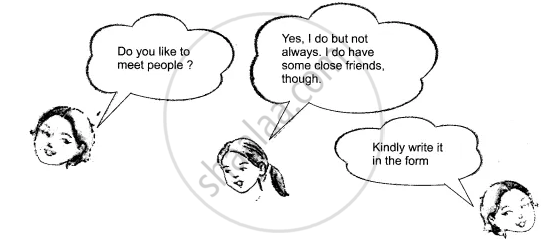
| Questions | Yes/No | Additional Response |
|
1. Do you like to meet people? |
Yes I do, but not always | I do have some close friends, though. |
|
2. Do you like the area you live in? |
No, I Don't | But I have no choice |
What feeling of the poet is exhibited in his peeping through the window?
Why did the daimio reward the farmer, but punish his neighbour for the same act?
