Advertisements
Advertisements
प्रश्न
Which one of the following is not the objective of NITI Aayog?
विकल्प
To provide strategic input to the development process of India.
To serve as a Think Tank of the Union government.
To arrange funds for the developmental programmes.
To put an end to the tardy implementation of the policies.
Advertisements
उत्तर
To arrange funds for the developmental programmes.
Explanation:
After the Planning Commission was abolished in 2014, the NITI Aayog was formed. It is not the role of this group to arrange finances for development.
APPEARS IN
संबंधित प्रश्न
Which of the following ideas did not form part of the early phase of India’s development policy ?
Match the following :
| (a) Charan Singh | (i) Industrialization |
| (b) PC Mahalanobis | (ii) Zoning |
| (c) Bihar Famine | (iii) farmers |
| (d) Verghese Kurien | (iv) Milk Cooperatives |
What were the major differences in the approach towards development at the time of Independence? Has the debate been resolved?
Which of the following is not a contributory factor for development?
The Socialist model of development was related to ______.
Planning Commission was scrapped on ______.
Who appoints the Vice-Chairperson of NITI Aayog?
Number of part-time members in NITI Aayog is ______.
Who amongst the following is the longest serving member of Tripura State Planning Board?
Which state was carved out of Assam from the following?
______ Policy has been adopted by NITI Aayog.
Consider these statements about NITI Aayog. Find the Wrong statement.
Observe the figure below and answer accordingly.
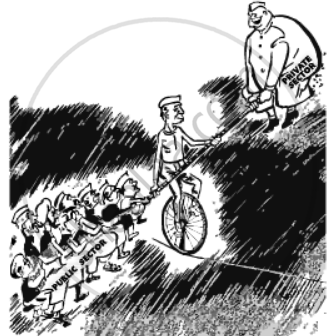
Who in the picture is balancing between the public and private sectors?
Observe the figure below and answer accordingly.
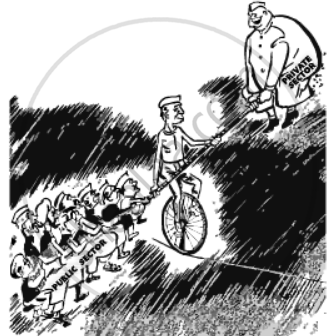
Why has a big tilt towards the public sector been shown in the cartoon?
Observe the figure below and answer accordingly.
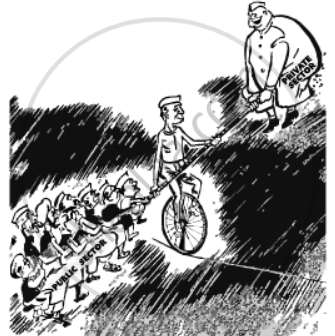
Which type of economic model was adopted by India?
The idea of planning in India was drawn from
- The Bombay plan
- Experiences of the Soviet bloc countries
- Gandhian vision of society
- Demand by peasant organisations
Planning Commission was scrapped on
Read the following passage and answer the question.
"In the early years of Independence, two contradictory tendencies were already well advanced inside the Congress Party. On the one hand, the national party executive endorsed socialist principles of state ownership, regulation, and control over key sectors of the economy in order to improve productivity and at the same time curb economic concentration. On the other hand, the national Congress ·government pursued liberal economic policies and incentives to private investment that was justified in terms of the sold criterion of achieving a maximum increase in production". - Francine Frankel
What is the contradiction that the author is talking about? What would be the political implications of a contradiction like this?
When was Planning Commission set up in India by a simple resolution of the government of India?
Which of the following is/are correct about the Bombay plan?
Choose the correct statement.
- The Club of Rome published a book in 1972 entitled Limits to Growth.
- In 1987, Brundtland Report, our common futures was published.
- The Rio Summit produced conventions dealing with climate change, and biodiversity forestry and recommended a list of development called Agenda 21.
- Common but differentiated responsibilities were declared at the Earth Summit in 1992.
Which of the following facts is/are incorrect about National Development Council?
Which factor was responsible for discouraging research and development in the manufacturing sector?
The idea of planning in India was drawn from
- The Bombay Plan
- Experiences of the Soviet Bloc countries
- Gandhian vision of Society
- Demand by Peasant organizations
Which of the following statements about NITI Aayog are true?
- NITI Aayog acts as a “think tank” of the Union Government.
- NITI Aayog acts against terrorism.
- NITI Aayog acts in the spirit of cooperative federalism.
- NITI Aayog decides more roles for bigger states and smaller roles for smaller states.
Choose the correct option:
