Advertisements
Advertisements
प्रश्न
What were the major differences in the approach towards development at the time of Independence? Has the debate been resolved?
Advertisements
उत्तर
At the time of independence, development was about becoming more like the industrialised countries of the West, to be involved with the break down of traditional social structure as well as rise of capitalism and liberalism.
1. Modernisation referred to growth, material progress and scientific rationality.
2. India had two models of modern development at the time of independence into considerations to be adopted i.e. the liberal capitalist model like Europe and the US and the socialist model like the USSR.
3. A debate had been occurred regarding adoption of model of development as communists, socialists and Pt. J.L. Nehru supported the socialist model to reflect a broad consensus to be developed during national movement.
4. Above mentioned intentions cleared that the government made the priority to poverty alleviation alongwith social and economic redistribution.
5. At the same time, these leaders differed and debated:
- Industrialisation should be the preferred path or
- Agricultural development should take place or
- Rural poverty should be alleviated.
APPEARS IN
संबंधित प्रश्न
Which of the following ideas did not form part of the early phase of India’s development policy ?
In India, planning was conceived as the main instrument of ______.
The Chairman of the National Development Council is ______.
Who among the following was the first chairman of Tripura State Planning Board?
Local Self Government intends to improve ______.
Tripura State Planning Board was set up in ______.
Engagement of local people in development project refers to ______.
The entire process of participatory development can be completed in ______.
NITI Aayog serves as a think-tank to promote ______ federation where government acts as a ______ with the help of technology. Select the correct option.
Why was the Planning Commission replaced by NITI Aayog?
Observe the figure below and answer accordingly.
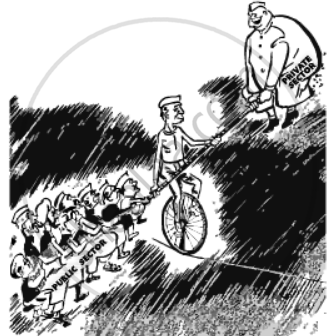
Who in the picture is balancing between the public and private sectors?
Observe the figure below and answer accordingly.
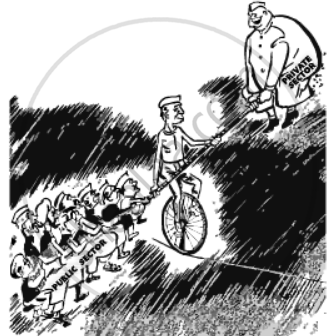
Why has a big tilt towards the public sector been shown in the cartoon?
Observe the figure below and answer accordingly.
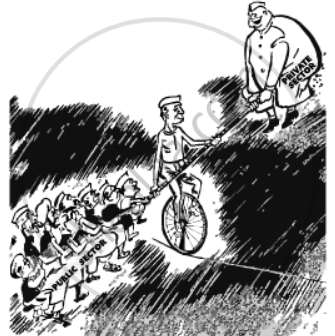
Which type of economic model was adopted by India?
The idea of planning in India was drawn from
- The Bombay plan
- Experiences of the Soviet bloc countries
- Gandhian vision of society
- Demand by peasant organisations
Planning Commission was scrapped on
Following are a few points given on the approach towards development at the time of Independence. Which of them is correct?
- The common perception of Development was becoming modernized which involved the breakdown of traditional social structure
- After independence India had two models of development one was Europe's and US's liberal capital model and the other USSR's socialist model.
- Many including the Communist Party of India and leaders like Nehru. were impressed by the Soviet model and very few favored the American models.
Which of the following is not a feature of Indian economic planning?
Read the following passage and answer the question.
"In the early years of Independence, two contradictory tendencies were already well advanced inside the Congress Party. On the one hand, the national party executive endorsed socialist principles of state ownership, regulation, and control over key sectors of the economy in order to improve productivity and at the same time curb economic concentration. On the other hand, the national Congress ·government pursued liberal economic policies and incentives to private investment that was justified in terms of the sold criterion of achieving a maximum increase in production". - Francine Frankel
What is the contradiction that the author is talking about? What would be the political implications of a contradiction like this?
What is the meaning and importance of economic planning in the Indian context?
Which of the following option is true in the context of the "Kerala Model"?
What is Plan Holiday?
Which two model of development India had adopted on the eve of independence?
Why did India adopt planning?
In which year was the NITI Aayog constituted?
Who was the first vice chairperson of NITI Aayog?
Choose the correct statement.
- The Club of Rome published a book in 1972 entitled Limits to Growth.
- In 1987, Brundtland Report, our common futures was published.
- The Rio Summit produced conventions dealing with climate change, and biodiversity forestry and recommended a list of development called Agenda 21.
- Common but differentiated responsibilities were declared at the Earth Summit in 1992.
