Advertisements
Advertisements
प्रश्न
When you take cells or tissue pieces and grind them with an acid in a mortar and pestle, all the small biomolecules dissolve in the acid. Proteins, polysaccharides and nucleic acids are insoluble in mineral acid and get precipitated. The acid soluble compounds include aminoacids, nucleosides, small sugars etc. When one adds a phosphate group to a nucleoside, one gets another acid soluble biomolecule called ______.
विकल्प
Nitrogen base
Adenine
Sugar phosphate
Nucleotide
Advertisements
उत्तर
When you take cells or tissue pieces and grind them with an acid in a mortar and pestle, all the small biomolecules dissolve in the acid. Proteins, polysaccharides and nucleic acids are insoluble in mineral acid and get precipitated. The acid soluble compounds include aminoacids, nucleosides, small sugars etc. When one adds a phosphate group to a nucleoside, one gets another acid soluble biomolecule called nucleotide.
Explanation:
Nucleotide = base + sugar + phosphate
APPEARS IN
संबंधित प्रश्न
The following statement applies to DNA only, some to RNA only, and some to both. Label them accordingly.
The polynucleotide contains guanine. (_______)
Write the sequence of the complementary strand for the following segment of a DNA molecule.
5' - CGTTTAAG - 3'
The sugar component of nucleotide unit in RNA is _________________
Sugar present in DNA is ___________
Draw structure of following.
2-Deoxy-D-ribose
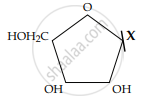
Given below is the diagrammatic representation of one of the categories of small molecular weight organic compounds in the living tissues. Identify the category shown & one blank component “ X” in it.
Distinguish between Nitrogen base and a base found in inorganic chemistry.
______ is a single ring compound.
Identify the monomer of nucleic acid.
Which pair of bases is present both in DNA and RNA?
Give any three differences between DNA and RNA.
Which of the following are substituted purines?
Which carbon atom of deoxy Ribose sugar in DNA does not contain \[\begin{array}{cc}|\phantom{...}\\\ce{- C - OH}\\|\phantom{....}\\ \end{array}\] bond?
Watson and Crick (1953) proposed DNA double helix model and won the Nobel Prize; their model of DNA was based on:
- X-ray diffraction studies of DNA were done by Wilkins and Franklin.
- Chargaff’s base equivalence rule
- Griffith's transformation experiment
- Meselson and Stahl's experiment
Which of the following are correct combination of purine bases?
Define the Nucleic acids.
Identify the INCORRECT statement regarding nuclein.
According to Chargaff's Rule, what is the relationship between purines and pyrimidines in DNA?
What is the primary function of DNA in living organisms?
