Advertisements
Advertisements
प्रश्न
What is the difference between pulmonary circulation and systemic circulation?
Distinguish between the two types of circulation in our body.
Differentiate between the Following.
Pulmonary and Systemic circulation
Advertisements
उत्तर १
| Pulmonary circulation | Systemic circulation | |
| 1. | This involves the circulation of blood between the heart and the lungs. | This involves the circulation of blood between the heart and body organs (except the lungs). |
| 2. | It carries deoxygenated blood to the lungs to receive oxygen. | It carries oxygenated blood to the body's organs. |
| 3. | It begins on the right ventricle and ends on the left auricle. | It starts at the left ventricle and ends at the right auricle. |
| 4. | It returns oxygenated blood back to the heart. | It returns deoxygenated blood back to the heart. |
| 5. | Blood flows as: Right ventricle > deoxygenated blood > Lungs > oxygenated blood > Left auricle. |
Blood flows as: Left ventricle > oxygenated blood > Body organs > deoxygenated blood > Right auricle. |
उत्तर २
| Systemic Circulation | Pulmonary Circulation |
| 1. Circulation of oxygenated blood from the left ventricle of the heart to various organs of the body. | 1. Circulation starts in the right ventricle of the heart and reaches the lungs with deoxygenated blood. |
| 2. Return of deoxygenated blood to the right atrium. | 2. Pulmonary Artery collects the oxygenated blood from the lungs. |
| 3. Aorta carries oxygenated blood to all the organs of the body. | 3. Oxygenated blood is supplied to the left atrium of the heart by the Pulmonary. |
Notes
Students can refer to the provided solutions based on their preferred marks.
APPEARS IN
संबंधित प्रश्न
What is meant by the term ‘single circulation’?
In which organ of our body does blood get oxygenated?
Blood in the human body circulates twice for making one complete round through the body. Explain.
Differentiate between the following pair of terms: Pulmonary artery and pulmonary vein
Explain the Term
Double Circulation
In the given diagram, 'X' indicates ______
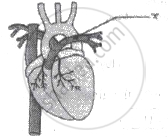
In which of the following groups of organisms, blood flows through the heart only once during one cycle of passage through the body?
Why is the small intestine in herbivores longer than in carnivores?
Select the correct option:

Explain the advantage of the complete partition of ventricle among birds and mammals and hence leading to double circulation.
Complete the following flow diagram of double circulation:

Why is the separation of the right side and the left side of the heart useful? How does it help birds and mammals?
Give scientific reason.
Closed circulation is more efficient than open circulation.
Oxygenated blood to the liver is supplied by ______.
Why is the double circulation of blood in human beings necessary?
From where to where do the following blood vessel carry blood?
Hepatic vein
Define portal vein.
Name these:
Two phases of circulation of blood in human body
Write the exact location of the following:
Hepatic portal vein
