Advertisements
Advertisements
प्रश्न
What is the difference between calcination and roasting?
Compare roasting and calcination.
Differentiate between calcination and roasting.
Advertisements
उत्तर
| Roasting | Calcination | |
| (1) | The ore is heated in the excess of air. | The ore is heated in the absence of air. |
| (2) | Volatile impurities are removed as oxides (SO2, P2O5, As2O3) and the ore becomes porous and more reactive. | Moisture and organic impurities are removed and the ore becomes porous and more reactive. |
| (3) | Sulphide ores are roasted, so SO2 is given off. \[\ce{2ZnS + 3O2 ->[800^\circ-900^\circ C]2ZnO + 2SO2}\] |
Carbonate and hydrated ores are calcined and CO2 or water vapour are given off. \[\ce{ZnCO3 -> ZnO + CO2}\] |
APPEARS IN
संबंधित प्रश्न
In the electrolytic refining of a metal M, what would you take as anode, cathode and electrolyte?
Write the steps involved in the extraction of pure metals in the middle of the activity series from their carbonate ores.
Why are the metals like Na, K, Ca and Mg never found in their free state in nature?
The rocky material found with ores is called ______.
How are the less reactive metals (which are quite low in the reactivity series) extracted? Explain with the help of an example.
What iron compound is present in haematite ore? Also write its chemical formula.
Name the metal which is extracted from haematite ore.
An important ore of zinc metal is ______.
Which of the following is an ore of mercury metal?
Calamine ore can be converted into zinc oxide by the process of ______.
Aluminum is used in thermite welding:
what is thermit?
Which one of the following is not true of metal :
Metals are malleable and ductile
Which one of the following is not true of metal :
Metals form non-polar covalent compounds
Froth floatation process is generally used to concentrate ______ ores.
Write the name.
Strongly heating carbonate ores in insufficient air -
Explain concept with example/explain with the help of a balanced equation.
Roasting
Complete flow chart given below.
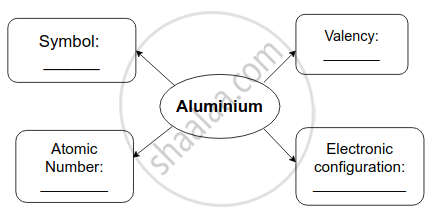
Read the following passage and answer the questions.
According to the reactivity series, zinc is more reactive than iron, iron is more reactive than silver. During study of this, a student dipped the iron nails in silver nitrate solution.
- What is reactivity series?
- What will happen when iron nails are dipped in silver nitrate solution?
- Which type of reaction happens when iron metal reacts with silver nitrate solution?
- What will happen if a zinc rod is used instead of iron nail?
The process in which a carbonate ore is heated strongly in the absence of air to convert it into metal oxide is called ____________.
