Advertisements
Advertisements
प्रश्न
Explain Bayer’s process.
Advertisements
उत्तर
- In Bayer’s process, the bauxite ore is first crushed and then it is leached by heating with hot concentrated caustic soda (NaOH) solution under high pressure for 2 to 8 hrs at 140 to 150 °C in a tank called a digester.
- Aluminium oxide, being amphoteric in nature, dissolves in an aqueous NaOH solution, forming water-soluble sodium aluminate.
\[\ce{\underset{\text{oxide}}{\underset{\text{Aluminium}}{Al2O3.2H2O_{(s)}}} + \underset{\text{hydroxide}}{\underset{\text{Sodium}}{2NaOH_{(aq)}}} -> \underset{\text{aluminate}}{\underset{\text{Sodium}}{2NaAlO_{2(aq)}}} + \underset{\text{Water}}{3H2O_{(l)}}}\] - The iron oxide present in the gangue does not dissolve in aqueous NaOH solution and is separated by filtration.
- However, silica from the gangue dissolves in aqueous NaOH solution forming water-soluble sodium silicate.
- The solution of sodium aluminate is diluted with water and then cooled to 50 °C. This gives aluminium hydroxide as a precipitate.
\[\ce{\underset{\text{aluminate}}{\underset{\text{Sodium}}{NaAlO_{2(aq)}}} + \underset{\text{Water}}{2H2O_{(l)}} -> \underset{\text{hydroxide}}{\underset{\text{Sodium}}{NaOH_{(aq)}}} + \underset{\text{hydroxide}}{\underset{\text{Aluminium}}{Al(OH)_3↓}}}\] - The aluminium hydroxide is then filtered, washed, dried and calcined by heating at 1000 °C to get pure aluminium oxide, called alumina.
\[\ce{\underset{\text{hydroxide}}{\underset{\text{Aluminium}}{2Al(OH)_{3(s)}}} ->[heat][1000°C] \underset{\text{oxide}}{\underset{\text{Aluminium}}{Al2O_{3(s)}}} + \underset{\text{vapour}}{\underset{\text{Water}}{3H2O_{(g)}}}}\]
संबंधित प्रश्न
Name a reducing agent that may be used to obtain manganese from manganese dioxide.
Name two metals which are highly resistant to corrosion.
Name one ore of copper (other than cuprite). Which compound of copper is present in this ore? Also, write its chemical formula.
The two metals which can be extracted just by heating their sulphides in air are ______.
An important ore of zinc metal is ______.
Which of the following reactants are used to carry out the thermite reaction required for welding the broken railway tracks?
Give the principles of the froth floatation process.
Answer the following questions based on the extraction of aluminium from alumina by Hall - Heroult’s Process :
Name the electrode, from which aluminium collected.
How many valence electrons are present in metals ?
choose the most appropriate term to match the given description.
Heating of the ore in the absence of air to high temperature
How is the method of extraction of metals high up in the reactivity series different from that for metals in the middle? Why can the same process not be applied for them? Name the process used for the extraction of these metals.
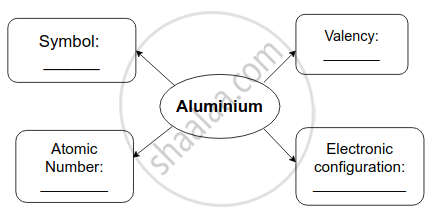
Atomic number of aluminium is _______ and its electronic configuration is _______.
_______ is the least reactive metal.
Zinc sulphide : Roasting : : zinc carbonate : _______
Explain the reactions of nonmetals with water with the help of examples.
Explain concept with example/explain with the help of a balanced equation.
Ionic bond and ionic compounds
Explain concept with example/explain with the help of a balanced equation.
Roasting
Complete flow chart given below.
Explain the difference between Bayer’s process and Hall’s process by explaining the Bayer’s process.
