Advertisements
Advertisements
प्रश्न
What is meant by the term ‘Double circulation’?
Advertisements
उत्तर
Double circulation is the type of blood circulation in which blood passes through the heart twice during one complete circulation. It consists of pulmonary circulation (heart → lungs → heart) and systemic circulation (heart → body → heart). Therefore, blood circulation in humans is called double circulation.
APPEARS IN
संबंधित प्रश्न
Name the two types of transport systems in the human beings.
What is meant by the term ‘single circulation’?
Which blood vessel does not carry any carbon dioxide?
What is the difference between pulmonary circulation and systemic circulation?
Differentiate between the following pair of terms: Pulmonary artery and pulmonary vein
The diagram represents the ‘closed system’ or ‘double circulation’ of blood in mammals.
Justify the above statement.
State two structural and two functional differences between the arteries and veins.
State the changes in the composition of blood as it passes through the following organs:
(a) Lungs (b) Gut (c) Liver (d) Kidneys.
State the Location: Hepatic portal vein
In the given diagram, 'X' indicates ______
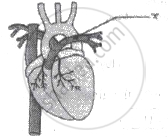
In which of the following groups of organisms, blood flows through the heart only once during one cycle of passage through the body?
In double circulatory system, the function of veins is to carry ______.
Explain the advantage of the complete partition of ventricle among birds and mammals and hence leading to double circulation.
From where to where do the following blood vessel carry blood?
Hepatic vein
From where to where do the following blood vessel carry blood?
Hepatic portal vein
Define portal vein.
Distinguish between the following pair on the basis of words indicated in the bracket ( ):
Pulmonary and Systemic circulation (Kind of blood)
Write important role/roles of the following:
Hepatic portal vein
Write the exact location of the following:
Hepatic portal vein
