Advertisements
Advertisements
प्रश्न
What do you understand by the term parallel circuit?
Advertisements
उत्तर
Parallel circuit: When a number of resistances (bulbs) are connected in an electrical circuit in such a way that all of them are connected to the common positive and common negative terminal of a cell, then the resistance (bulbs) are said to be connected in parallel.
OR
A number of resistors are said to be connected in parallel if one end of each resistor is connected to one point and the other end of each resistor is connected to another point so that the potential difference across each resistor is the same.
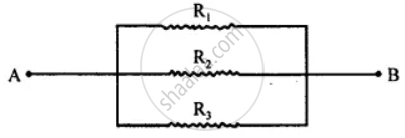
Here the three resistors R1, R2 and R3 are in parallel.
APPEARS IN
संबंधित प्रश्न
State three differences between the primary and secondary cells.
The unit of current is :
A cell of potential difference 12 V is connected to a bulb. The resistance of filament of bulb when it glows is 24Ω. Find the current drawn from the cell.
There is a positively charged sphere A and negatively charged sphere B, such that they are brought in electrical contact by a copper wire.
In which direction electronic current flows?
What is the electrical potential at a point in an electric field when 24 J of work is done in moving a charge of 96 C from infinity?
Select the correct option:
In a metallic conductor, electric current is thought to be due to movement of:
What do you mean by an electric current?
