Advertisements
Advertisements
प्रश्न
State three differences between the primary and secondary cells.
Advertisements
उत्तर
|
Primary Cell |
Secondary cell |
|
1. Chemical reaction is irreversible. 2. Only chemical energy is converted into electrical energy when current is drawn from it. 3. It cannot be recharged and its internal resistance is high. |
1. Chemical reaction is reversible. 2. It converts electrical energy into chemical energy when current is passed in it (i.e., during charging), while converts chemical energy into electrical energy when current is drawn from it (i.e., during discharging). 3. It can be recharged and its internal resistance is low. |
APPEARS IN
संबंधित प्रश्न
What is a secondary cell?
What is the function of a key (or switch) in an electric circuit?
Write symbol and state function of following component in an electric circuit :
cell
How are the potential difference (V), current (l) and resistance (R) related?
Name the physical quantity of which the unit is ohm
State the kind of charge on a negative ion.
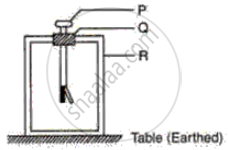
The following Figure represents a negatively charged gold Ieaf electroscope. Label the parts, P, Q, and R and the estate whether each is an insulator or a conductor. Also, indicate the distribution of charges on the system in the diagram.
Is electric current a scalar quantity?
