Advertisements
Advertisements
प्रश्न
What do you mean by vestigial structures? Name four vestigial organs found in man.
Advertisements
उत्तर
1. Ill developed structures or structures which are of no use are sometimes found in both plants and animals. They are referred to as vestigial organs. The same organ may be functional in one organism but vestigial in another.
2. Vermiform appendix of man is one such organ. The reason could be that human ancestors were eating uncooked food with considerable amount of cellulose in it. The normal function of caecum and appendix
in mammals is the digestion of cellulose.
3. Man shows a number of other vestigial organs. About 100 have been named. A few examples are ear muscles, wisdom teeth, plica semilunaris (representing nictitating membrane of the eye), coccyx (reduced tail) etc.
4. In plants, the scale like leaves on the Indian pipe, a plant which has lost its chlorophyll and became saprophytic in nature, is vestigial.
5. There are certain flowers in which stamens do not bear anthers.
APPEARS IN
संबंधित प्रश्न
Mammals : _________ : : Amphibia : Fishes
Find out from newspapers and popular science articles any new fossil discoveries or controversies about evolution.
Differentiate between analogous and homologous structures.
There are five animals A, B, C, D and E. The animal A uses its modified forelimbs for flying. The animal B uses its forelimbs for running whereas the animal C uses its forelimbs for grasping. The animal D can live on land as well as in water and uses its forelimbs to prop up the front end of its body when at rest. The animal E which respires by using spiracles and tracheae uses wings for flying but its wings are analogous to the modified forelimbs of animal A.
(a) What could the animals A, B, C, D and E be?
(b) Why are the forelimbs of animals A, B, C, D called homologous organs?
(c) What does the existence of homologous organs in animals A, B, C and D tell us about their ancestors ?
(d) Why are the modified forelimbs of animal A and the wings of animal E called analogous organs?
(e) State whether animals A and E have a common ancestor or not.
Select a set of homologous organs from the following:
(A) Wings of a bat and wings of a butterfly
(B) Wings of a pigeon and wings of a bat
(C) Wings of a butterfly and wings of a pigeon
(D) Forelimbs of a duck, forelimbs of a cow and forelimbs of a lizard
What do we call the degenerated or partially developed useless organs in living organisms? Enlist such organs in human body? How the same organs are useful in other animals?
Complete the following chart:
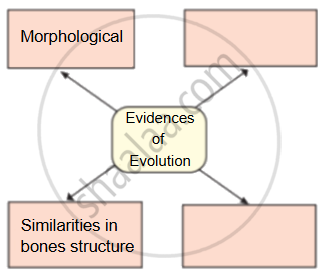
Explain the importance of Anatomical evidences with examples.
______ is a vestigial organ in human beings.
Match the following.
| Column A | Column B |
| 1) Morphological evidences | a) Tail-bone or wisdom teeth |
| 2) Paleontological evidences | b) Leaf venation |
| c) Fossils |
Give scientific reason.
Duck-billed platypus shows relationship with mammals.
Homologous organs and vestigial organs are examples of ______ type of evidence in evolution.
Select the CORRECT match.
Evolution has exhibited a greater stability of molecular structure when compared with morphological structures. Comment on the statement and justify your opinion.
Study of fossils is ______.
Flippers of Penguins and Dolphins are examples of:
Fossils are generally found in ______.
What were the characteristics of life forms that had been fossilised?
I am the connecting link of annelida and arthropoda. What is my name?
As shown in figure below some organisms that share a common ancestor have features that have different functions, but similar structures.

These are known as ______. Give example.
