Advertisements
Advertisements
प्रश्न
What do you mean by dynamic and static equilibrium? Give one example of each.
Advertisements
उत्तर
When the body remains in the state of rest under the influence of applied forces, it is in static equilibrium and if it remains in the state of uniform motion, it is in dynamic equilibrium.
For example: In a beam balance when the beam is balanced in the horizontal position, the clockwise and anti-clockwise moments balance each other and the beam has no rotational motion i.e., it is in static equilibrium.
A body moving with uniform velocity in a straight line over a frictionless surface is in dynamic equilibrium.
संबंधित प्रश्न
State the principle of moments. Give one device as an application of it
A uniform meter scale is in equilibrium as shown in the diagram :
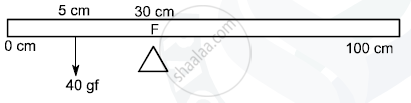
(i) Calculate the weight of the meter scale.
(ii) Which of the following options is correct to keep the ruler in equilibrium when 40 gf wt is shifted to 0 cm mark ?
F is shifted towards 0 cm
or
F is shifted towards 100 cm
State two conditions for a body acted upon by several forces to be in equilibrium.
A meter scale is pivoted at its mid point and a 50 g mass suspended from the 20 cm mark. What mass balances the ruler when suspended from 65 cm mark?
Give scientific reason for the following:
When a man climbs a slope he bends forward.
Give scientific reason for the following:
While climbing a hill you will try to bend your body forward.
State the principle of moments.
What is a couple?
One end of a spring is kept fixed while the other end is stretched by a force as shown in the diagram.

(i) Copy the diagram and mark on it the direction of the restoring force.
(ii) Name one instrument which works on the above principle.
Give an experiment to verify the principle of moments.
