Advertisements
Advertisements
प्रश्न
What did the speaker’s brother say about the Shed?
Advertisements
उत्तर
The speaker’s brother talked about the presence of a ghost inside the shed. He also warned the speaker that if he ever went inside the shed, the ghost might chop off his head. Saying so, the speaker’s brother frightened the speaker.
संबंधित प्रश्न
The Shehnai of Bismillah Khan Thinking about the text :
Tick the right answer.
Bismillah Khan learnt to play the shehnai from (Ali Bux, Paigambar Bux, Ustad Faiyaaz
Khan).
What is Behrman’s masterpiece? What makes Sue say so?
Read the comic strip based on. H.G. Wells' novells.


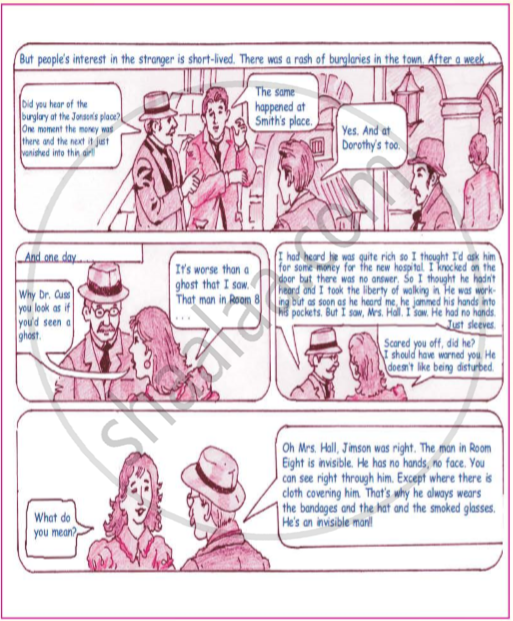
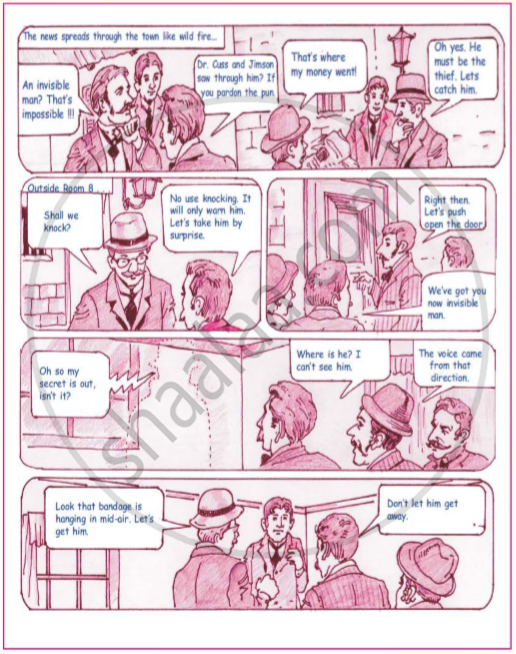
Answer the questions by ticking the correct option.
(a) The strange-looking man wanted ....
(i) the best room at the inn.
(ii} a room with a fire and a good lock.
(iii} a room with a good view.
(iv) a room where he could work quietly.
(b) Jimson was suspicious of the stranger because ...
(i} he did not answer Jimson's questions.
(ii} he did not want to talk about the weather.
(iii} he kept his back turned towards Jimson at all times.
(iv) he shouted atJimson when he entered his room.
(c) The people of the town gossiped about the stranger as ...
(i} he did not go out or talk to anyone in the town.
(ii} he had met with an accident and his face was bandaged.
(iii} he was new to the town and behaved rudely.
(iv) he stayed in his room and did not show his face to anyone.
(d) 'There was a rush of burglaries in the town. This means that ________
(i} there were many robberies in the town.
(ii) a few people in the town had seen a rob her.
(iii} the burglaries in the town were done in a rush.
(iv) the burglar was a rash and careless man.
(e) Although Jimson and Dr Cuss are suspicious of the strange guest, Mrs Hall tolerates him because ....
(i} she is not superstitious or ignorant.
(ii) she is sorry for the stranger who is bandaged.
(iii} the stranger is paying her a good amount of money for the room.
(iv} the stranger is polite and kind to Mrs Hall at all times.
(f) The stranger who was staying at the inn can be described as being ....
(I} violent
(ii} upright
(iii} dishonest
(iv) sensible
What does he plant who plants a tree? a
He plants a friend of sun and sky;b
He plants the flag of breezes free;
The shaft of beauty, towering high;
He plants a home to heaven anigh;
For song and mother-croon of bird
In hushed and happy twilight heard____
The treble of heaven's harmony_____
These things he plants who plants a tree.
Read the lines given above and answer the question that follow:
It was a summer evening,
Old Kaspar's work was done,
And he before his cottage door
Was sitting in the sun,
And by him sported on the green
His little grandchild Wilhelmine.
She saw her brother Peterkin
Roll something large and round,
Which he beside the rivulet
In playing there had found;
He came to ask what he had found,
That was so large, and smooth, and round.
Read the lines given above and answer the question that follow.
What did Peterkin find?
Such wondrous, fine, fantastic tales
Of dragons, gypsies, queens, and whales
And treasure isles, and distant shores
Where smugglers rowed with muffled oars,
And pirates wearing purple pants,
And sailing ships and elephants,
And cannibals crouching 'round the pot,
Stirring away at something hot.
(It smells so good , what can it be?
Good gracious, it's Penelope.)
The younger ones had Beatrix Potter
With Mr.Tod,the dirty rotter,
And Squirrel Nutkin,Pigling Bland,
And Mrs.Tiggy-Winkle and-
Just How The Camel Got His Hump,
And How the Monkey Lost His Rump,
And Mr. Toad, and bless my soul,
There's Mr.Rat and Mr. Mole-
Oh, books, what books they used to know,
Those children living long ago!
Read the lines given above and answer the question given below.
Explain with reference to context.
Beside him in the shoals as he lay waiting glimmered a blue gem. It was not a gem, though: it was sand—?worn glass that had been rolling about in the river for a long time. By chance, it was perforated right through—the neck of a bottle perhaps?—a blue bead. In the shrill noisy village above the ford, out of a mud house the same colour as the ground came a little girl, a thin starveling child dressed in an earth—?coloured rag. She had torn the rag in two to make skirt and sari. Sibia was eating the last of her meal, chupatti wrapped round a smear of green chilli and rancid butter; and she divided this also, to make
it seem more, and bit it, showing straight white teeth. With her ebony hair and great eyes, and her skin of oiled brown cream, she was a happy immature child—?woman about twelve years old. Bare foot, of course, and often goosey—?cold on a winter morning, and born to toil. In all her life, she had never owned anything but a rag. She had never owned even one anna—not a pice.
Why does the writer mention the blue bead at the same time that the crocodile is introduced?
Ans. The author mentions the blue bead at the same time that the crocodile is introduced to create suspense and a foreshadowing of the events’to happen.
Read the extract given below and answer the question that follow.
Describe Sibia.
Answer the following question.
What happened one Sunday when the lady was going to her sister’shouse? What did the lady do? What was the bear’s reaction?
What did Tilloo hope to see once he emerged from his underground home?
On getting a gift of chappals, the beggar vanished in a minute. Why was he in such a hurry to leave?
How do the desert plants fulfill their need for water?
Describe Mr. Purcell’s daily routine at the shop.
Give the character sketch of the bear in The Bear Story’.
Why didn’t the farmer’s wife want to leave the baby alone with the mongoose?
What was the farmer’s comment on his wife’s fears?
What did the other courtiers feel about Tansen?
What have certain doctors found about dreams?
Why does father ask mother to stand away?
Multiple Choice Question:
Which one of the following is not associated with the real beauty?
What does the broken glass window suggest?
