Advertisements
Advertisements
प्रश्न
What are simple tissues? Explain their three different types.
Advertisements
उत्तर
Simple tissues consist of cells that are structurally and functionally similar. They are made up of only one type of cells.
The three types of simple tissues are as follows:
(a) Parenchyma: It forms the bulk of the plant body. The main function of parenchyma is to store and assimilate food.
(b) Collenchyma: It is located below the epidermis of dicotyledonous stem and petiole. It provides mechanical support to the plant body.
(c) Sclerenchyma: It consists of dead cells. It provides mechanical support and protection to the plant.
APPEARS IN
संबंधित प्रश्न
How are simple tissues different from complex tissues in plants?
Complete the following chart:

What are the functions of phloem?
Study the diagram given below and then answer the question that follows:
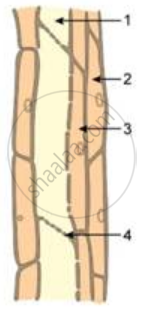
Name the parts labelled 1, 2, 3 and 4.
Study the diagram given below and then answer the question that follows:
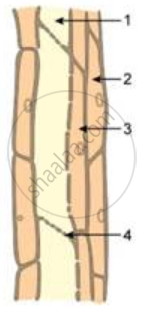
Where is this tissue likely to be found in the plant?
Define the following:
Permanent tissue
Name the tissue associated with the following:
Conduction of water in the plant body.
Name the tissue associated with the following:
Movement of food in the plant body
The question has four answers. Choose the correct answer:
Collenchymatous hypodermis is found in
Name the two types of sclerenchyma cells.
