Advertisements
Chapters
Advertisements
Solutions for Chapter 2: Tissues
Below listed, you can find solutions for Chapter 2 of CBSE P S Verma and V K Agarwal for बायोलॉजी पार्ट ३ [अंग्रेजी] कक्षा ९.
P S Verma and V K Agarwal solutions for बायोलॉजी पार्ट ३ [अंग्रेजी] कक्षा ९ 2 Tissues Intext Questions [Page 63]
Activity 1. Apical meristem causes growth in length
|
Take two glass jars and fill them with water. In next step, take two onion bulbs and place one on each jar. Placement of the onion bulbs on the mouth of each jar should be in such a way that the stem and root parts of each onion remain in contact with water (Figure 6). Observe the growth of roots in both the onion bulbs. Measure the length of roots on day 1, day 2 and day 3. However, on day 4 cut the root tips (i.e., up to 1 cm) in jar B. Observe the growth of roots in both jars for a few more days and record your observation in the following table: |
| Length of root | Day 1 | Day 2 | Day 3 | Day 4 | Day 5 |
|---|---|---|---|---|---|
| 1. Jar A | |||||
| 2. Jar B |
From the above observations, answer the following questions:
- Which of the jars has longer roots?
- Do the roots continue growing even after you have removed their tips?
- Why do the root tips stop growing in jar B after you have cut them?
Observe and compare the structures of different types of muscle tissues. Note their shape, number of nuclei and position of nuclei within the cell.
P S Verma and V K Agarwal solutions for बायोलॉजी पार्ट ३ [अंग्रेजी] कक्षा ९ 2 Tissues Very Short Answer Type Questions [Pages 87 - 89]
(Carrying 1 marks each)
What types of functions does the single cell of unicellular organism such as Amoeba perform?
What types of functions does the single cell of multicellular organism perform?
Define the term “tissue”.
Name the two basic types of tissues found in plants.
Name a basic tissue which is present in plants but absent in animals.
What is division of labour?
Which types of tissues are more common in plants?
Why do animals consume more energy as compared to plants?
What contribute more to the difference in organ system design of plants and animals?
Give one example of apical meristem.
Give one example of lateral meristem.
Where can one find meristematic tissues in plants?
What is a permanent tissue?
Define simple tissue.
Name types of simple tissues.
What is the main function of parenchyma?
Which chemical is deposited at the corner of cells in collenchyma?
Which chemical is deposited in the cell wall of sclerenchyma?
Give two functions of collenchyma.
Define complex tissue.
Name the complex tissue which helps in conduction of water and minerals.
Name the complex tissue which helps in conduction/transport of food.
What is the common name of Xylem?
What is the common name of Phloem?
Name the plant cell which is attached to the lateral side of sieve tube.
Which type of simple tissue of plants is used for making ropes?
Give one example of protective tissue in plants.
What is the function of stomata?
What is the function of lateral meristem?
Enumerate four main types of animal tissues.
Describe functions of squamous epithelial tissue.
Where is squamous epithelium found?
What is goblet cell?
What is the function of ciliated epithelium?
Define the term of connective tissue
Enumerate protein fibres of connective tissue.
Enumerate various cells of connective tissue.
Define the following:
tendon
Define the following:
ligament
Define the following:
cartilage.
What is the name of the bone cell?
Write the names of the various types of white blood cells (WBCs).
What is a blood platelet?
How many types of muscles occur in animals?
What is a neuron? Define it.
Which tissue protects the entire animal body?
Classify epithelial tissues on the basis of arrangements of layers.
Give one example each of squamous epithelium.
Give one example each of columnar epithelium.
Which type of epithelium (on the basis of function) is present in sweat gland.
Which type of epithelium (on the basis of function) is present in testis?
Which type of epithelium is present in the organs where exchange of substances takes place?
Which type of tissue is most abundant in animals?
Give one example of connective tissue in which matrix is solid.
Which type of connective tissue is present in hump of camel and blubber of whale?
Which tissue is commonly known as "packaging tissue"?
Which connective tissue connects bone to another bone?
Give two examples of cartilage.
Which type of skeletal tissue contains chondrin and ossein respectively?
Which type of connective tissue has fibreless matrix?
What are serums?
What is the function of WBC?
What is the function of RBCs?
What is the function of blood platelets?
Distinguish between Blood and lymph.
Which type of WBC is most abundant in lymph?
Name any one structure in our body which bears ciliated epithelium.
Name the following:
Multinucleate muscle fibre
Name the following:
Spindle-shaped muscle fibre
Name the muscle which gets fatigued soon.
Name the muscle of heart.
What are the two types of striated muscle fibres?
Name the muscle which is commonly found in visceral organs.
Name the muscle fibre which contains intercalated discs.
Name the following:
Neurons which carry impulses towards brain.
Name the following:
Process of neuron which carries impulses away from cyton
P S Verma and V K Agarwal solutions for बायोलॉजी पार्ट ३ [अंग्रेजी] कक्षा ९ 2 Tissues Short Answer Type Questions [Page 89]
(Carrying 2 marks each)
What is the importance of tissues?
Why do plants and animals possess different types of tissues?
Tabulate differences between plants and animal tissues.
Write a short note on intercalary meristem.
Write one main function of Apical meristem.
Write one main function of Lateral meristem.
What are simple tissues?
Explain three different types of simple tissues.
Draw a well labelled diagram of parenchyma.
Draw a well labelled diagram of collenchyma.
Draw a well-labelled diagram of phloem.
Draw a well labelled diagram of xylem.
Give two functions of collenchyma.
Write a short note on sclerenchyma.
Distinguish between xylem and phloem.
Distinguish between tracheids and vessels.
(Carrying 3 marks each)
Explain different types of elements present in phloem.
What are tracheary elements?
Describe the functions of tracheary elements?
Write the functions of parenchyma.
Give two functions of collenchyma.
Write the functions of sclerenchyma.
What is the difference between parenchyma and collenchyma?
What is the differences between collenchyma and sclerenchyma?
Name the different types of elements found in the xylem.
What are the functions of xylem?
What are the functions of phloem?
Write down names of different types of plant tissues.
Explain how sieve tubes manage to be living?
Give four important functions of epithelial tissue. Name one specific place in the body where each function is carried out.
Enlist three types of muscles with their locations.
In Which Tissue is Found Anyone of the Following Structures : Neuron, Dendrite, Cilia, Collagen Fibres, Elastin Fibre.
List one function of the Following:
Osteoblast
List One Function of the Following:
Chondroblasts
List One Function of the Following:
Goblet Cell
List one function of the following:
neuron
List One Function of the Following:
Muscle Cell
State two characteristics of nerve cells.
What is the function of bone?
What is the function of cartilage?
What is the function of ligament?
Name the following :
(a) Tissue which stores fat
Name the Following : (B) Epithelium Which Lines Lung Alveoli.
Give three functions of blood.
What are the different tissues in animals.
Draw and label a neuron.
Diagrammatically show the difference in three types of muscle fibres.
P S Verma and V K Agarwal solutions for बायोलॉजी पार्ट ३ [अंग्रेजी] कक्षा ९ 2 Tissues Long Answer Type Questions [Page 89]
(Carrying 5 marks each)
What are different types of tissues in plants? Describe simple tissues.
What are meristematic tissues? Explain with the help of suitable diagram. Give their classification on the basis of their position in the plant body.
What is simple tissue? Classify and explain its different types with suitable diagram.
What do you know about complex tissue? Classify and explain its different types in plants with suitable diagrams.
Distinguish between the following pair in one or two sentences for RBCs and WBCs.
Distinguish between the following pair in one or two sentences for bone and cartilage.
Distinguish between the following pair in one or two sentences for blood and lymph.
Distinguish between the following pair in one or two sentences for striated and unstriated muscles.
Differentiate between:
Tendon and Ligament
Distinguish between the following pair in one or two sentences for axon and dendrite.
Describe the structure of epithelium.
Describe the functions of epithelium.
Classify connective tissue and give one example of each type.
Describe the composition of blood.
What are the functions of blood?
Define muscular tissue.
Classify and explain different types of muscles with the help of suitable diagrams.
Explain the structure of neuron with the help of a labelled diagram.
P S Verma and V K Agarwal solutions for बायोलॉजी पार्ट ३ [अंग्रेजी] कक्षा ९ 2 Tissues Multiple Choice Questions (MCQs) [Pages 90 - 92]
Tissue is a group of
cells similar in structure
cells similar in origin
cells coordinating for a particular function
all of these
Growth in plants is different from that of animals in being ______.
restricted to certain regions
diffused
at the tips only
absent
Plant cells which lack vacuole are ______.
epidermal cells
meristematic cells
collenchyma cells
parenchyma cells
Meristematic tissue in plants are ______.
not limited to certain regions
growing in volume
localized and permanent
localized and dividing cells
Girth of stem increases due to
apical meristem
lateral meristem
intercalary meristem
vertical meristem
The tissue also called the "skin of plants".
epidermis
cork
permanent tissue
cuticle
Cork cells are characterized by the deposition of ______.
lignin
cellulose
suberin
pectin
Plant tissue which has guard cells present in it is a ______.
epidermis
parenchyma
xylem
sclerenchyma
Taking up of a particular permanent shape, size and function by a newly formed cell is called ______.
differentiation
organization
supportive cell
dedifferentiation
Cells of epidermis are
flat
covered with cuticle
having thick outer wall
all of these
Thin-walled isodiametric cells with or without intercellular spaces, having cytoplasm, vacuole and nucleus belong to plant tissue.
parenchyma
xylem
collenchyma
sclerenchyma
Plant tissue having long narrow cells pointed at both ends and uniformly thickened by deposition of lignin is ______.
sclerenchyma
collenchyma
parenchyma
aerenchyma
Collenchyma is
mechanical tissue
flexible tissue
thickened irregularly at corners
all of these
Conducting tissues present in a vascular bundle are ______.
sclerenchyma and collenchyma
xylem and phloem
parenchyma and sclerenchyma
parenchyma and collenchyma
The conducting elements of xylem are ______.
tracheids and vessels
vessels only
tracheids only
tracheids, vessels and xylem fibres
Living tubular cells with perforated end walls are ______.
sieve cells
sieve tubes
tracheids
vessels
Walls of collenchyma are irregularly thickened due to the deposition of ______.
pectin
lignin
suberin
all of these
A student was shown two slides of a plant tissue and was asked to identify the slide of sclerenchyma. The correct identifying feature given by the student is ______.
spherical thin-walled cells
polygonal cells with conspicuous nucleus
elongated cells with thick walls and no nucleus
all of these
A student was asked to write the characteristic feature of a nerve cell or neuron, after viewing it under the microscope. The correct feature will be
oval cells with lobed nucleus
spindle-shaped cells with bands
loosely packed cells floating in matrix
a cell body with branched cytoplasmic extensions at one end and a long projection at the other end
Complete the analogy given below and choose the correct option:
Cutin : Epidermis ; Suberin : ______
cambium
apical meristem
sieve tube
cork cells
The flexibility in plants is due to the tissue called ______.
parenchyma
collenchyma
sclerenchyma
chlorenchyma
The oesophagus and the lining of mouth is covered by ______.
squamous epithelium
cuboidal epithelium
simple epithelium
columnar epithelium
Which is absent in an epithelium?
intercellular spaces
nucleus
mitochondria
barrier to movement
Which of the following helps in repair of tissue and fills up the space inside the organ?
Tendon
Adipose tissue
Areolar
Cartilage
A strong and non-flexible connective tissue is ______.
areolar tissue
bone
adipose tissue
cartilage
Two bones are connected by ______.
flexible connective tissue called ligament
non-flexible ligament
non-flexible tendon
flexible tendon
Tendon is strong fibrous connective tissue with little flexibility for ______.
attaching muscles to skin
attaching cartilage to bone
attaching muscles to bones
attaching cartilage to cartilage
Branched muscle fibres interconnected by oblique bridges are ______.
cardiac muscle fibres
skeletal muscle
striated muscle
unstriated muscle
It is found in cartilage.
mast cells
osteocytes
monocytes
chondrocytes
Voluntary muscles are found in ______.
stomach
lungs
limbs
oesophagus
Haversian canals occur in ______.
liver
bone
cartilage
lungs
The tissue that forms glands.
epithelial
connective
nervous
muscular
Unit of the nervous tissue is ______.
axon
cyton
dendron
neuron
P S Verma and V K Agarwal solutions for बायोलॉजी पार्ट ३ [अंग्रेजी] कक्षा ९ 2 Tissues Questions Based on High Order Thinking Skills (HOTS) [Pages 92 - 94]
What will happen if a bone is dipped in hydrochloric acid (HCl)?
What will happen if a bone is dried?
What will happen if a ligament gets overstretched?
What will happen if heparin is absent from blood?
What will happen if striated muscles contract rapidly for long time?
What will happen if the apical meristem is damaged or cut?
What will happen if cork is not formed in older stems and roots?
What will happen if lymph is not returned to blood?
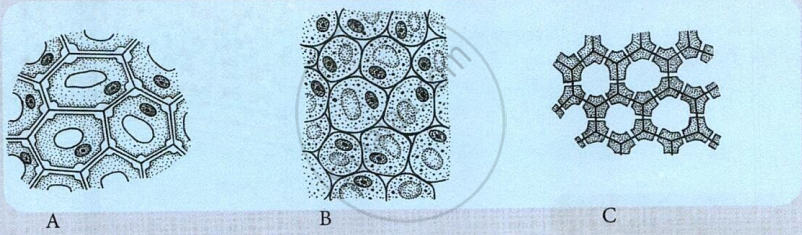
- Identify Figures A, B and C.
- Which has heavy lignin deposition?
- Which provides mechanical strength as well as flexibility?
- Which can form air cavities in aquatic plants?
- Which is commercially exploited to obtain hemp and jute?
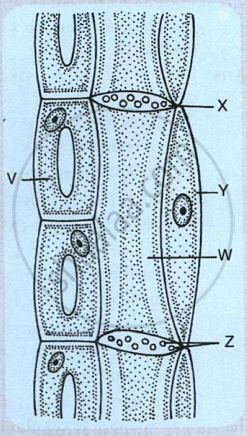
- Identify the figure. What is its function?
- Label V and W.
- Label X, Y and Z.
- W loses its nucleus in the mature state, still it remains alive. Explain how?
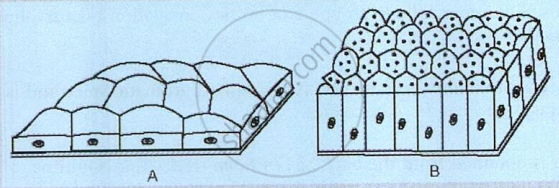
- Identify Figures A and B.
- Which is called tesselated and pavement epithelium?
- Which one lines the gastrointestinal tract and epiglottis?
- Which one allows diffusion of substances?
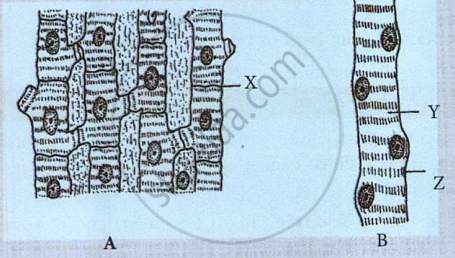
- Identify Figures A and B.
- Label X, Y and Z.
- Which acts as an impulse booster?
- Which is under voluntary control?
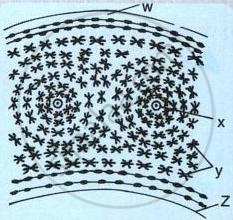
- Identify the figure.
- Label W, X, Y and Z.
- State the chemical composition of the material of the figure.
- What is the function of X?
P S Verma and V K Agarwal solutions for बायोलॉजी पार्ट ३ [अंग्रेजी] कक्षा ९ 2 Tissues Questions Based on Assertion-Reason [Page 96]
In the following questions, two statements are given-one labelled Assertion (A) and the other labelled Reason(R): Select the correct answer to these questions from the codes as given below:
Assertion (A): Epidermis protects the interior from microbes, injury and loss of water.
Reason (R): It is a continuous layer covered by cuticle.
Both A and R are true and R is correct explanation of the assertion.
Both A and R are true but R is not the correct explanation of the assertion.
A is true but R is false.
A is false but R is true.
Assertion (A): Parenchyma cells store food.
Reason (R): Presence of chloroplast converts parenchyma into chlorenchyma.
Both A and R are true and R is correct explanation of the assertion.
Both A and R are true but R is not the correct explanation of the assertion.
A is true but R is false.
A is false but R is true.
Assertion (A): Collenchyma provides mechanical strength and flexibility.
Reason (R): It has thickened walls with lignin.
Both A and R are true and R is correct explanation of the assertion.
Both A and R are true but R is not the correct explanation of the assertion.
A is true but R is false.
A is false but R is true.
Assertion (A): Bone is a very strong, hard and rigid or non-flexible tissue.
Reason (R): The matrix of bone is rich in salts of calcium and magnesium.
Both A and R are true and R is correct explanation of the assertion.
Both A and R are true but R is not the correct explanation of the assertion.
A is true but R is false.
A is false but R is true.
Assertion (A): The red blood corpuscles (RBCs) carry oxygen to the tissues for the oxidation of food and release of energy.
Reason (R): The blood transports hormones and vitamins to the tissue.
Both A and R are true and R is correct explanation of the assertion.
Both A and R are true but R is not the correct explanation of the assertion.
A is true but R is false.
A is false but R is true.
Solutions for 2: Tissues
P S Verma and V K Agarwal solutions for बायोलॉजी पार्ट ३ [अंग्रेजी] कक्षा ९ chapter 2 - Tissues
Shaalaa.com has the CBSE Mathematics बायोलॉजी पार्ट ३ [अंग्रेजी] कक्षा ९ CBSE solutions in a manner that help students grasp basic concepts better and faster. The detailed, step-by-step solutions will help you understand the concepts better and clarify any confusion. P S Verma and V K Agarwal solutions for Mathematics बायोलॉजी पार्ट ३ [अंग्रेजी] कक्षा ९ CBSE 2 (Tissues) include all questions with answers and detailed explanations. This will clear students' doubts about questions and improve their application skills while preparing for board exams.
Further, we at Shaalaa.com provide such solutions so students can prepare for written exams. P S Verma and V K Agarwal textbook solutions can be a core help for self-study and provide excellent self-help guidance for students.
Concepts covered in बायोलॉजी पार्ट ३ [अंग्रेजी] कक्षा ९ chapter 2 Tissues are Muscular Tissue, Meristems or Meristematic Tissues, Tissues - “The Teams of Workers”, Animal Tissues, Simple Permanent Tissues (Supporting Tissue), Complex Permanent Tissues, Epithelial Tissue, Plant Tissues, Connective Tissue, Plant and Animals Tissue, Permanent Tissue, Complex Permanent Tissue: Xylem Structure and Function (Conducting Tissue), Complex Permanent Tissue: Phloem Structure and Function (Conducting Tissue), Nervous Tissue.
Using P S Verma and V K Agarwal बायोलॉजी पार्ट ३ [अंग्रेजी] कक्षा ९ solutions Tissues exercise by students is an easy way to prepare for the exams, as they involve solutions arranged chapter-wise and also page-wise. The questions involved in P S Verma and V K Agarwal Solutions are essential questions that can be asked in the final exam. Maximum CBSE बायोलॉजी पार्ट ३ [अंग्रेजी] कक्षा ९ students prefer P S Verma and V K Agarwal Textbook Solutions to score more in exams.
Get the free view of Chapter 2, Tissues बायोलॉजी पार्ट ३ [अंग्रेजी] कक्षा ९ additional questions for Mathematics बायोलॉजी पार्ट ३ [अंग्रेजी] कक्षा ९ CBSE, and you can use Shaalaa.com to keep it handy for your exam preparation.
