Advertisements
Advertisements
प्रश्न
Verify whether the following zeroes of the polynomial, indicated against them.
p(x) = (x + 1) (x – 2), x = – 1, 2
Advertisements
उत्तर
If x = −1 and x = 2 are zeroes of polynomial p(x) = (x + 1) (x − 2), then p(−1) and p(2) should be 0.
Here, p(−1) = (−1 + 1) (−1 − 2)
= 0 (−3)
= 0
Also, p(2) = (2 + 1) (2 − 2)
= 3 (0)
= 0
Therefore, x = −1 and x = 2 are zeroes of the given polynomial.
APPEARS IN
संबंधित प्रश्न
Verify whether the following zeroes of the polynomial are indicated against them.
p(x) = 5x – π, `x = 4/5`
Verify whether the following zeroes of the polynomial, indicated against them.
p(x) = 2x + 1, `x = 1/2`
Verify whether the indicated numbers is zeroes of the polynomials corresponding to them in the following case:
`f ( x ) = 3x +1, x = - 1/3`
Verify whether the indicated numbers is zeroes of the polynomials corresponding to them in the following case:
`f(x)=x^2- 1,x=1,-1`
Verify whether the indicated numbers is zeroes of the polynomials corresponding to them in the following case:
`f(x) = lx + m , x = - m/1`
Find the zero of the polynomial of the following :
f(z) = 8z
Verify whether the following are zeros of the polynomial indicated against them, or not
p(x) = 2x − 1, x = `1/2`
Find the number of zeros of the following polynomial represented by their graph
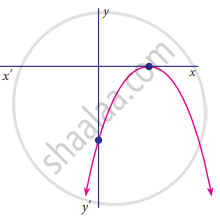
Zeros of (2 – 3x) is ___________
Find the zeroes of the polynomial in the following:
p(x) = x – 4
