Advertisements
Advertisements
प्रश्न
Using properties of determinants, prove that:
`|(alpha, alpha^2,beta+gamma),(beta, beta^2, gamma+alpha),(gamma, gamma^2, alpha+beta)|` = (β – γ) (γ – α) (α – β) (α + β + γ)
Advertisements
उत्तर
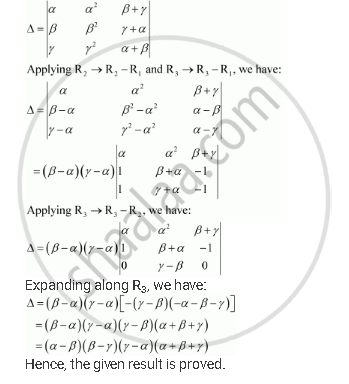
APPEARS IN
संबंधित प्रश्न
Using the property of determinants and without expanding, prove that:
`|(2,7,65),(3,8,75),(5,9,86)| = 0`
By using properties of determinants, show that:
`|(0,a, -b),(-a,0, -c),(b, c,0)| = 0`
Using properties of determinants, prove that:
`|(x, x^2, 1+px^3),(y, y^2, 1+py^3),(z, z^2, 1+pz^2)|` = (1 + pxyz) (x – y) (y – z) (z – x), where p is any scalar.
Using properties of determinants, prove that:
`|(3a, -a+b, -a+c),(-b+a, 3b, -b+c),(-c+a, -c+b, 3c)|`= 3(a + b + c) (ab + bc + ca)
Prove the following using properties of determinants :
\[\begin{vmatrix}a + b + 2c & a & b \\ c & b + c + 2a & b \\ c & a & c + a + 2b\end{vmatrix} = 2\left( a + b + c \right) {}^3\]
Using propertiesof determinants prove that:
`|(x , x(x^2), x+1), (y, y(y^2 + 1), y+1),( z, z(z^2 + 1) , z+1) | = (x-y) (y - z)(z - x)(x + y+ z)`
Solve for x : `|("a"+"x","a"-"x","a"-"x"),("a"-"x","a"+"x","a"-"x"),("a"-"x","a"-"x","a"+"x")| = 0`, using properties of determinants.
Evaluate the following determinants:
`|(x - 1, x, x - 2),(0, x - 2, x - 3),(0, 0, x - 3)| = 0`
Find the value (s) of x, if `|(1, 4, 20),(1, -2, -5),(1, 2x, 5x^2)|` = 0
Without expanding the determinants, show that `|(l, "m", "n"),("e", "d", "f"),("u", "v", "w")| = |("n", "f", "w"),(l, "e", "u"),("m", "d", "v")|`
Without expanding evaluate the following determinant:
`|(2, 7, 65),(3, 8, 75),(5, 9, 86)|`
Using properties of determinant show that
`|(1, log_x y, log_x z),(log_y x, 1, log_y z),(log_z x, log_z y, 1)|` = 0
If `|(4 + x, 4 - x, 4 - x),(4 - x,4 + x,4 - x),(4 - x,4 - x, 4 + x)|` = 0, then find the values of x.
Select the correct option from the given alternatives:
The system 3x – y + 4z = 3, x + 2y – 3z = –2 and 6x + 5y + λz = –3 has at least one Solution when
Select the correct option from the given alternatives:
If x = –9 is a root of `|(x, 3, 7),(2, x, 2),(7, 6, x)|` = 0 has other two roots are
Select the correct option from the given alternatives:
Which of the following is correct
Answer the following question:
Without expanding determinant show that
`|("b" + "c", "bc", "b"^2"c"^2),("c" + "a", "ca", "c"^2"a"^2),("a" + "b", "ab", "a"^2"b"^2)|` = 0
The value of `|(1, 1, 1),(""^"n""C"_1, ""^("n" + 2)"C"_1, ""^("n" + 4)"C"_1),(""^"n""C"_2, ""^("n" + 2)"C"_2, ""^("n" + 4)"C"_2)|` is 8.
Evaluate: `|("a" - "b" - "c", 2"a", 2"a"),(2"b", "b" - "c" - "a", 2"b"),(2"c", 2"c", "c" - "a" - "b")|`
Prove that: `|("a"^2 + 2"a", 2"a" + 1, 1),(2"a" + 1, "a" + 2, 1),(3, 3, 1)| = ("a" - 1)^3`
If `[(4 - x, 4 + x, 4 + x),(4 + x, 4 - x, 4 + x),(4 + x, 4 + x, 4 - x)]` = 0, then find values of x.
The determinant `|("b"^2 - "ab", "b" - "c", "bc" - "ac"),("ab" - "a"^2, "a" - "b", "b"^2 - "ab"),("bc" - "ac", "c" - "a", "ab" - "a"^2)|` equals ______.
If the value of a third order determinant is 12, then the value of the determinant formed by replacing each element by its co-factor will be 144.
`|(x + 1, x + 2, x + "a"),(x + 2, x + 3, x + "b"),(x + 3, x + 4, x + "c")|` = 0, where a, b, c are in A.P.
Using properties of determinants `abs ((1, "a", "a"^2 - "bc"),(1, "b", "b"^2 - "ca"),(1, "c", "c"^2 - "ab")) =` ____________.
If the ratio of the H.M. and GM. between two numbers a and bis 4 : 5, then a: b is
The A.M., H.M. and G.M. between two numbers are `144/15`, 15 and 12, but not necessarily in this order then, H.M., G.M. and A.M. respectively are
A number consists of two digits and the digit in the ten's place exceeds that in the unit's place by 5. If 5 times the sum of the digits be subtracted from the number, the digits of the number are reversed. Then the sum of digits of the number is:
The value of the determinant `|(6, 0, -1),(2, 1, 4),(1, 1, 3)|` is ______.
By using properties of determinant prove that `|(x+y,y+z,z+x),(z,x,y),(1,1,1)|` = 0.
Without expanding determinant find the value of `|(10,57,107),(12,64,124),(15,78,153)|`
By using properties of determinants, prove that
`|(x+y, y+z, z+x),(z, x, y),(1, 1, 1)|` = 0
Without expanding evaluate the following determinant.
`|(1,"a","b+c"),(1,"b","c+a"),(1,"c","a+b")|`
if `|(a, b, c),(m, n, p),(x, y, z)| = k`, then what is the value of `|(6a, 2b, 2c),(3m, n, p),(3x, y, z)|`?
Without expanding evaluate the following determinant.
`|(1, a, b + c),(1, b, c + a),(1, c, a + b)|`
