Advertisements
Advertisements
प्रश्न
Using Euler’s formula, find the values of a, b, c and d.
| Faces | a | 5 | 20 | 6 |
| Vertices | 6 | b | 12 | d |
| Edges | 12 | 9 | c | 12 |
Advertisements
उत्तर
| Faces | a | 5 | 20 | 6 |
| Vertices | 6 | b | 12 | d |
| Edges | 12 | 9 | c | 12 |
(i) a + 6 – 12 = 2
⇒ a = 2 – 6 + 12
= 14 – 6
= 8
(ii) b + 5 – 9 = 2
⇒ 6 = 2 + 9 – 5
= 6
(iii) 20 + 12 – c = 2
⇒32 – c = 2
⇒ c = 32 – 2
⇒ c = 30
(iv) 6 + d – 12 = 2
⇒ d – 6 = 2
⇒ d = 2 + 6
= 8
संबंधित प्रश्न
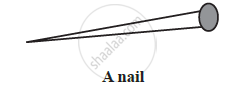
The given Figure are prisms or not?
How are prisms and cylinders alike?
Is a square prism same as a cube? Explain.
Verify Euler’s formula for given solids.

Can a polyhedron have 10 faces, 20 edges and 15 vertices?
What is the least number of planes that can enclose a solid? What is the name of the solid?
Is it possible to have a polyhedron with any given number of faces?
Verify Euler's formula for the following polyhedron:
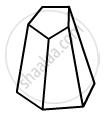
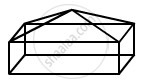
Verify Euler's formula for the following polyhedron:
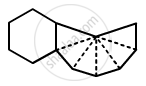
Name the polyhedron that can be made by folding net:
The figure, given below, shows shadows of some 3D object when seen under the lamp of an overhead projector:
A rectangle
In this case, name the object.
Dice are cubes with dots or dots on the face. Opposite faces of a die always have a total of seven on them.
In the given below net to make dice (cube), the numbers inserted in the square indicate the number of dots in it.
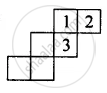
Insert suitable numbers in the blank so that numbers in opposite faces of the die have a total of seven dots.
Verify Euler’s formula for the table given below.
| Faces | Verticles | Edges |
| 10 | 6 | 12 |
Verify Euler’s formula for the table given below.
| Faces | Verticles | Edges |
| 12 | 20 | 30 |
How many vertices does the following solid have?
Cylinder
Total number of edges a cylinder has ______.
The common portion of two adjacent faces of a cuboid is called ______.
The corners of solid shapes are called its ______.
The corner points where edges of a solid meet are called:
