Advertisements
Advertisements
प्रश्न
Verify Euler’s formula for the table given below.
| Faces | Verticles | Edges |
| 10 | 6 | 12 |
योग
Advertisements
उत्तर
Euler’s formula is given by F + V – E = 2
F = 10, V = 6, E = 12
F + V – E = 10 + 6 – 12 = 16 – 12 = 4 ≠ 2
∴ Euler’s formula is not satisfied.
shaalaa.com
क्या इस प्रश्न या उत्तर में कोई त्रुटि है?
अध्याय 2: Measurements - Exercise 2.3 [पृष्ठ ७२]
APPEARS IN
संबंधित प्रश्न
Can a polyhedron have for its face 3 triangles?
Verify Euler's formula for the following polyhedron:

Verify Euler's formula for the following polyhedron:
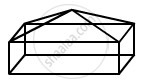
Draw net for the following polyhedron :
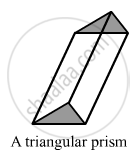
Which of the following shapes has a vertex?
How many vertices does the following solid have?
Octagonal Pyramid
How many edges does the following solid have?
Hexagonal Prism
Find the number of faces in the given shape:

How many faces does a cylinder have?
The corner points where edges of a solid meet are called:
