Advertisements
Advertisements
प्रश्न
Use the above relation to obtain the condition on the position of the object and the radius of curvature in terms of n1and n2 when the real image is formed.
Advertisements
उत्तर
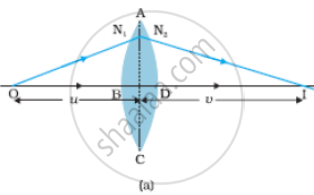
(a) The position of the object, and the image formed by a double convex lens,
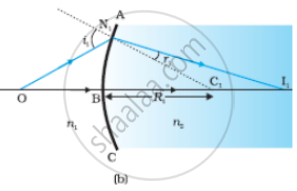
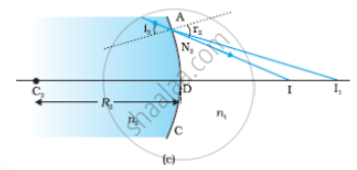
(b) Refraction at the first spherical surface and (c) Refraction at the second spherical surface.
Figure (a) shows the geometry of image formation by a double convex lens. The image formation can be seen in terms of two steps: (i) The first refracting surface forms the image I1 of the object O [Fig. (b)]. The image I1 acts as a virtual object for the second surface that forms the image at I [Fig. (c)].
Applying Equation `"n"_2/"v"-"n"_1/"u" = ("n"_2-"n"_1)/"R"` to the first interface ABC,
We get
`"n"_1/"OB" + "n"_2/"BI"_1 = ("n"_2-"n"_1)/"BC"_1` ......(1)
A similar procedure applied to the second interface ADC gives,
`"n"_2/"DI"_1 +"n"_1/"DI" = ("n"_2-"n"_1)/"DC"_1` ......(2)
For a thin lens, BI1= DI1. Adding
Eqs. (1) and (2), we get
`"n"_1/"OB" + "n"_1/"DI" = ("n"_2 - "n"_1)(1/"BC"_1+1/"DC"_2)`.....(3)
Suppose the object is at infinity, i.e., `"OB" -> ∞ and "DI" = f, Eq.(3) "gives"`
`"n"_1/f = ("n"_2-"n"_2)(1/"BC"_1 + 1/"DC"_2) ......(4)`
The point where image of an object placed at infinity is formed is called the focus F, of the lens and the distance f gives its focal length.
By the sign convention,
`"BC"_1 = + "R"_1`
`"DC"_2 = -"R"_2`
So Eq.(4) can be written as
`1/f = ("n"_21 -1)(1/"R"_1 - 1/"R"_2).........(5) (∵ "n"_21 = "n"_2/"n"_1)`
Equation (5) is known as the lens maker’s formula. It is useful to design lenses of desired focal length using surfaces of suitable radii of curvature. Note that the formula is true for a concave lens also. In that case R1is negative, R2is positive and therefore, f is negative.
From Eqs. (3) and (4), we get
`"n"_1/"OB" + "n"_1/"DI" = "n"_1/f`...............(6)
Again, in the thin lens approximation, B and D are both close to the optical centre of the lens. Applying the sign convention,
BO = –u, DI = +v,we get
`1/"v"-1/"u"=1/f`.............(7)
Equation (7) is the familiar thin lens formula.
APPEARS IN
संबंधित प्रश्न
The equation of refraction at a spherical surface is \[\frac{\mu_2}{\nu} - \frac{\mu_1}{\mu} = \frac{\mu_2 - \mu_1}{R}\]
Taking \[R = \infty\] show that this equation leads to the equation
\[\frac{\text{ Real depth }}{\text{ Apparent depth }} = \frac{\mu_2}{\mu_1}\]
for refraction at a plane surface.
A particle executes a simple harmonic motion of amplitude 1.0 cm along the principal axis of a convex lens of focal length 12 cm. The mean position of oscillation is at 20 cm from the lens. Find the amplitude of oscillation of the image of the particle.
Define the term ‘focal length of a mirror’.
According to new Cartesian sign conventions, all the distances are measured from the ______.
Obtain an expression for refraction at a single convex spherical surface, i.e., the relation between μ1 (rarer medium), μ2 (denser medium), object distance u, image distance v and the radius of curvature R.
What is a spherical refracting surface?
In the Cartesian sign convention, distances measured in the direction of incident light are taken as:
When light goes from a rarer to a denser medium at a spherical surface, the refracted ray:
Which set of variables is primarily involved in refraction at a spherical surface, as opposed to refraction at a plane surface?
An object is placed at a distance of 100 cm in air from a convex spherical surface of glass of refractive index 1.5. The radius of curvature is 20 cm. What is the image distance?
