Advertisements
Advertisements
प्रश्न
Two waves of the same pitch have amplitudes in the ratio 1 : 3 What will be the ratio of their
- loudness,
- pitch?
Two waves of the same pitch have amplitudes in the ratio 1 : 3. What will be the ratio of their
- loudness, and
- frequencies ?
Advertisements
उत्तर
- Loudness ∝ (amplitude)2
Loudness is proportional to amplitude square Ratio of loudness = `"L"_1/"L"_2 =((a_1)^2)/((a_2)^2)`
= `(1)^2/(3)^2 = 1\/9`
= 1: 9 - Frequency of the sound wave has no effect on amplitude.
so, frequency remains the same if the pitch is unchanged.
∴ `"Pitch of first wave"/"Pitch of second wave"`=`1/1`
= 1 :1
संबंधित प्रश्न
Shrillness of a sound is determined by the ______ of vibration.
What do you understand by the loudness of sound?
State the safe limit of sound level in terms of decibel for human hearing.
A person standing between two vertical cliffs and 480 m from the nearest cliff shouts. He hears the first echo after 3s and the second echo 2s later. Calculate:
- The speed of sound.
- The distance of the other cliff from the person
When sound propagates in air, it does not carry energy with it.
In a longitudinal wave, compression and rarefaction are formed.
The quality of a sound depends on the amplitude of wave.
Define the following term:
Frequency
Name the characteristic of the sound affected due to a change in its
(a) amplitude (b) waveform (c) frequency.
Figure shows four waves A, B, C, and D
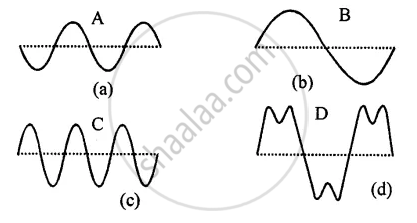
Name the wave which shows
(a) a note from a musical instrument,
(b) a soft note
(c) a shrill note.
Two waves have frequencies 256 Hz and 512 Hz, but same amplitude. Compare their (i) loudness, and (ii) pitch
Two waves of the same pitch have amplitudes in the ratio 1:3. What will be the ratio of frequencies?
Explain the following and illustrate your answer by drawing appropriate diagram:
Quality of a musical note.
What is meant by the ‘pitch’ of a note? Does it depend on the loudness or ‘quality’ of the ‘note’? How is pitch ‘related’ with frequency?
Draw a diagram to show the waveforms of a pure note and a musical note, of the same pitch and same loudness.
The frequency of the stretched string of a fixed length is f when it is plucked in the middle. Where should it be plucked so that string vibrates with frequency (i) 2f, (ii) 3f?
Draw diagrams to show these vibrations and name them.
Two waves of the same pitch have their amplitudes in the ratio 2 : 3.
(i) What will be the ratio of their loudness?
(ii) What will be the ratio of their frequencies?
______ is a general term for the distinguishable characteristic of a wave.
Give scientific reason.
In earlier times, people used to listen for the arrival of a distant train by putting their ear to the rail.
