Advertisements
Advertisements
प्रश्न
Two sides of a triangle are 6 cm and 8 cm. If the height of the triangle corresponding to 6 cm side is 4 cm; find :
(i) area of the triangle
(ii) height of the triangle corresponding to 8 cm side.
Advertisements
उत्तर

BC = 6 cm
height AD = 4 cm
area of Δ = `1/2 "base" xx "height"`
= `1/2 xx "BC" xx "AD"`
= `1/2 xx 6 xx 4 = 12 "cm"^2`
Again area of Δ = `1/2 "AC" xx "BE"`
`12 = 1/2 xx 8 xx "BE"`
∴ BE = `(12 xx 2)/8`
BE = 3 cm
∴ (i) 12 cm2 (ii) 3 cm
APPEARS IN
संबंधित प्रश्न
The sides of a triangular field are in the ratio 5: 3: 4 and its perimeter is 180 m. Find:
- its area.
- the altitude of the triangle corresponding to its largest side.
- the cost of leveling the field at the rate of Rs. 10 per square meter.
Find the area and the perimeter of quadrilateral ABCD, given below; if AB = 8 cm, AD = 10 cm, BD = 12 cm, DC = 13 cm and ∠DBC = 90°.
Find the area of a triangle, whose sides are :
10 cm, 24 cm, and 26 cm
The area of an equilateral triangle is numerically equal to its perimeter. Find its perimeter correct to 2 decimal places.
One of the equal sides of an isosceles triangle is 13 cm and its perimeter is 50 cm. Find the area of the triangle.
Find the area of the right-angled triangle with a hypotenuse of 40 cm and one of the other two sides of 24 cm.
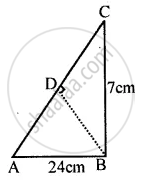
Use the information given in the adjoining figure to find :
(i) the length of AC.
(ii) the area of an ∆ABC
(iii) the length of BD, correct to one decimal place.
The perimeter of a triangle is 72cm and its sides are in the ratio 3:4:5. Find its area and the length of the altitude corresponding to the longest side.
The perimeter of a triangle is 28 cm. One of it’s sides is 8 cm. Write all the sides of the possible isosceles triangles with these measurements.
A piece of string is 30 cm long. What will be the length of each side if the string is used to form an equilateral triangle?
