Advertisements
Advertisements
प्रश्न
Two-point charges q1 and q2 are kept at a distance of r12 in air. Deduce the expression for the electrostatic potential energy of this system.
Advertisements
उत्तर
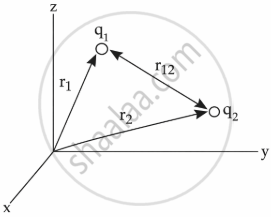
When q1 is placed, the potential at r2 = V2
= `k q_1/r_12`
Potential energy when q2 is placed at r2 = U1
= q2V2
= `k q_2/r_12`
Potential energy when q1 is placed at r1 = U2
= q1V1
= `k q q_2/r_12`
Potential energy of the system:
= `1/2 [k q_2 q_1/r_12 + k q_1 q_2/r_12]`
= `k (q_1 q_2)/r_12`
संबंधित प्रश्न
A long charged cylinder of linear charged density λ is surrounded by a hollow co-axial conducting cylinder. What is the electric field in the space between the two cylinders?
Why is electrostatic potential constant throughout the volume of the conductor and has the same value (as inside) on its surface?
Deduce the expression for the electrostatic energy stored in a capacitor of capacitance 'C' and having charge 'Q'.
A hollow metal sphere of radius 10 cm is charged such that the potential on its surface is 5 V. What is the potential at the centre of the sphere?
If an external electric field (E) is applied on the system, write the expression for the total energy of this system.
The electric field in a region is given by `vec"E"` = (Ax + B) `hat"i"`, where E is in NC-1 and x is in metres. The values of constants are A = 20 SI unit and B = 10 SI unit. If the potential at x = 1 is V1 and that at x = -5 is V2, then V1 - V2 is ______.
Which of the following represents the correct vector form of the electric field in three dimensions in terms of the potential gradient?
Regarding the direction of the electric field vector, which statement is strictly correct?
How is the magnitude of the electric field \[E\] defined with respect to an equipotential surface?
How does a smartphone touchscreen detect the location of a finger based on electrostatic principles?
